


Quick Answer
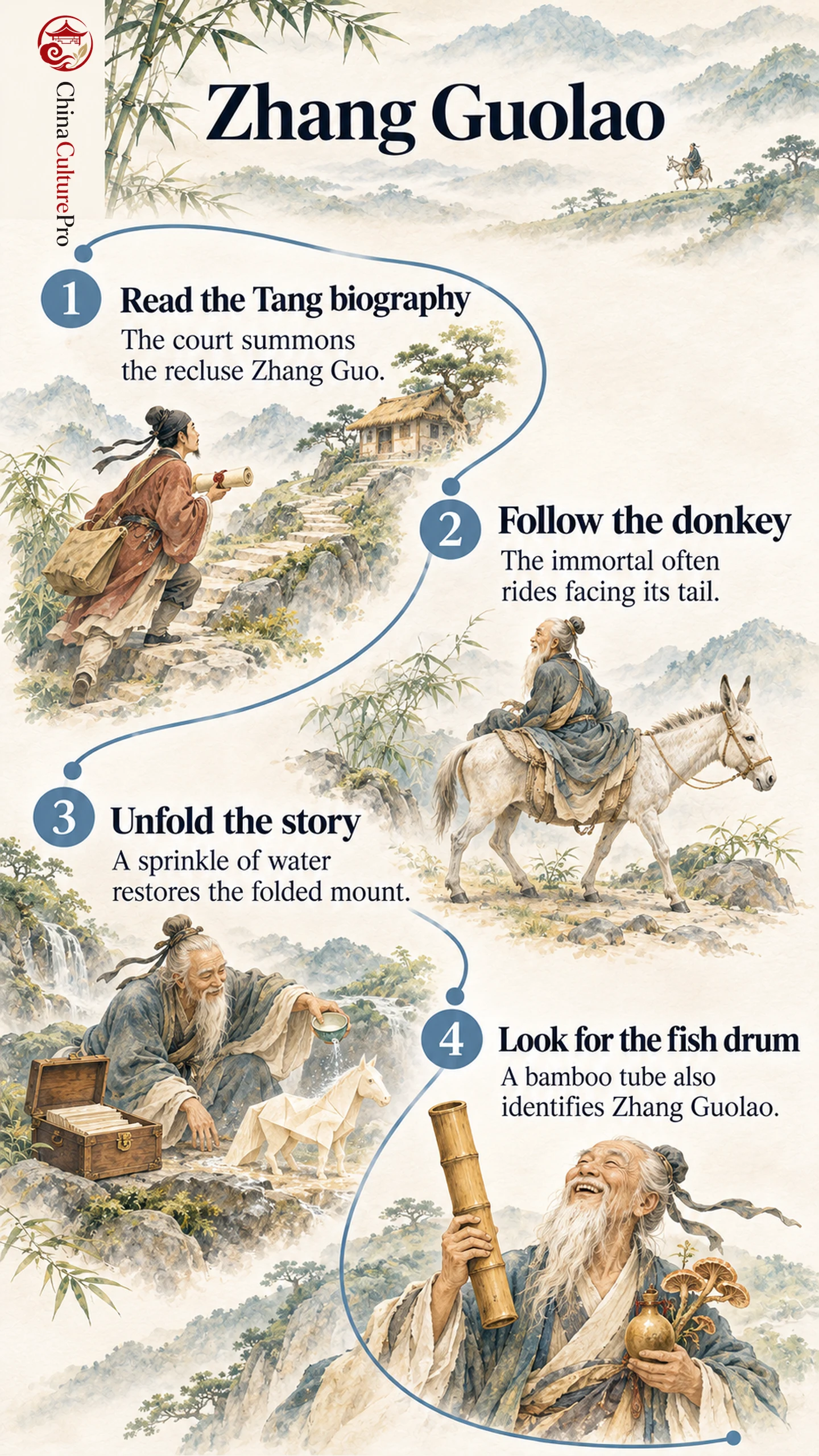
Zhang Guolao (張果老, Zhāng Guǒlǎo) is one of the Eight Immortals (八仙, Bāxiān). He is often shown riding a white donkey backward or carrying a fish drum (漁鼓, yúgǔ). Both details identify the figure associated with a Tang-dynasty recluse called Zhang Guo (張果, Zhāng Guǒ).[1][2][4]
- The court account: The *Old Book of Tang* (舊唐書, Jiù Táng Shū) describes a recluse summoned by Emperor Xuanzong (唐玄宗, Táng Xuánzōng).[1]
- The donkey story: In a Ming retelling, he folds his mount like a sheet of paper and restores it with water.[3]
- The identifying object: The fish drum is a bamboo percussion instrument. It can identify him even when the donkey is absent.[2][4][5]
The court biography already includes extraordinary tales about Zhang’s longevity. The folded donkey appears in a later story, and the backward rider became a familiar way to depict the immortal.
The same immortal can look very different in two collections. In a Qing painting at Princeton he is the donkey rider. In a bamboo figure in Taipei he stands holding a drum. His companions and attributes help connect the two.[2][4]
What the Tang court biography records
The *Old Book of Tang* begins by saying that Zhang’s origins were unknown. It places him in the mountains and reports his reputation for unusual longevity. In the twenty-first year of the Kaiyuan era (開元, Kāiyuán), 733, a regional official brought him to the emperor’s attention. After an initial encounter in which Zhang appeared to stop breathing, a second envoy brought him to the eastern capital, Luoyang (洛陽, Luòyáng).[1]
The emperor granted him the title Master Who Penetrates the Mystery (通玄先生, Tōngxuán Xiānshēng). Zhang asked to return to the mountains, and the account ends with the court establishing a Daoist monastery at his former retreat. The dated summons provides an anchor for the court account. His reported age of several hundred years belongs to the reputation the biography records.[1]
How the white donkey became his signature
In Ling Mengchu’s (凌濛初, Líng Méngchū) Ming collection *Slapping the Table in Amazement*, Zhang rides a white donkey that covers fabulous distances. On arrival, he folds it flat and stores it in a case. A sprinkle of water brings it back to life. The ability to pack the animal away turns an ordinary mount into one of the most recognizable wonders of his stories.[3]
The backward pose works as a visual clue. Princeton University Art Museum describes the convention in its entry for an undated Qing painting by Wang Yuanxun (王元勳, Wáng Yuánxūn). The rider on a donkey is one way to pick him out in scenes of the Eight Immortals crossing the sea, although artists may use his drum instead.[2]
How to recognize him without the donkey
The fish drum has a bamboo tube with a membrane across one end. Princeton describes Zhang carrying it on his back with two hooked implements. In a Qing bamboo set at Taiwan’s National Palace Museum, he holds the drum in his right hand and a vessel with a sprig of lingzhi (靈芝, língzhī) in his left. A small gourd hangs behind his waist. The museum notes that the carving’s drumhead is missing, so the surviving tube and the context of the set matter when identifying it.[2][4][5]
The carving is one of eight figures in a set. The same set gives another immortal a flute and another a palm-leaf fan. These attributes give the viewer a way to tell the figures apart, even when the poses and expressions are similar.[4][5]
FAQs About Zhang Guolao
Was Zhang Guolao a real person?
The traditional basis is Zhang Guo, a recluse recorded in the *Old Book of Tang*. The court account and later tales both include miraculous details.[1][2][3]
What is the fish drum?
It is a bamboo percussion instrument with a skin stretched over one end. When an image shows Zhang standing, the drum can serve as his main identifying object.[4][5]
How does Zhang Guolao restore his folded donkey?
In the Ming story, he sprinkles water on it. The mount returns to its full size and he can ride away.[3]
資料來源
[1] Wikisource. Old Book of Tang, volume 191: Zhang Guo
[2] Princeton University Art Museum. Zhang Guolao Riding on a Donkey
[3] Ling Mengchu, translated by Yang Shuhui and Yang Yunqin. Slapping the Table in Amazement, chapter 7
[4] National Palace Museum, Taipei. Bamboo carving of the Eight Immortals: Zhang Guolao
[5] National Palace Museum Southern Branch. Qing bamboo carvings of the Eight Immortals