


Quick Answer: What Is the Yiwen Leiju?
The Yiwen Leiju (艺文类聚, Yìwén Lèijù) is a leishu (类书, lèishū), a classified compilation of excerpts. Ouyang Xun (欧阳询, Ōuyáng Xún) and colleagues compiled it under imperial commission in the early Tang dynasty (唐朝, Táng Cháo), completing it in 624. It contains one hundred juan (卷, juàn), or textual divisions.[1][5]
- Organization: Topic headings bring related passages from different earlier works together.
- Literary dimension: Entries combine explanatory or anecdotal material with poetry and prose, often labeled by genre.[1][2]
- Historical value: Excerpts preserve earlier writing, including material whose original books no longer survive.[4]
Read it as an arranged collection of voices, not a single continuous narrative or a modern encyclopedia written in one editorial voice.
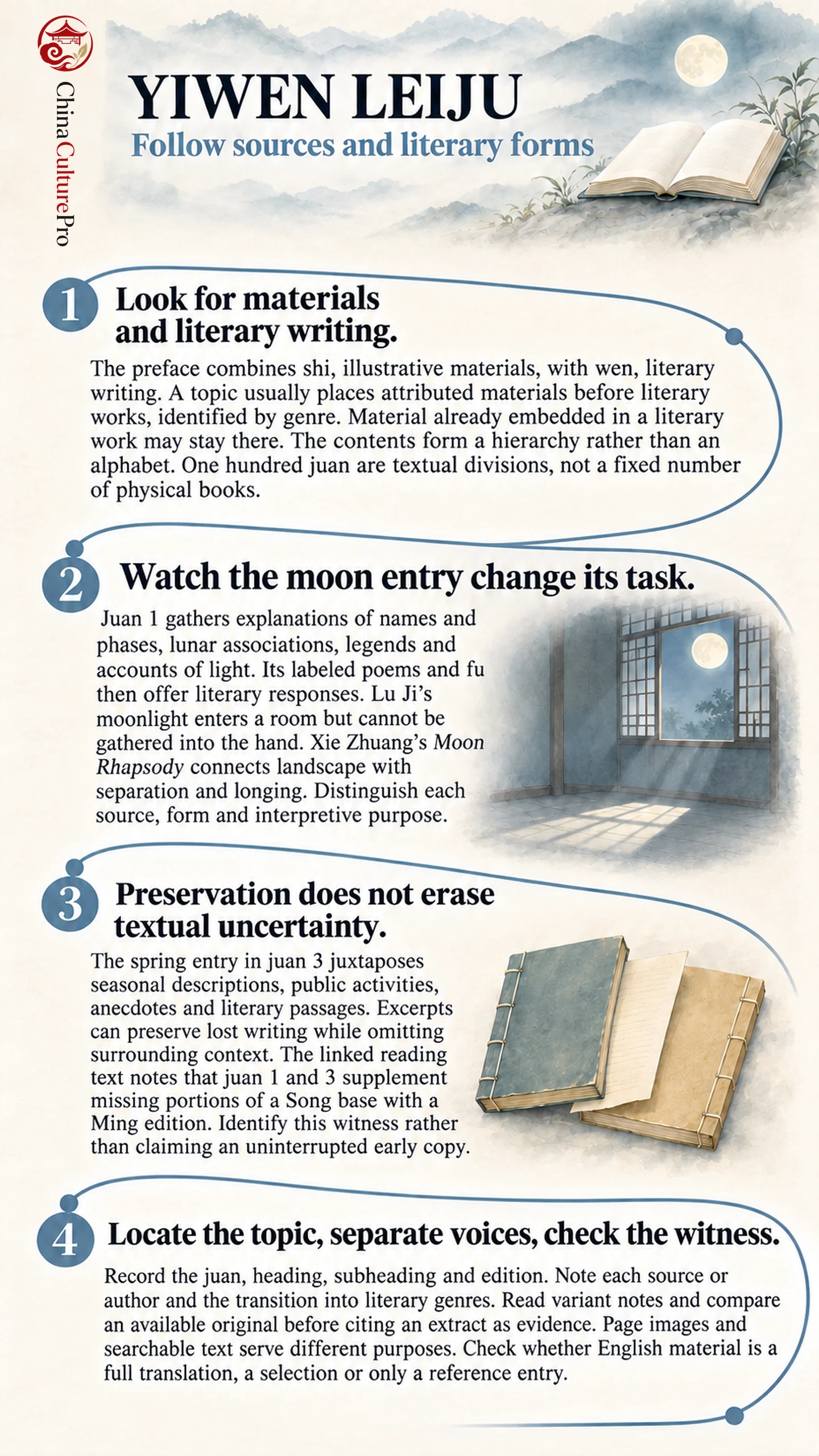
A moon entry can place word explanations, legends, accounts of light and poems beside one another. That combination is the point of the Yiwen Leiju: it helps readers find both material about a subject and literary ways of writing about it.
A Classified Collection of Materials and Literary Works
The preface explains the project through two terms: shi (事, shì), matters or illustrative materials, and wen (文, wén), literary writing. It contrasts earlier collections that privileged one side and describes a work useful for looking things up and for composition. Selection and arrangement are central to the project.[1]
A typical topic moves from attributed source passages to literary works. Genre markers help a reader recognize poetry, fu (赋, fù), or rhapsodic prose, and other forms. The preface also allows material already embedded in a literary work to remain there. “Materials first, literature afterward” is an organizing principle, not a command to split every passage mechanically.[1][2]
The contents range from celestial subjects and seasons to people, rites, music, offices, dwellings, food, plants and animals. This is not an alphabetical arrangement. A topic must be located within a hierarchy, and related imagery may also appear under another heading. The hundred juan describe the text’s divisions, not a required hundred physical books in every edition.[1][4]
For a different model of literary gathering, compare the Wenyuan Yinghua guide. Keep the compilations distinct: a shared interest in earlier writing does not make their selection, classification or surviving contents identical.
The Moon Entry: From Explanation to Literary Response
In juan 1, the moon entry begins with attributed explanations of names and phases. It then gathers passages about lunar associations, legends and the moon’s light. One quoted account attributes the moon’s light to illumination by the sun. Other passages concern beings or narratives associated with the moon. Their juxtaposition does not make them claims of the same kind.[2]
The shift to labeled poetry changes the reader’s task. Lines attributed to Lu Ji (陆机, Lù Jī) describe moonlight entering a room: it gives abundant radiance, yet cannot be gathered into the hand. The image makes light present while resisting possession. It is a literary response, not another explanation of lunar mechanics.[2]
A later section gives fu, including a Moon Rhapsody attributed to Xie Zhuang (谢庄, Xiè Zhuāng). Its imagery connects moonlit landscape with separation and longing. Read the literary setting and the speaker’s situation before extracting a beautiful phrase; the entry is preserving composition as well as supplying reusable subject matter.[2]
This small exercise gives the compilation an intelligible structure. Source titles distinguish voices; genre labels distinguish forms; the topic provides a meeting point. Read across those boundaries to compare treatments, but do not flatten them into one account of what the compiler personally believed.
What Excerpts Preserve—and What They Leave Uncertain
The spring entry in juan 3 offers another kind of montage. Calendar and seasonal descriptions stand beside ritual and administrative material, anecdotes and literary passages. An extract about spring’s prescribed public activities answers a different question from a poem responding to warmth or lingering cold. Classification creates proximity without eliminating difference.[3]
Such excerpting can preserve valuable traces of works that later disappeared. It can also remove surrounding argument, narrative or qualification. A source title is a lead for investigation; it does not guarantee that an extract is complete, unchanged, correctly attributed or sufficient to reconstruct an entire lost book.[1][4]
The edition also has a history. The linked text explicitly notes that juan 1 and juan 3 were missing from its Song dynasty (宋朝, Sòng Cháo) base and supplied from a Ming dynasty (明朝, Míng Cháo) edition. That local notice matters: the present reading text should not be described as an uninterrupted reproduction of one early copy.[2][3]
For related classified reference reading, continue to Taiping Yulan. Comparison is most useful when it asks how a particular extract is selected, attributed and placed, rather than assuming all compilations transmit identical versions.
How to Follow a Topic and Cite an Extract
- Locate the topic: Record the juan, main heading, subheading and edition rather than saving only a search result.
- Separate the voices: Note each cited book or author and mark the transition into a labeled literary genre.
- Check the witness: Read variant notes and compare the original work when available before citing the extract as evidence.
Choose a punctuated text with usable notes for close reading; consult page images when an editorial sign or reading needs checking. A facsimile preserves the appearance of its source edition, while a searchable transcription makes retrieval easier. Neither format removes the need to identify the textual witness.[4]
When using English resources, check whether the item is a complete translation, a translated selection or an introductory reference entry. Keep the Chinese title and heading alongside translated wording so another reader can locate the passage. The Chinese poetry 及 Chinese literature guides provide broader context for the forms encountered here.
FAQs About the Yiwen Leiju
Is the Yiwen Leiju a novel or a single argument?
Neither. It is a classified collection assembled from many sources. Read by topic and through its source and genre labels, rather than expecting a plot or a single sustained thesis.
Did Ouyang Xun write all the passages?
No. His role is associated with compilation, alongside colleagues. Attributed passages and literary works have their own source identities; the compiler’s preface and arrangement are a separate layer.
Can its natural-world entries be read as scientific facts?
No. Entries combine different kinds of material, including explanation, historical report, symbolic association, legend and literary imagery. Identify the source and purpose before deciding what a passage can establish.
資料來源
[1] Public-domain Chinese text. Yiwen Leiju: preface and one-hundred-juan contents
[2] Public-domain Chinese text. Yiwen Leiju, juan 1: the moon
[3] Public-domain Chinese text. Yiwen Leiju, juan 3: spring
[4] National Library of China Publishing House. Songben Yiwen Leiju: facsimile edition and contents (2024)
[5] Ministry of Education, Education Encyclopedia. Yiwen Leiju: compilation and organization