


Quick Answer: Who Was Wang Fuzhi?
Wang Fuzhi (王夫之, Wáng Fūzhī, 1619–1692), also known as Wang Chuanshan (王船山, Wáng Chuánshān), was a historian and philosopher of the Ming–Qing transition. He served the Ming cause and wrote extensively during the early Qing.[1][4][5]
- History: His Du Tongjian Lun (读通鉴论, Dú Tōngjiàn Lùn) examines how institutions changed over time.
- Philosophy: His commentary explores change through qi (气, qì).
- Evidence: His writings allow readers to compare his own arguments with the later biography.
His political allegiance helps explain his historical setting. His own arguments are preserved in distinct works.
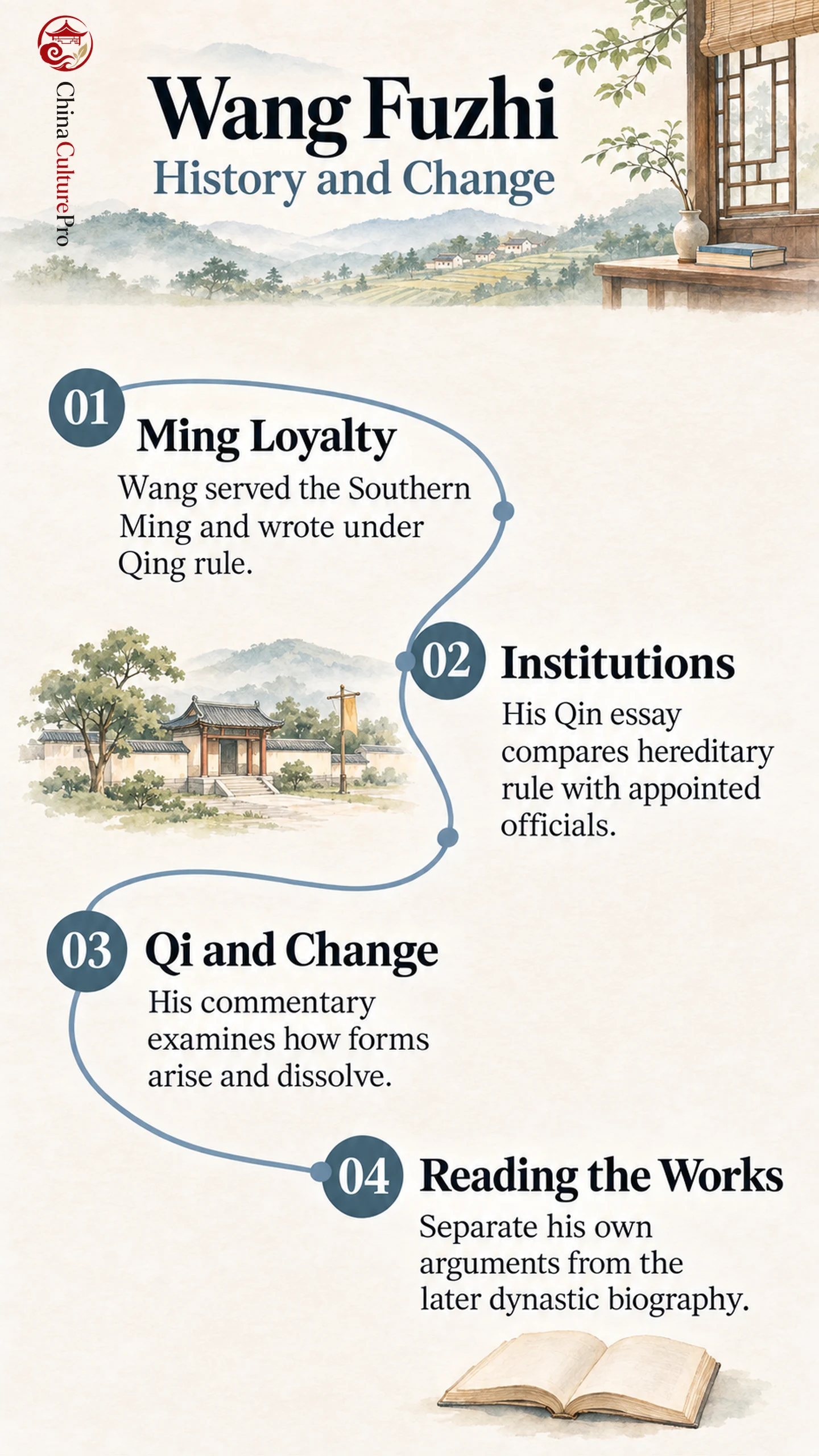
Wang Fuzhi lived through the fall of a dynasty and wrote about change on very different scales. His historical arguments ask why institutions take the forms they do. His classical commentary asks how change can be understood within the world itself.
A Ming Loyalist in the Early Qing
Wang came from Hengyang in present-day Hunan. The Draft History of Qing places him among scholars formed at the end of the Ming Dynasty and describes his service in the Southern Ming (南明, Nán Míng), the courts that continued to claim Ming rule after the fall of Beijing. The biography places him in service to the Southern Ming court at Guilin and presents his later withdrawal against that background.[1]
After the Ming cause collapsed, he lived in retreat in Hunan. The name Chuanshan is associated with his home near Shichuanshan. His aliases matter when comparing catalogue entries for his works. The late dynastic biography also frames withdrawal as a sign of loyalty, a judgment to distinguish from the sequence of posts and places it records.[1][4]
Reading History Through Institutional Change
The Du Tongjian Lun responds to history organized in the Zizhi Tongjian (资治通鉴, Zīzhì Tōngjiàn), the Comprehensive Mirror for Aid in Government. Wang follows earlier periods and episodes as occasions for argument. The work can be read beside the earlier chronicle to see when a recorded event becomes the starting point for an interpretation.[2]
In the opening discussion of Qin, Wang considers hereditary domains and an administrative system of commanderies and counties. He notes that the latter system had precedents before Qin. He asks what changes when officials can be appointed and replaced instead of holding authority by descent. That question puts the long life of an institution beside the much shorter life of one dynasty.[2]
He also recognizes harms on both sides. Hereditary rule can leave subjects exposed to the misconduct of a lineage, and appointing officials can still produce abusive administrators. The passage asks whether a system provides a way to remove an abusive official. It also allows that the same institutions can have different consequences for the ruler and for those governed. Wang distinguishes the survival of a dynasty from the political consequences of its administrative arrangements.[2]
Qi and Change in His Classical Commentary
Wang’s Zhangzi Zhengmeng Zhu (张子正蒙注, Zhāngzǐ Zhèngméng Zhù) is a commentary on the work of Zhang Zai (张载, Zhāng Zǎi), a major thinker in the tradition now called Neo-Confucianism. An edition that marks the base text and the commentary separately helps readers distinguish the earlier text from the later interpretation. Identifying which voice is speaking is part of understanding the argument.[1][3]
In the opening chapter on harmony, the text and commentary consider how qi gathers and disperses. Gathering can give things a determinate form, and dispersal can end that form. The discussion uses transformation to connect what takes shape with what does not yet have a visible shape. Modern English words for qi each capture only part of the vocabulary.[3]
For Wang, gathering and dispersal give continuity to transformations that might otherwise look like abrupt beginnings and endings. The visible form changes while the process in which it formed continues. This offers one entry into his commentary without trying to reduce his account to a modern theory of matter.[3][5]
How to Read Wang Fuzhi Across His Works
One way into Wang’s contribution to Chinese philosophy is to choose a passage that makes a comparison. In the Qin discussion, compare what the institutions do for the people governed by them. In the commentary, compare visible form and the conditions from which it emerges. The two arguments share an interest in change but operate in different domains.[2][3][5]
The dynastic biography serves a different purpose. Its list of works shows how widely Wang wrote across the classics and history. Its account of him as a loyal subject also reflects the concerns of a later historical compilation. A reader looking for his argument about a specific law or concept should go back to the work in which he makes it.[1]
The Draft History appeared in the twentieth century, after the fall of the dynasty it describes. This gap matters when its entry gives Wang a place in the history of learning. The compilation can show what later historians chose to record about him. For his own interpretation of the Qin system, the relevant evidence is his earlier essay.[1][2][6]
FAQs About Wang Fuzhi
Why is Wang Fuzhi called Wang Chuanshan?
Chuanshan is a name associated with the place where he lived in retreat near Hengyang. It appears in catalogues and in references to his collected works.
Did Wang Fuzhi write the Comprehensive Mirror?
The Comprehensive Mirror is the earlier chronicle associated with Sima Guang. Wang Fuzhi wrote a later work that discusses its history and draws his own conclusions from it.
Was Wang Fuzhi a Ming or a Qing thinker?
His life crossed the transition. He served the Southern Ming and did much of his writing under Qing rule. Political allegiance and the dates of his work describe different aspects of his life.
資料來源
[1] Draft History of Qing, chapter 480. Biography of Wang Fuzhi
[2] Wang Fuzhi, Du Tongjian Lun, juan 1. First Emperor of Qin section
[3] Wang Fuzhi, Zhangzi Zhengmeng Zhu. Supreme Harmony chapter
[4] National Central Library, Taiwan. Wang Fuzhi authority record
[5] Routledge Encyclopedia of Philosophy. Wang Fuzhi (1619–92)
[6] University of Vienna research repository. Last Chapter Unfinished