

Quick Answer: What Is The Broken Battle Formation About?
The Broken Battle Formation (破阵子, Pò Zhèn Zǐ) is the tune of a ci (词, cí) lyric by Xin Qiji (辛弃疾, Xīn Qìjí) for Chen Tongfu (陈同甫, Chén Tóngfǔ). An aging speaker pictures a military campaign with the vividness of a dream.[1][2]
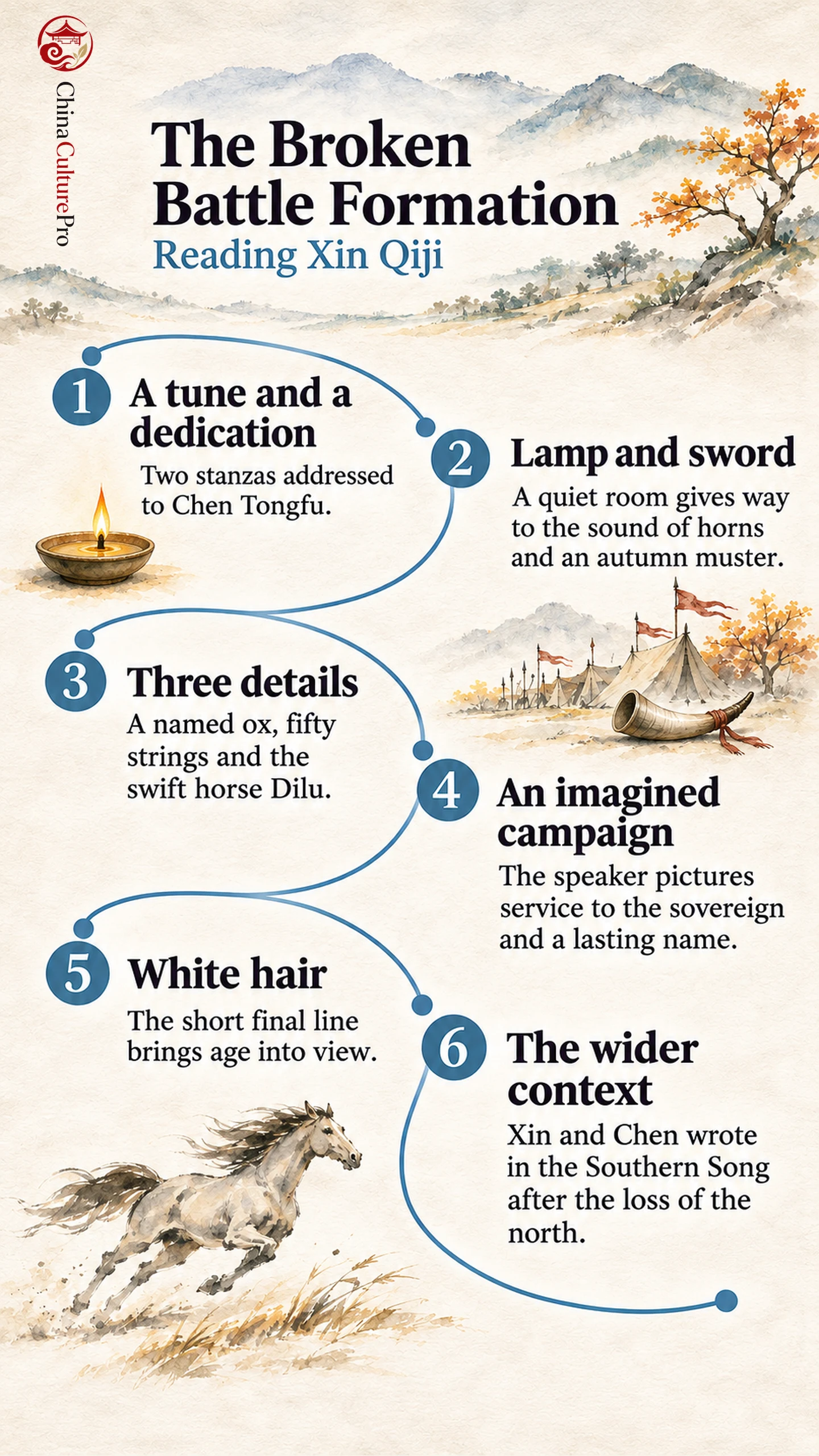
- Setting: A lamp and sword give way to horns, camp music and an autumn muster.
- Ambition: The speaker sees himself settling the sovereign’s affairs and earning lasting renown.
- Ending: One line about white hair brings the vision up against the speaker’s age.[1]
The lyric names its recipient, but it leaves the battle unnamed.[1]
A sword catches the light of a lamp. A few phrases later, horses are flying and bows crack like thunder. The quiet beginning and noisy middle make the final five characters hit with unusual force. They measure the distance between the campaign the speaker can still picture and the time he has left to fight it.
The Complete Lyric in Chinese, Pinyin and English
The lyric has two stanzas of five lines, with the same 6, 6, 7, 7 and 5 character pattern in each. The dedication describes it as a stirring lyric sent to Chen Tongfu. The English below follows the Chinese line divisions.[1]
| 中文 | 拼音 | 大意 |
|---|---|---|
| 醉里挑灯看剑 | Zuì lǐ tiǎo dēng kàn jiàn | Drunk, I raise the wick to look at my sword. |
| 梦回吹角连营 | Mèng huí chuī jiǎo lián yíng | In dream I return to horns sounding camp to camp. |
| 八百里分麾下炙 | Bābǎilǐ fēn huīxià zhì | Roast beef is shared among the troops beneath the banner. |
| 五十弦翻塞外声 | Wǔshí xián fān sàiwài shēng | Fifty strings sound out tunes from beyond the frontier. |
| 沙场秋点兵 | Shāchǎng qiū diǎn bīng | On the field in autumn, the troops muster. |
| 马作的卢飞快 | Mǎ zuò Dìlú fēikuài | The horses fly as swiftly as Dilu (的卢, Dìlú). |
| 弓如霹雳弦惊 | Gōng rú pīlì xián jīng | The bowstrings crack like thunder. |
| 了却君王天下事 | Liǎoquè jūnwáng tiānxià shì | To settle the affairs of the realm for my lord. |
| 赢得生前身后名 | Yíngdé shēngqián shēnhòu míng | To win a name in life and after death. |
| 可怜白发生 | Kělián báifà shēng | Alas, white hair is growing. |
From the Lamp to the Muster
The first line narrows the reader’s view to a wick and a sword. The next carries sound across a line of camps. The troops share food, musicians play and the men assemble for inspection. The camp takes shape through things people do together. The poem moves into that world without a narrative explanation of how the speaker got there.[1]
The phrase 梦回 can be heard as a return in dream or as a return from dream. The sense translation takes the former, which makes the camps part of the vision. The passage can also be read as dream and waking bleeding into one another. Either way, the last line breaks the military sequence more decisively than the opening marks any boundary.[1][2]
The Ox, the Strings and the Horse
Three short references keep the pace quick while giving the scene texture.[1][2]
- Eight Hundred Li: The phrase 八百里 (bābǎilǐ) evokes the name of an ox in an older anecdote. Here it helps put roast beef before the troops. The number gives neither the camp’s length nor the distance covered.
- Fifty strings: The strings stand for music in the camp, with a frontier sound. The phrase also appears in The Brocade Zither, where strings set off a chain of memories. Here the music belongs to a company of soldiers.
- Dilu: The name recalls the swift mount associated with Liu Bei. The poem makes that horse a measure of speed for the charge, then gives the bows their own sudden noise.
Why the Last Line Is About White Hair
The pair “in life” and “after death” gives the imagined success a long future. A soldier could finish the sovereign’s work and earn a name that lasts beyond his body. The closing line takes away that scale. Instead of imagining what people will say after his death, the speaker has to look at what age is doing now.[1]
The change is also a matter of form. The two seven-character lines give room to name the ambition and its reward. The five-character ending has room for one visible detail. White hair does the work that a longer explanation of frustration would have done, and it makes the realization arrive all at once. In Ugly Slave by Xin Qiji, a different short ending also changes how the reader hears the speaker’s account of age.
For another Southern Song poem that looks back to a figure of military resolve, read Li Qingzhao’s Summer Quatrain. Its allusion asks what courage looks like after defeat.
Who Was Chen Tongfu?
Tongfu was the courtesy name of Chen Liang (陈亮, Chén Liàng), a Southern Song thinker and fellow writer. He and Xin both belong to a literary and political setting shaped by the loss of the north to the Jurchen Jin. Xin had direct military experience in that struggle, and the Southern Song retreat gives a reader the wider background for his lyric’s ambitions.[2][3][4]
The dedication makes the speaker’s frustration something addressed to a person who could recognize the stakes. It gives a specific recipient to a lyric whose battlefield remains unnamed. The wider writing of Xin Qiji ranges beyond the military subjects for which this lyric is known.[1][3]
FAQs About The Broken Battle Formation
Is The Broken Battle Formation the name of the poem or the tune?
It translates the tune title Po Zhen Zi. The dedication to Chen Tongfu identifies this particular lyric among several written to that pattern.[1]
Does the lyric describe a recorded battle?
It names no battlefield, opponent or date. Xin’s military experience helps explain the setting, while the dream frame and the last line make the lyric a reflection on an ambition.[1][3]
資料來源
[1] Xin Qiji. Lyrics to the Tune Po Zhen Zi
[2] Higher Education Press. Po Zhen Zi: A Stirring Lyric Sent to Chen Tongfu
[3] Renditions, Chinese University of Hong Kong. Xin Qiji
[4] Key Concepts in Chinese Thought and Culture. Bold and Unconstrained