


Quick Answer: What Is Tan Yang Gong Fu?
Tan Yang Gong Fu(坦洋工夫,tǎnyáng gōngfu), also written Tanyang Gongfu or Tanyang Congou, is a black tea associated with Fu’an in northeastern Fujian.[2][6]
- 產地: Its name comes from Tanyang village, a center of the regional tea-making tradition.[1]
- Craft: Withering, rolling, oxidation, drying and refining develop its black-tea character.[2]
- Flavor: Published profiles range from longan-like richness to floral and fruity styles.[1][4]
- Material: Traditional local leaf and newer cultivars both appear in this tea family.[1][5]
Gong Fu here identifies a tea-making tradition; it does not require a particular brewing set.[6]
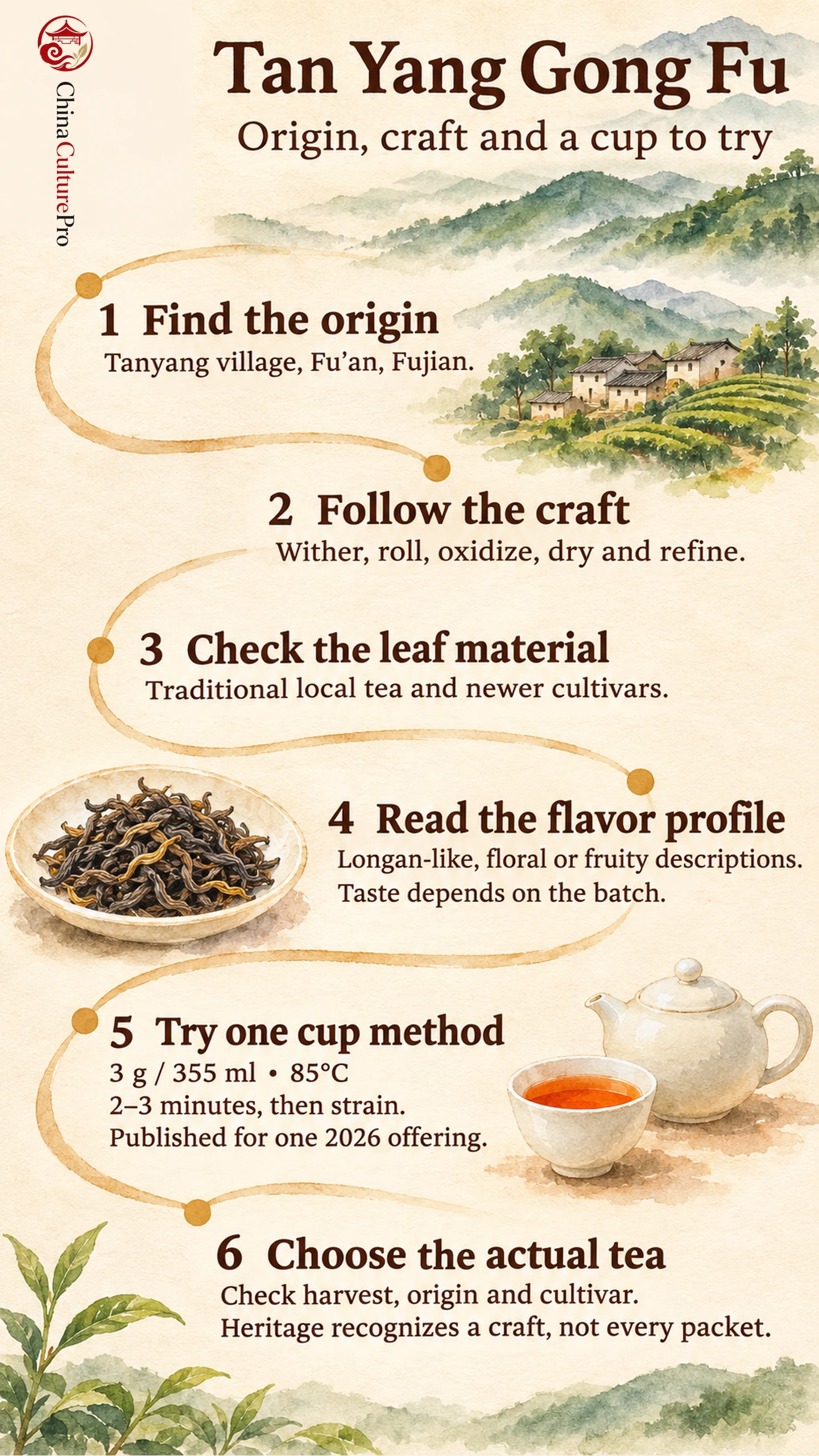
A dark, tightly worked leaf can open into a surprisingly floral cup. Understanding the material and craft helps explain the range.
Tanyang Village, Fu’an and the Historical Record
The tradition centers on Tanyang village in Shekou, Fu’an, within 福建. An official provincial account dates the development of the black tea to 1851 and connects its growth with exports to Western Europe through Saiqi.[2]
The making skill entered China’s national intangible-cultural-heritage list as an extension project in 2021. The project covers a living regional craft extending beyond the village, not one uniform commercial packet.[1]
It is commonly grouped with Bai Lin Gong Fu(白琳工夫,báilín gōngfu)and Zheng He Gong Fu(政和工夫,zhènghé gōngfu) among Fujian’s three well-known Gong Fu black teas.[3]
From Withering to Refined Black Tea
The basic sequence moves from withering and rolling into oxidation, drying and refinement. Rolling works the leaf into strands; refinement sorts the resulting tea rather than merely adding a finishing aroma.[1][2]
The heritage description emphasizes compound withering, changes in rolling pressure and speed, loosening the leaf, and careful sieving and sorting. These linked decisions help produce fine, even strands and a bright red infusion.[1]
Traditional Material and Modern Floral Styles
The heritage account names Tanyang Caicha(坦洋菜茶,tǎnyáng càichá)as traditional material.[1]
Modern flower-and-fruit-aroma versions use a broader material palette. A 2026 study evaluated eight locally grown cultivars for this style, including Jin Mudan(金牡丹,jīn mǔdān), Meizhan and Fuding Dahao. Jin Mudan scored highest in that particular trial; the result concerns processing suitability, not a ranking of every tea sold under the regional name.[5]
Flavor Examples from Two Published Batches
Two product descriptions show how much the name can encompass. They are different harvests and products, so the comparison does not isolate a single cause of flavor.
| Published example | Reported character |
|---|---|
| May 18, 2026, Tanyang village, Tanyang Caicha | Glossy twisted leaves with golden tips; orange-red liquor, floral and sweet-potato aroma, smooth taste and sweet finish.[3] |
| Spring 2025, Baiyun Mountain, Fu’an | A markedly floral profile with guava, osmanthus-like hints and a sweet-potato note; smooth, medium-bodied liquor.[4] |
Longan, osmanthus and guava are sensory comparisons, not an ingredient list. Ask separately whether a particular product has added flavoring.
A Complete Cup-Brewing Starting Point
The 2026 example provides a simple cup method, useful when you do not want a concentrated small-pot session:[3]
- Measure 3 g of tea for 355 ml of water.
- Use water at 85°C and infuse for 2–3 minutes.
- Strain or decant the tea, then adjust the next infusion to your preference.
These directions belong to that offering, not a compulsory recipe for the entire tradition. Keep your water and measured dose consistent when comparing packets.
Choosing a Tan Yang Gong Fu Tea
Ask for the harvest, production area, named plant material and intended flavor style. Compare descriptions of specific batches.[3][4]
Keep cultivar and tea type separate: the plant name supplies useful detail, while the regional tea name supplies another. Choose a sample for the flavor you want rather than relying on the tea’s reputation alone.
FAQs About Tan Yang Gong Fu
Does Gong Fu Mean a Special Brewing Set Is Required?
No. The name concerns the making tradition. A measured cup infusion is also a documented way to prepare it.[3][6]
Is Every Tan Yang Gong Fu Made from Tanyang Caicha?
No. That is traditional material, while modern floral-style research includes several other cultivars. Check the actual product’s leaf information.[5]
Does a Heritage Listing Certify Every Packet?
No. The listing recognizes the making skill and its transmission. It is not a batch-specific quality certificate for everything sold under the name.[1]
資料來源
[1] China Intangible Cultural Heritage Network. 红茶制作技艺(坦洋工夫茶制作技艺)
[2] Foreign Affairs Office of Fujian Provincial People’s Government. GI Episode 28: Fujian Tea
[3] TeaVivre. Superfine Tan Yang Gong Fu Black Tea
[4] Jing Tea Shop. Tan Yang Gong Fu
[5] Xie Miaoqin et al. Adaptability of Different Tea Cultivar for Producing Flower-Fruit-scented TanYang Congou Black Tea
[6] TeaPlain. Tanyang Gongfu: grades, brewing and storage