


Quick Answer: What Is Jin Mudan Black Tea?
Jin Mudan(金牡丹,jīn mǔdān)black tea is made from the Jin Mudan tea cultivar, bred in Fujian. The name, often translated as Golden Peony, identifies the plant material rather than a blend of tea and peony petals.[1]
- Plant: Jin Mudan can be processed into more than one tea category.
- Craft: Black-tea production develops its leaf differently from oolong production.
- 香氣: Floral and fruity notes are important, including peach-like character in studied samples.[3]
A Jin Mudan label still needs a tea category, origin and batch description; the cultivar name cannot supply all three.
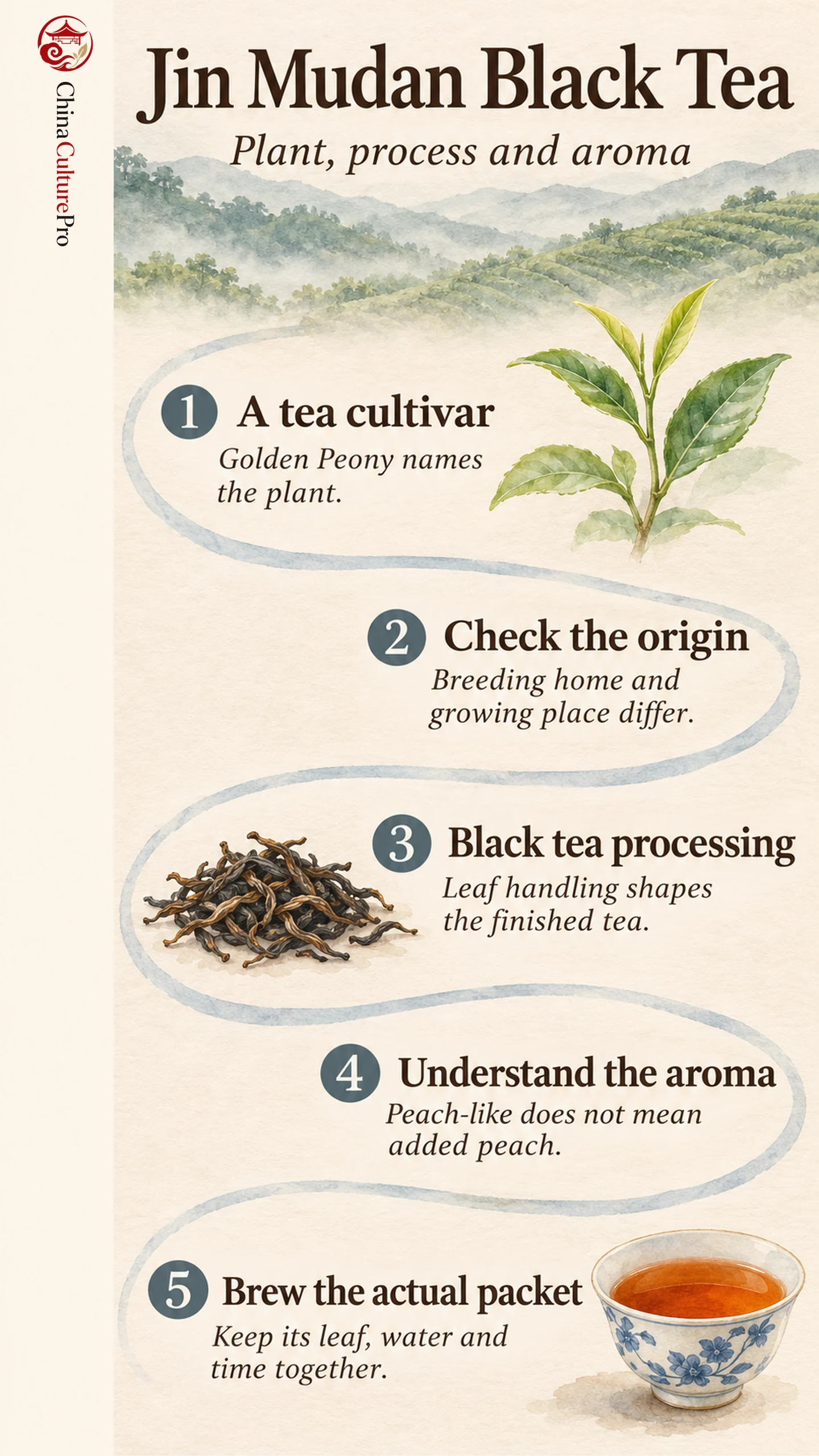
Golden Peony appears on black-tea and oolong menus. The shared name identifies the plant; the finished teas need separate descriptions.
A Fujian Cultivar, Not a Peony Blend
The cultivar was bred at the Fujian Academy of Agricultural Sciences Tea Research Institute. Its parents are Tieguanyin(铁观音,tiěguānyīn)and Huangdan(黄棪,huángdàn). The breeding record spans 1978–2002, with provincial approval in 2003 and national identification in 2010.[2]
That is a modern plant-breeding history. It does not make the resulting black tea a mixture of two finished teas. Its suitability for black, oolong and green tea illustrates why cultivar and tea type must be read separately.[1]
Huangdan is also associated with Huang Jin Gui oolong. That relationship helps place the plant family; it does not make those finished teas interchangeable.
Where Jin Mudan Black Tea Is Made
Fujian is the cultivar’s breeding home, but the actual production location belongs on the packet. Shouning in northeastern Fujian has developed a locally identified Jin Mudan black tea. Its local description emphasizes tightly formed dark strands, orange-red liquor and a pronounced floral aroma.[4]
Other records concern different places: a sensory study examined black teas collected in Fu’an, while a processing trial used Jin Mudan leaves grown in Fenggang, Guizhou.[2][3] Those locations distinguish the cultivar’s breeding home from a finished tea’s production origin.
Processing: Black Tea with Aromatic Possibilities
Withering softens the leaf before rolling breaks its tissues and brings leaf compounds into contact with oxygen. The oxidation stage, commonly called fermentation, follows; drying finishes the leaf. One documented Guizhou process also uses repeated turning and resting to bring out aroma before rolling.[2]
The Fu’an black-tea samples likewise underwent turning-over after withering. This borrowed oolong technique was one stage within a black-tea process.[3] It is an example of a specific aromatic style, not a requirement for every tea bearing the cultivar name.
Floral and Peach-Like Notes: What They Mean
Floral fragrance is associated with the cultivar, but finished aroma reflects processing too.[1] In the studied Fu’an black teas, analysis and sensory work identified several contributors to floral and peach-like impressions. Those findings concern the samples tested, rather than every Jin Mudan packet.[3]
Appearance varies as well. The Shouning description is of tight, dark strands and bright orange-red liquor, whereas the Guizhou trial produced reddish-brown leaf pieces with a bright golden infusion.[2][4] Neither example establishes a universal leaf shape or cup color.
Peach-like, floral or berry-like language describes a tasting impression. It does not establish that fruit, flowers or flavorings were added. Check the ingredient statement if that distinction matters to your choice.
Choosing and Brewing Jin Mudan Black Tea
Start with the category: confirm that you are buying black tea. Then check its producer, leaf selection and origin label. Read those fields separately.
For one documented Wuyishan black-tea product, two drinking methods use quite different leaf loadings:[5]
- Short infusions: 5 g per 100 ml at 100°C; a quick rinse, then a first infusion of about 5 seconds, adding 5–10 seconds in later rounds.
- Longer infusion: 3–4 g per 500 ml at 90–95°C for 1½–2½ minutes.
To use the short-infusion method, keep its quantities and timing together:
- Measure the leaf and water for that method.
- Follow the product’s brief rinse instruction.
- Infuse for the starting duration, pour off the drink, and taste.
- Lengthen subsequent infusions within the suggested increments, adjusting to the cup.[5]
The rinse belongs to that product’s instructions. It is not a universal obligation for all Jin Mudan black tea.
FAQs About Jin Mudan Black Tea
Is Jin Mudan Black Tea the Same as Jin Mudan Oolong?
No. The cultivar name may be shared, but the finished tea categories reflect different processing.[1]
Does Jin Mudan Tea Contain Peony Flowers?
The name identifies a tea cultivar, not a required floral ingredient. Read the ingredients to identify an actual blend.[1]
Is Every Jin Mudan Black Tea Peach-Scented?
No. Peach-like aroma has been studied in particular black-tea samples; a cultivar name does not guarantee an identical aroma in every product.[3]
資料來源
[1] Fujian Academy of Agricultural Sciences Tea Research Institute. 茶树新品种‘金牡丹’及其配套栽培加工关键技术
[2] Tang Binbin. 金牡丹片型花香红茶加工技术
[3] Qingyang Wu et al. Identification of Key Components Responsible for the Aromatic Quality of Jinmudan Black Tea by Means of Molecular Sensory Science
[4] Today Shouning. 寿宁金牡丹红茶入选全国“名特优新”名录
[5] 7 Days Of Tea. Jin Mu Dan Black Tea