


Quick Answer: What Is Taiji, the Supreme Ultimate?
Taiji (太极, tàijí), often translated as Supreme Ultimate or Great Ultimate, names a fundamental term in Chinese accounts of change. The Changes places it before the differentiation of the Two Modes. Zhou Dunyi (周敦颐, Zhōu Dūnyí) connects it to movement, stillness, yin and yang. Zhu Xi (朱熹, Zhū Xī) explains it through the idea of pattern.[1][2][3]
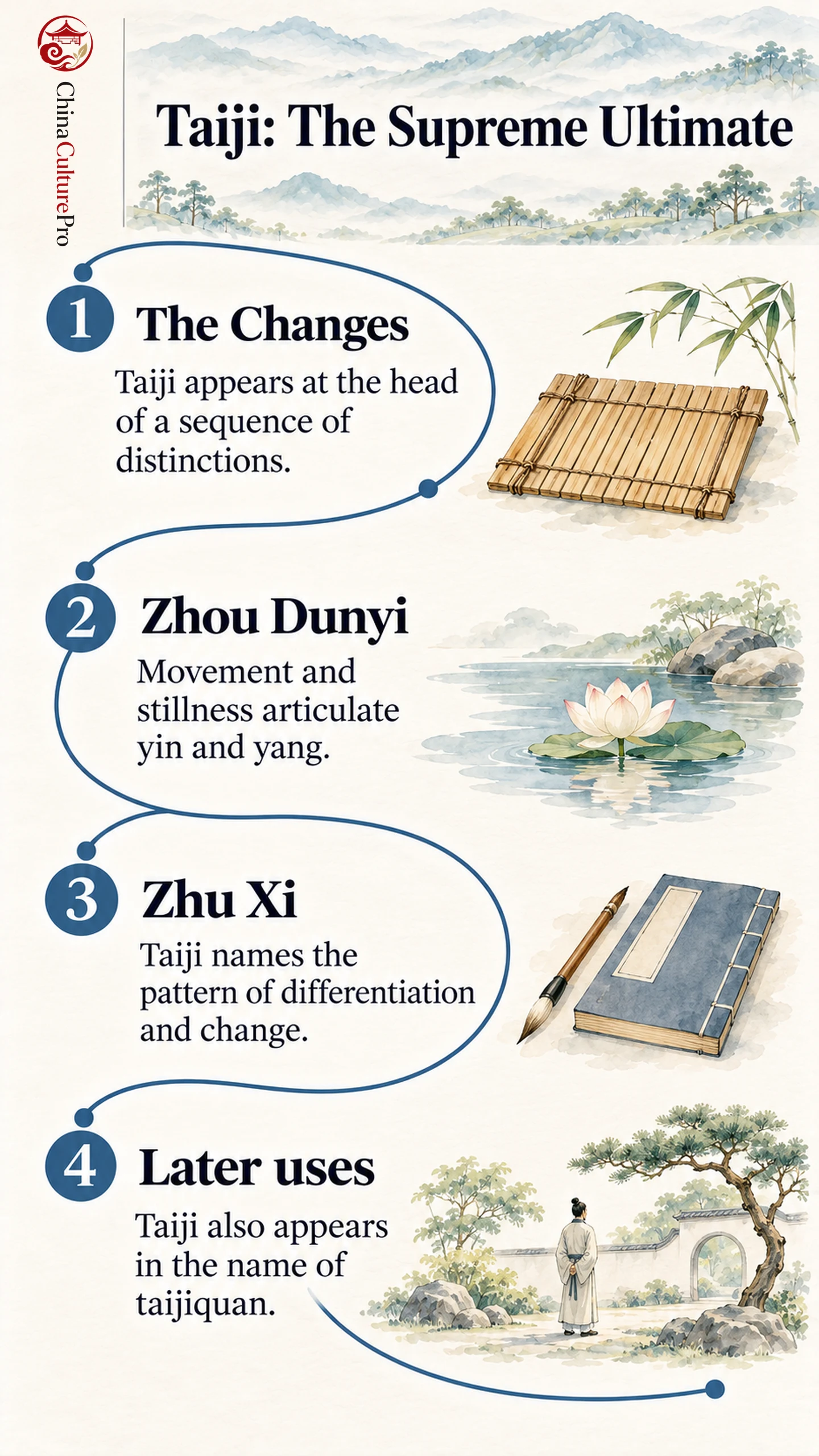
- The Changes: Taiji stands at the start of a sequence leading to the trigrams.
- Zhou Dunyi: The discussion connects alternating movement and stillness with the development of the world.
- Zhu Xi: The concept helps explain the order at work in such changes.[1][2][3]
The English choices bring out different features. “Supreme Polarity,” for example, foregrounds the relationship between the two modes.
The term can be encountered in classical commentary, beside a diagram or in the name of a practice. The earlier texts give a way to understand the term before assuming every later use has the same meaning.
The Changes and Its Sequence of Distinctions
The Appended Statements (系辞, Xìcí) give a sequence. The Changes has taiji, which gives rise to the Two Modes. These give rise to the Four Images and then the Eight Trigrams. It is useful to read the line within the commentarial material associated with the Changes, because the sequence describes the organization of change and its figures in a compact form.[1]
Commentators can explain the progression through the combination of lines and also draw wider conclusions about the way differences emerge. The two aspects help account for the range of interpretation. Someone concerned with the figures can follow the relation between the pairs and the trigrams. Someone concerned with cosmology can ask how the emergence of distinct modes makes changing processes intelligible.[1][3]
Zhou Dunyi: Movement, Stillness and the Diagram
Zhou Dunyi’s Explanation of the Taiji Diagram begins by bringing together the terms wuji, or the limitless, and taiji. The text then moves to activity and stillness, which are associated with yang and yin. The two are described in relation to one another, with each giving way to the other at its limit. The ensuing account connects this movement with the Five Phases and the production of the myriad things.[2][3]
The opening line has prompted different readings. Some translations stress an order of emergence, while others read the two terms as descriptions of one reality under different aspects. The rest of the account connects what can sound like a remote metaphysical question to the recurring alternation of activity and stillness. The diagram traditionally transmitted with the explanation uses multiple registers to make the progression visible.[2][3][4]
Zhu Xi: Reading Taiji as Pattern
In the tradition later associated with the School of Principle, Zhu Xi relates taiji to li, or intelligible pattern. His reading attends to the order through which the two modes and their changes can be understood. “Supreme Polarity” is one modern translator’s attempt to bring out that feature. “Supreme Ultimate” more readily conveys a familiar name for a fundamental ground.[1][3]
The choice of gloss can shape the image a reader has of the concept. If a translation seems to suggest a separate object that first appears and later causes yin and yang, it can obscure Zhu Xi’s interest in the order of their differentiation and activity. Reading the gloss together with the commentary helps make its explanatory role clearer.[1][3]
FAQs About Taiji
Is Zhou Dunyi’s diagram the familiar yin-yang symbol?
The diagram traditionally associated with Zhou Dunyi is a vertically arranged composition with several levels. The familiar black-and-white symbol is a different visual form associated with yin and yang.[2][4]
How are wuji and taiji related?
Zhou Dunyi’s opening line brings them together. Zhu Xi’s interpretation understands the fundamental pattern without assigning it a physical form. The wording has supported different accounts of how the two terms relate.[2][3]
Is taiji the same as taijiquan?
Taijiquan (太极拳, tàijíquán), often called tai chi in English, is a historical physical practice with its own traditions. Taiji is also a philosophical term whose use in the Changes and in Song philosophy can be read on its own.[1][2][5]
資料來源
[1] Joseph A. Adler, Kenyon College. Translation of the Xici and Zhu Xi’s Commentary
[2] Joseph A. Adler, Kenyon College. Zhou Dunyi and Explanation of the Supreme Polarity Diagram
[3] Joseph A. Adler. The Lotus Sutra and Zhu Xi
[4] Wiley. From Nothingness to Infinity: The Origin of Zhou Dunyi’s Cosmology
[5] UNESCO. Taijiquan