


Quick Answer: What Was the Spring and Autumn Period?
The Spring and Autumn period (春秋时期, Chūnqiū Shíqī) was the earlier phase of the Eastern Zhou (东周, Dōng Zhōu), beginning around 770 BCE and ending around 481–476 BCE under common chronologies. The royal court remained in place while regional states gained power and formed shifting alliances.[1][2][4][5]
- Dates: The historical period began before the surviving chronicle that gave it its name.[1][2][3]
- Political order: Leading states organized alliances while Zhou royal titles and rank retained prestige.[4][6]
- Ritual and thought: Covenants, court ceremonies and debates about proper conduct mattered in a world of competing rulers.[3][7][10][12]
Political authority moved toward regional courts at different speeds in different places.
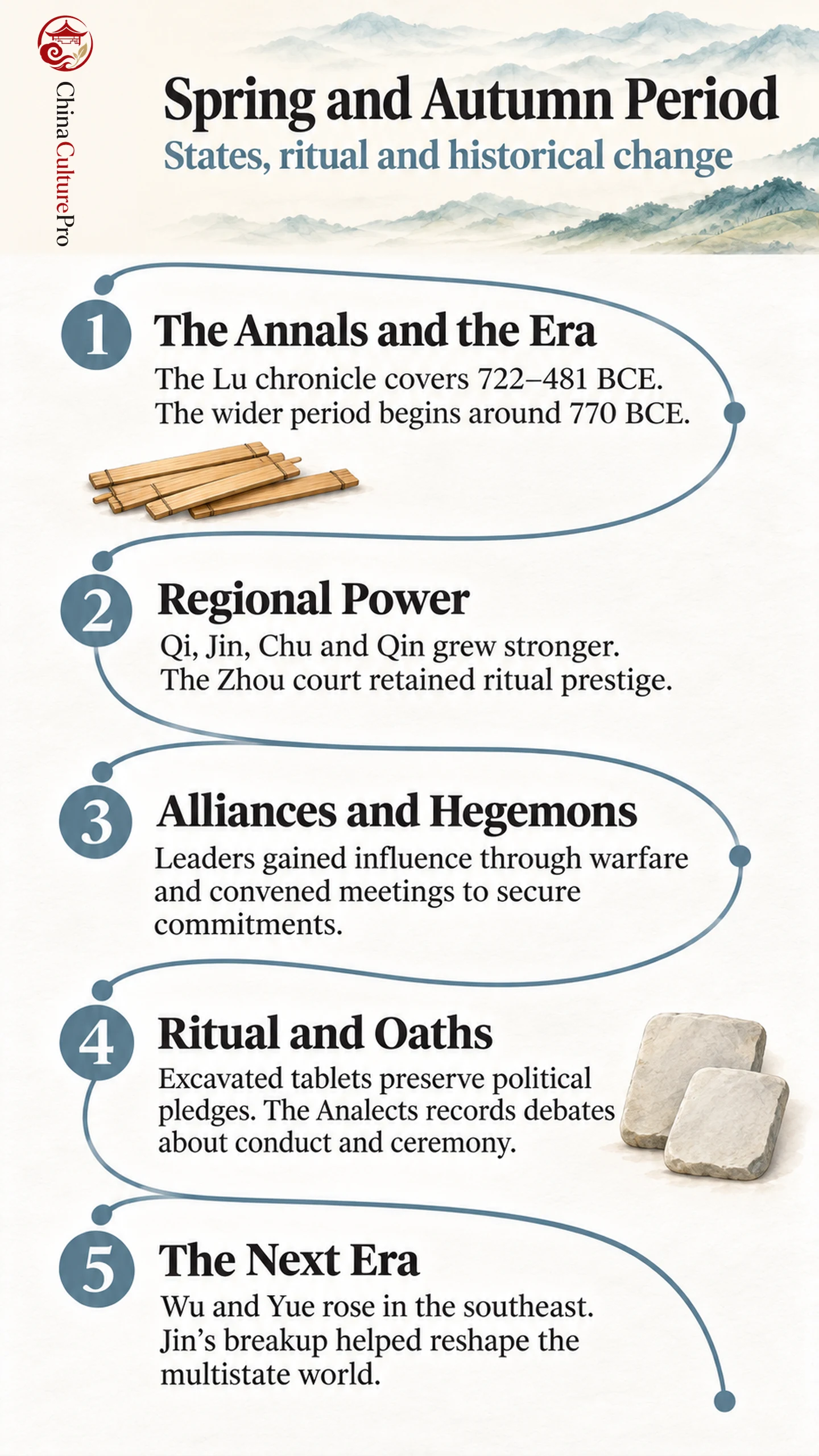
A short chronicle entry can record who attended a meeting. A longer account can tell a story about why it mattered. A stone tablet placed in the ground during an oath is a third kind of evidence. Reading the Spring and Autumn period means keeping those records separate.[3][7][10]
Why the Period Has Two Sets of Dates
Histories commonly begin the period around 770 BCE, when the Zhou dynasty court moved east to Luoyang after the western court fell in 771. Some use the fall of the earlier court as the starting point. The two dates describe the destruction of the western court and the relocation of its successor.[1][2][5]
The Spring and Autumn Annals (春秋, Chūnqiū) are a terse chronicle of the state of Lu (鲁, Lǔ). The surviving entries run from 722 to 481 BCE. These are dates covered by the text. The wider period includes developments before 722, and some chronologies continue it through 479 or about 476 BCE. The boundaries depend on whether the historian follows the chronicle, a broader convention or changes in the distribution of power.[1][2][3]
The Zuo Commentary (左传, Zuǒ Zhuàn) adds narratives, speeches and explanations to many of the events recorded in the annals. A dated entry and an elaborated speech give historians different things to work with. The entry gives the event as recorded in the Lu tradition. A speech in the commentary can also show what later writers considered persuasive or proper conduct.[2][3]
Regional States and the Zhou Court
Some of the largest states were on the edges of the area originally tied to the Western Zhou court. Qi (齐, Qí) was a power in the east, Jin (晋, Jìn) in the north, Chu (楚, Chǔ) in the south and Qin (秦, Qín) in the west. The court at Luoyang retained prestige. Its ability to command military action or impose settlements across these territories was limited.[1][4][5][6]
Regional lords could call on inherited ranks and forms of address while pursuing their own interests. Rival states built alliances, competed for territory and drew smaller neighbors into their conflicts. A weaker court might need the protection of a stronger one. The leading states in turn needed cooperation to maintain their position, even while expanding their own power.[1][4][6]
One episode in the Zuo Commentary shows how ceremony could help a weaker court negotiate. After Jin defeated Qi, a Zhou king objected to the way Jin’s envoy proposed to present the spoils of victory. He invoked rules about when a ruler could offer such spoils and then entertained the envoy at a private feast. The account presents ceremony as a way to register disapproval while preserving ties to a powerful protector.[6]
Authority also shifted within states. Leading families could accumulate offices and military resources over generations. A state might become stronger relative to the Zhou court at the same time that its own ruler faced powerful rivals within his territory. This helps explain why the later breakup of Jin was both an internal conflict and a change in the balance between states.[1][4][15]
Hegemons, Battles and Covenants
Historians use the term hegemons (霸, bà) for regional leaders who exercised authority over groups of other states. Military strength helped make that influence possible. The leading ruler also had to assemble allies, convene meetings and represent an order that still drew on Zhou rank. A hegemon held regional power within a hierarchy that still recognized the royal court.[6][9]
Duke Huan of Qi (齐桓公, Qí Huángōng) convened a meeting at Kuiqiu (葵丘, Kuíqiū) in 651 BCE. The account in the Zuo Commentary records a covenant among lords. The gathering illustrates an attempt to preserve cooperation through a formal undertaking. The account has the lords make a commitment to restore good relations after the agreement. The meeting made that undertaking visible to the other rulers present.[7][9]
Duke Wen of Jin (晋文公, Jìn Wéngōng) gained influence after Jin and its allies defeated Chu at Chengpu (城濮, Chéngpú) in 632 BCE. A covenant at Jiantu (践土, Jiàntǔ) followed the victory that same year. Jin used the influence gained on the battlefield to organize an agreement among rulers. The regional lord acted through a political order in which recognition from the Zhou court still mattered.[6][8][9]
Ritual, Oaths and Confucius
Oaths were also used within states. Excavations that began in 1965 at Houma in Shanxi recovered jade and stone tablets carrying written commitments. The Houma covenant texts (侯马盟书, Hóumǎ Méngshū) record obligations and sanctions invoked in political relationships. They show how an oath could be written, deposited and made binding in a ritual setting. The texts give a view of allegiance within a state, alongside the agreements recorded between rulers.[10][11]
Some tablets name the person making the pledge, identify loyalties or prohibitions, and invoke a curse if the person breaks the terms. Those clauses show that the ritual had practical stakes. The surviving texts connect particular individuals to expectations about their conduct, even though the wider political circumstances of some pledges are disputed.[11]
Confucius (孔子, Kǒngzǐ), traditionally dated to 551–479 BCE, lived in Lu in the later part of the period. The received Analects (论语, Lúnyǔ) represents him as a teacher concerned with moral conduct, proper ceremony and the conduct of rulers. In this setting, learning rites meant understanding what people owed others in particular relationships. Debates over who observed or misused them were also debates over authority.[3][12]
The collected sayings and the tablets have different purposes. The sayings ask how a person should act within a relationship. The tablets record obligations that participants undertook in a particular political setting.[10][11][12]
From the Spring and Autumn Period to the Warring States
Power shifted beyond the northern states. In 506 BCE, Wu (吴, Wú) defeated Chu in a major campaign. In 473 BCE, Yue (越, Yuè) overcame Wu. The success of these southeastern states is part of a longer change in the political geography of the region. Depending on the date convention, the defeat of Wu can appear at the very end of the Spring and Autumn era or in the opening years of the next one.[1][2][13][16]
A sword bearing the name of the Yue ruler Goujian (勾践, Gōujiàn) was excavated from a tomb in Hubei in 1965. The bronze blade is 55.7 centimeters long and has a dark diamond pattern. A short inscription near the hilt names the ruler. Its excavation identifies where the object was buried. The inscription and findspot leave its route between the two places open. As with other Chinese bronze objects, manufacture, inscription and burial each tell a separate part of its history.[14]
The breakup of Jin offers another way to mark the transition. Three lineages gained effective control in 453 BCE and later won formal recognition as rulers in 403. The Warring States period (战国时期, Zhànguó Shíqī) saw larger territorial states competing on a different scale. Diplomatic meetings, oaths and court patronage continued amid those changes.[1][4][15]
FAQs About the Spring and Autumn Period
Why is it called the Spring and Autumn period?
It takes its name from the Spring and Autumn Annals, a chronicle of Lu covering 722–481 BCE. Historians use the name for a wider period that begins around the move of the Zhou court to Luoyang.[1][2][3][5]
Who were the Five Hegemons?
The Five Hegemons (春秋五霸, Chūnqiū Wǔbà) are leading regional rulers grouped in later traditions. Duke Huan of Qi, Duke Wen of Jin and King Zhuang of Chu (楚庄王, Chǔ Zhuāngwáng) appear in prominent lists. Some lists also include the rulers of Qin and Song. Others include rulers of Wu and Yue. The choices reflect different traditions about who exercised the most important leadership.[6][9]
Did Confucius write the Spring and Autumn Annals?
Later tradition associated Confucius with compiling or editing the annals. His exact role remains uncertain. Historians study the work as a chronicle of Lu and distinguish its surviving entries from later interpretations and commentaries.[2][3][12]
資料來源
[1] Cambridge University Press. The Spring and Autumn Period
[2] Routledge. Ancient China: The Spring and Autumn Period
[3] The Oxford Handbook of Early China. Historiography, Thought and Intellectual Development During the Spring and Autumn Period
[4] Cambridge University Press. From City-State to Autocratic Monarchy, 707 to 250 BCE
[5] Princeton University Art Museum. China Timeline
[6] Journal of Chinese History. A Speechless Monarch: Early China’s Battle for Intellectual Authority
[7] Chinese Text Project. Zuo Commentary: Duke Xi, Year Nine
[8] Chinese Text Project(中國哲學書電子化計劃). Zuo Commentary: Duke Xi, Year Twenty-Eight
[9] Academy of Chinese Studies. Hegemons of the Spring and Autumn Period
[10] Korean Journal of Chinese Language and Literature. Spring and Autumn Legal Practice in the Houma Covenant Texts
[11] SOAS University of London. Interpreting the Wenxian Covenant Texts
[12] Stanford Encyclopedia of Philosophy. Confucius
[13] National Museum of China. King Fuchai of Wu Bronze Jian
[14] Hubei Provincial Museum. The Sword of Goujian
[15] The Oxford Handbook of Early China. The Warring States Period: Historical Background
[16] Early China. Didactic Narrative and the Art of Self-Strengthening: Reading the Yue Gong Qi Shi Manuscript