


Quick Answer: What Was the Second Opium War?
The Second Opium War (第二次鸦片战争, Dì Èr Cì Yāpiàn Zhànzhēng) was fought from 1856 to 1860 between Qing China and Britain and France. The Treaties of Tianjin (天津条约, Tiānjīn Tiáoyuē) were signed in 1858, but fighting resumed. Britain and France forced a final settlement in Beijing in 1860. The British Convention of Peking (北京条约, Běijīng Tiáoyuē) put earlier concessions into effect and added new ones. [1][3][4][5][7][8]
- Trigger: Britain used a dispute over the Arrow to press for wider treaty rights.
- Turning point: Qing forces repelled an attack in 1859, but the Anglo-French expedition broke through in 1860.
- Terms: The settlement expanded foreign trade and diplomatic access. [1][2][3][4]
Opium duties came from the 1858 trade rules. The cession of part of Kowloon came from the 1860 convention. [6][7]
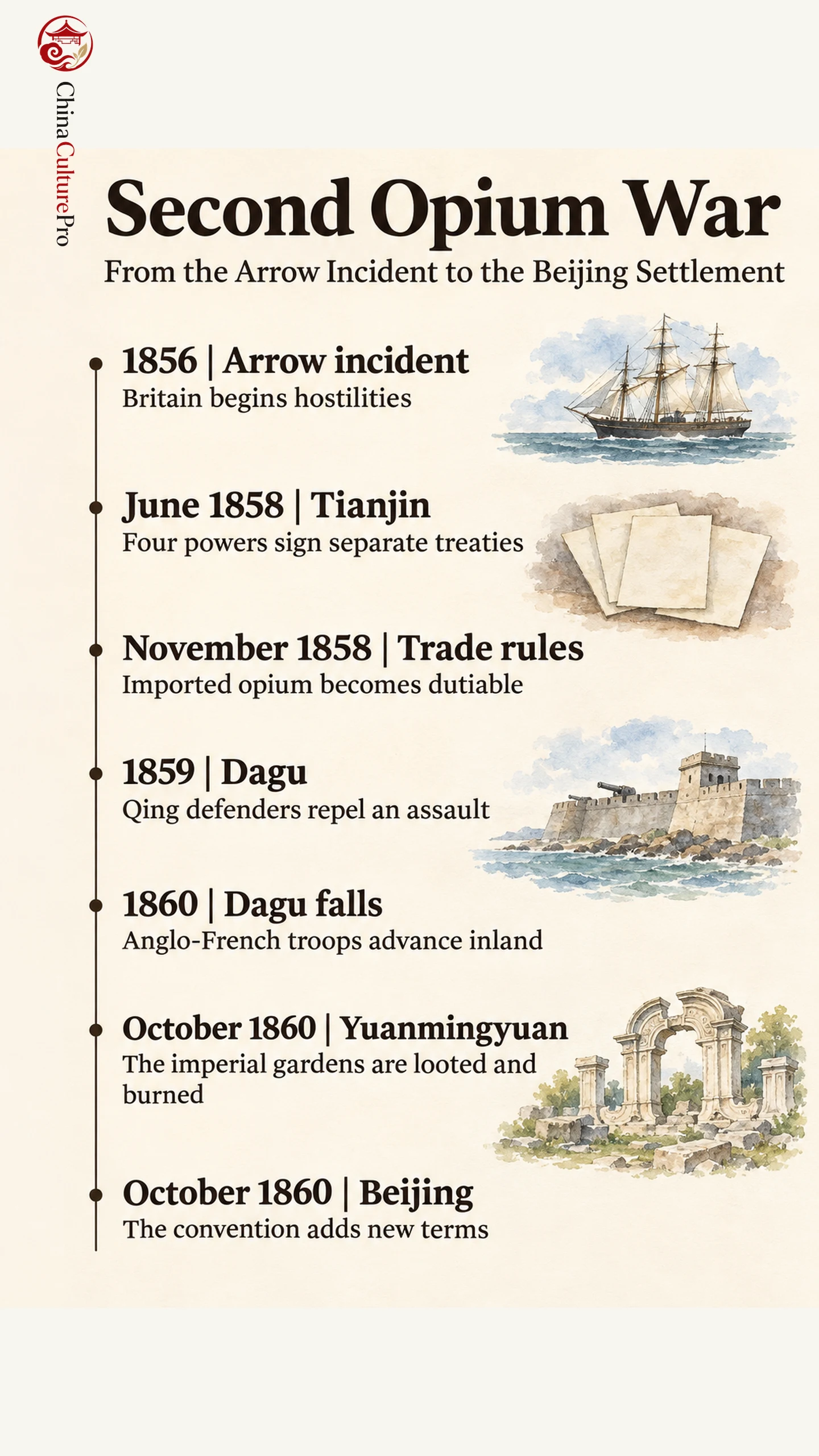
The Qing court signed new treaties in 1858. Two years later, foreign troops reached Beijing and secured terms the first agreements had not settled. The fighting between those dates explains how the two rounds of concessions fit together.
Why the War Began at Guangzhou
The First Opium War had already compelled the Qing dynasty to open five ports to British trade. By the 1850s foreign governments were pushing for broader access to Chinese markets and more direct dealings with the court. The dispute that began the second war came in October 1856, when Chinese officials boarded the Chinese-owned Arrow at Guangzhou and arrested crew members. [1][2][3][4]
British officials claimed the vessel was entitled to British protection through its Hong Kong registration. The right to that protection was disputed. The incident became the grounds for British military action. France joined Britain and cited the execution of the French missionary Auguste Chapdelaine in Guangxi earlier in 1856. Britain and France both sought a wider set of concessions than resolution of their immediate grievances. [2][3][4][8]
Why the 1858 Treaties Failed to End the Fighting
Anglo-French forces took Guangzhou in late 1857, then moved north. In 1858 they took the Dagu forts, which guarded the river approach to Tianjin. Qing negotiators signed separate treaties with Britain, France, Russia and the United States at Tianjin that June. Signing did not settle how foreign diplomats could travel to the capital to exchange ratifications. The route past the forts soon became a point of conflict. [1][3][4][5]
In June 1859 a British and French force tried to pass the rebuilt Dagu defenses on its way to exchange ratifications. Qing batteries repelled it. In 1860 a larger expedition, including troops from British India, landed north of the forts at Beitang and captured them from the land side. The expedition moved through Tianjin toward Beijing. The Xianfeng Emperor left the capital, and Prince Gong negotiated on behalf of the Qing. [3][4][8]
What the 1858 and 1860 Agreements Required
The following terms come from the British texts. France, Russia and the United States signed their own treaties. The British treaty made several rights conditional. It required British travelers in the interior to carry passports in most cases and initially named Zhenjiang as the exception to a restriction on opening Yangzi ports during the fighting along the river. [1][5][6][7]
| Document | 日期 | What it did |
|---|---|---|
| British Treaty of Tianjin | June 1858 | Provided for a diplomatic representative in Beijing, listed additional ports and gave conditional access to Yangzi trade. [5] |
| British rules of trade | November 1858 | Made imported opium liable to duty and limited where British importers could sell it. [6] |
| British Convention of Peking | October 1860 | Put the 1858 treaty into effect, opened Tianjin to trade, increased the indemnity and ceded part of Kowloon. [7] |
Under the November rules, opium importers paid 30 taels per picul. Foreign importers could sell the drug at the port. The agreement reserved transport into the interior to Chinese owners and carriers and left inland duties to the Qing government. It expressly excluded opium from the treaty’s general transit-duty rules. [6]
The Destruction of the Old Summer Palace and the War’s Legacy
In October 1860 British and French troops looted the Old Summer Palace (圆明园, Yuánmíngyuán), an imperial complex outside Beijing. British troops subsequently burned much of it on Lord Elgin’s orders. Elgin publicly justified the destruction as retaliation for the treatment and deaths of prisoners held by Qing forces. Many buildings were lost. Objects taken from the complex, including porcelain and books, were dispersed abroad. [3][4][8]
The treaties widened the network of ports and the foreign diplomatic presence in the Qing capital. British and French victories had imposed terms on a court facing rebellion at home as well. In 1861 Prince Gong took charge of the Zongli Yamen, the Qing office for foreign affairs. The office gave the Qing a standing institution for handling diplomatic business in the capital. [1][3][4][5][6][7][9]
FAQs About the Second Opium War
Why is it also called the Arrow War?
The name refers to the boarding of the Arrow at Guangzhou in 1856. Britain used that dispute to justify hostilities while pursuing broader demands for treaty revision. [1][2]
Which agreement made imported opium dutiable?
The November 1858 British trade rules set an import duty on opium and specified who could take it inland. The June treaty and the trade rules were separate documents. [5][6]
Did the United States and Russia fight alongside Britain and France?
Britain and France led the war against the Qing. The United States and Russia negotiated their own agreements at Tianjin. U.S. forces fought a separate clash at the Barrier Forts near Guangzhou in 1856. The United States and Qing then concluded a neutrality agreement, although an American naval commander gave limited help to the British at Dagu in 1859. [1][3][4][10]
資料來源
[1] U.S. Department of State, Office of the Historian. The Opening to China, Part II: The Second Opium War and the Treaty of Tianjin
[2] J. Y. Wong. The Arrow Incident: A Reappraisal
[3] National Army Museum, London. Second China War
[4] Palace Museum, Beijing. The Second Opium War
[5] The World and Japan Database. British Treaty of Tianjin, June 26, 1858
[6] The World and Japan Database. British Agreement on Rules of Trade, November 8, 1858
[7] The World and Japan Database. British Convention of Peking, October 24, 1860
[8] Fondation Napoléon. The Franco-British Expedition to China, 1860
[9] Palace Museum, Beijing. Yixin, Prince Gong
[10] U.S. Naval History and Heritage Command. The Battle of the Pearl River Forts, China, 1856