


Quick Answer: What Is Returning Home About?
Returning Home (歸去來兮辭, Guīqùláixī Cí) by 陶淵明 (陶淵明, Táo Yuānmíng) is a rhymed declamation (辭, cí) associated with his departure from office in 405. A prose preface explains the circumstances; the rhymed body imagines and celebrates a life brought back into accord with the self.[1]
- Decision: The speaker recognizes that supporting his body has come at the cost of his inner nature.
- Home: Family, wine, books, gardening and farming give the chosen life substance.
- Final return: Human life belongs to natural change, including its eventual end.
The work’s movement through homecoming and different seasons is a literary arrangement, not a dated travel diary.
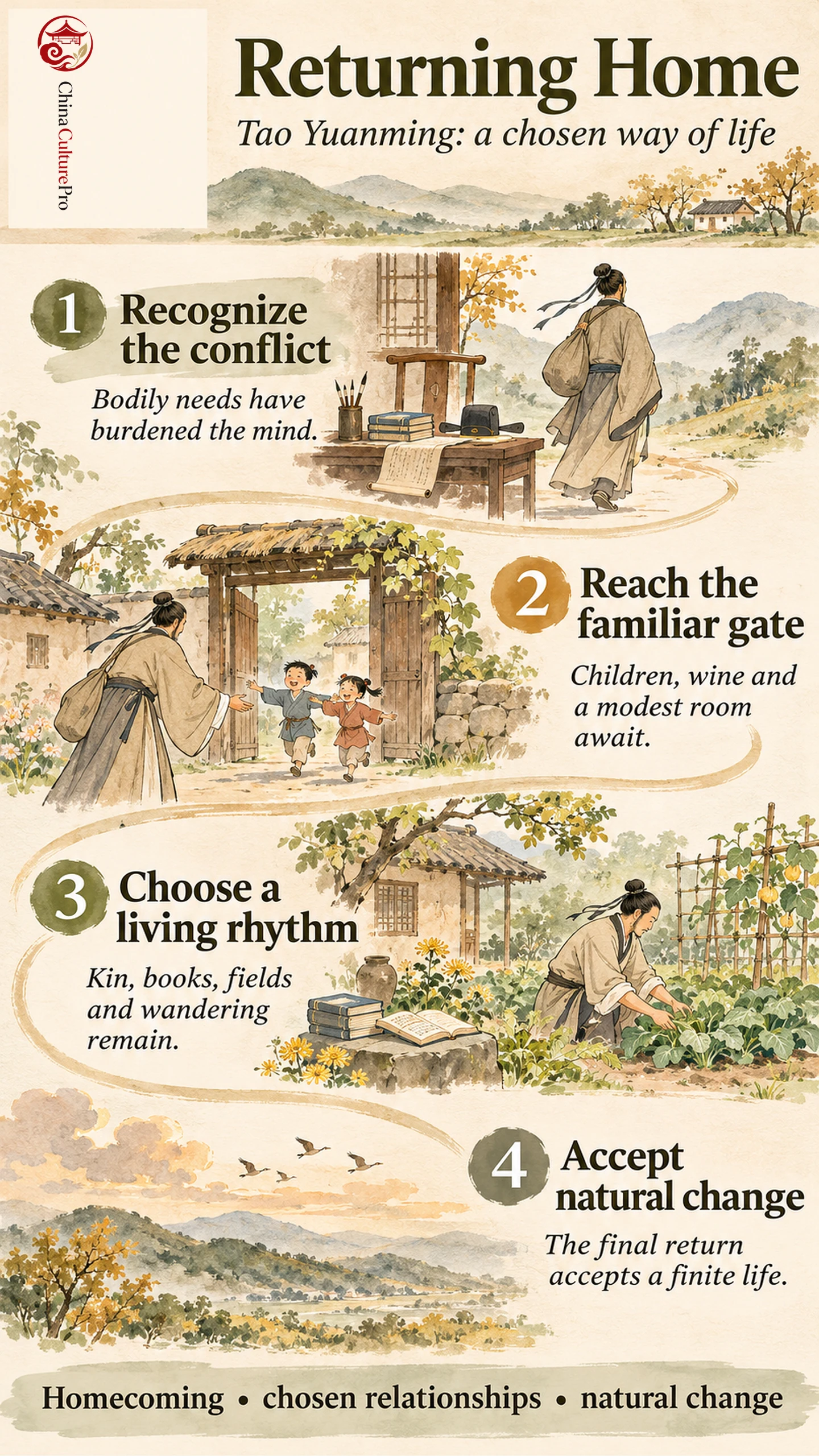
A boat moving toward home begins the visible journey; the deeper movement is away from a life the speaker can no longer accept. The welcome at the gate, a modest room, garden paths and spring work make that choice tangible. The work eventually asks what it means to accept the end of life itself.
The Preface: Poverty, Office and Departure
The preface places the decision within the Eastern Jin period. Tao describes a poor household with young children and inadequate grain. Relatives encouraged him to take office, and an uncle helped obtain a nearby appointment at Pengze (彭澤, Péngzé). Its public fields could also supply what he needed for wine.[1]
Yet he soon wanted to leave. Hunger and cold were difficult, but acting against his nature produced another kind of suffering. He initially hoped to wait for a harvest; news that his married younger sister had died then prompted his departure. He says that he held office for more than eighty days, from mid-autumn into winter.[1]
He dates the piece to the eleventh traditional month of 405. This is not a Gregorian November date, and the famous “five pecks of rice” episode is not the incident narrated in this preface. What follows summarizes neither a carefree escape from poverty nor a rejection of every human obligation: it presents the life he chooses despite material constraint.
The Complete Rhymed Text and an English Sense Translation
The complete rhymed body appears below in eight reading groups. The prose preface is summarized above rather than reproduced in full. This text uses 心, “mind,” and 善, “appreciate”; transmitted editions have variants. The English is an original sense translation, not an attempt to preserve every rhyme.[1][2]
| Chinese text | English sense translation |
|---|---|
| 歸去來兮,田園將蕪胡不歸? 既自以心為形役,奚惆悵而獨悲! 悟已往之不諫,知來者之可追; 實迷途其未遠,覺今是而昨非。 | Homeward, then! Fields and garden are about to run wild—why do I not return? Having myself made my mind labor for my bodily needs, why remain despondent and grieve alone? I understand that what has passed cannot be corrected, while what comes next can still be pursued. I have not traveled too far along the mistaken road: I recognize the present choice as right and the former one as wrong. |
| 舟遙遙以輕颺,風飄飄而吹衣。 問征夫以前路,恨晨光之熹微。 乃瞻衡宇,載欣載奔。 僮僕歡迎,稚子候門。 | The boat glides lightly onward; the wind ripples through my clothes. I ask a traveler about the road ahead, impatient with the faint dawn. Then my humble gateway comes into sight: delighted, I hurry toward it. The servants welcome me, and the young children wait at the door. |
| 三徑就荒,松菊猶存。 携幼入室,有酒盈罇。 引壺觴以自酌,眄庭柯以怡顏。 倚南窗以寄傲,審容膝之易安。 | The three paths have grown wild, but the pines and chrysanthemums remain. Taking a little one inside, I find a jar filled with wine. I draw the vessel and cup close and pour for myself; a glance at the courtyard branches brings pleasure to my face. Leaning by the south window, I rest in my independence and discover how readily a room scarcely large enough for my knees can bring contentment. |
| 園日涉以成趣,門雖設而常關。 策扶老以流憩,時矯首而遐觀。 雲無心以出岫,鳥倦飛而知還。 景翳翳以將入,撫孤松而盤桓。 | Daily walks make the garden a delight; there is a gate, but it is usually closed. With a walking staff I wander and rest, sometimes lifting my head to look far away. Clouds emerge from the mountain hollows without intention; birds, tired of flight, know to return. The light grows dim toward sunset, and I linger with my hand upon a solitary pine. |
| 歸去來兮!請息交以絕遊。 世與我而相違,復駕言兮焉求? 悅親戚之情話,樂琴書以消憂。 農人告余以春及,將有事於西疇。 | Homeward, then! Let me end those dealings and visits. The world and I are at odds—what would I seek by setting out again? I delight in the affectionate conversation of my kin, and enjoy the zither and books to ease my cares. Farmers tell me spring has arrived; there will be work in the western fields. |
| 或命巾車,或棹孤舟。 既窈窕以尋壑,亦崎嶇而經丘。 木欣欣以向榮,泉涓涓而始流。 善萬物之得時,感吾生之行休。 | Sometimes I call for a covered cart; sometimes I row a solitary boat. I seek out winding valleys and cross the rugged hills. Trees flourish toward new growth; springs begin to trickle. I appreciate how all things find their season, and feel my own life moving toward its close. |
| 已矣乎!寓形宇內復幾時? 曷不委心任去留? 胡為乎遑遑欲何之? 富貴非吾願,帝鄉不可期。 | Enough, then! How much longer can this bodily form lodge within the universe? Why not release my heart and accept departure or remaining? Why hurry anxiously, and where would I go? Wealth and high position are not my wish; the realm of immortals is not something I can expect. |
| 懷良辰以孤往,或植杖而耘耔。 登東皋以舒嘯,臨清流而賦詩。 聊乘化以歸盡,樂夫天命復奚疑! | Cherishing a fine day, I go out alone, or set my staff upright to weed and tend the crops. I climb the eastern rise and let out a long call; beside a clear stream I compose verse. Let me follow transformation to life’s end, content with what Heaven allots—what further doubt need remain? |
Homecoming as a Recovery of the Self
The opening makes the body’s needs and the mind’s freedom pull in different directions. The preface has already acknowledged the necessity of earning a living. The work’s argument is therefore sharper than “work is unpleasant”: the speaker judges that this particular service makes him live against himself.[1]
Homecoming answers that strain through actions. He asks the way, longs for clearer dawn, sees the gate and hurries. Once inside, the scale contracts to a child’s hand, a wine vessel, branches and a small room. Contentment is located in things he can actually do, rather than in another public achievement.
The clouds and returning birds extend that movement into the landscape. Clouds emerge without deliberate striving; tired birds recognize their return. These paired images make the human choice feel at home within natural movement. They do not claim that birds consciously teach a philosophical doctrine.
The surviving chrysanthemums also connect this work with the quieter garden encounter in Drinking Wine Number Five. The shared imagery is useful, but the two works have different structures: this one stages the decision, journey and chosen way of living.
Closed Gates, Living Connections and the Final Return
A usually closed gate does not produce a life empty of people. Affectionate relatives and farmers appear immediately after the renewed call to return. Read the break with “dealings and visits” alongside those continuing relationships: he is choosing the terms of social life, not erasing it.[1]
Nor does the countryside mean permanent leisure. Spring brings fieldwork, and the final section includes weeding and tending crops. A companion reading is Returning to Dwell in Gardens and Fields, where rural life receives a different poetic treatment.
Renewing trees and running springs then lead to an uncomfortable recognition: other things have their season, while his own life passes. The ending accepts that limit. It rejects both wealth as a goal and the expectation of an immortal realm before returning to ordinary acts—walking, cultivation, calling out and making poems.[1]
The last “return” is consequently larger than arrival at a house. Following transformation to the end means accepting a finite life. The text makes peace with change without claiming that mortality has disappeared.[1][3]
How to Read the Work’s Three Kinds of Return
- Separate the preface: Identify the stated circumstances of office and resignation before entering the rhymed scenes.
- Follow the journey: Track the movement from boat and road to gate, children and room.
- Examine the chosen life: Keep kin, books, farming and solitary wandering together rather than reducing reclusion to inactivity.
- Read the final widening: Compare returning home with the later acceptance of natural change and life’s end.
FAQs About Returning Home by Tao Yuanming
Did Tao Yuanming return home in spring?
The preface places his departure from office between mid-autumn and winter and dates the piece to the eleventh traditional month of 405. The spring scene belongs to the literary presentation of rural life; it does not establish a spring resignation date.
Does closing the gate mean rejecting everybody?
No. The work retains family conversation and contact with farmers. Its withdrawal from unwanted social dealings coexists with selected human connections.
Is the ending a promise of immortality?
No. The speaker explicitly sets aside hope of the immortal realm and accepts natural transformation through the end of his human life.
資料來源
[1] Tao Yuanming. Returning Home, with Preface
[2] Chinese University of Hong Kong Library. Yim Chihung: Text of Returning Home
[3] Hong Kong Education Bureau. Arts and Literature in Harmony: Returning Home