

Quick Answer: How Are Qi and Li Related?
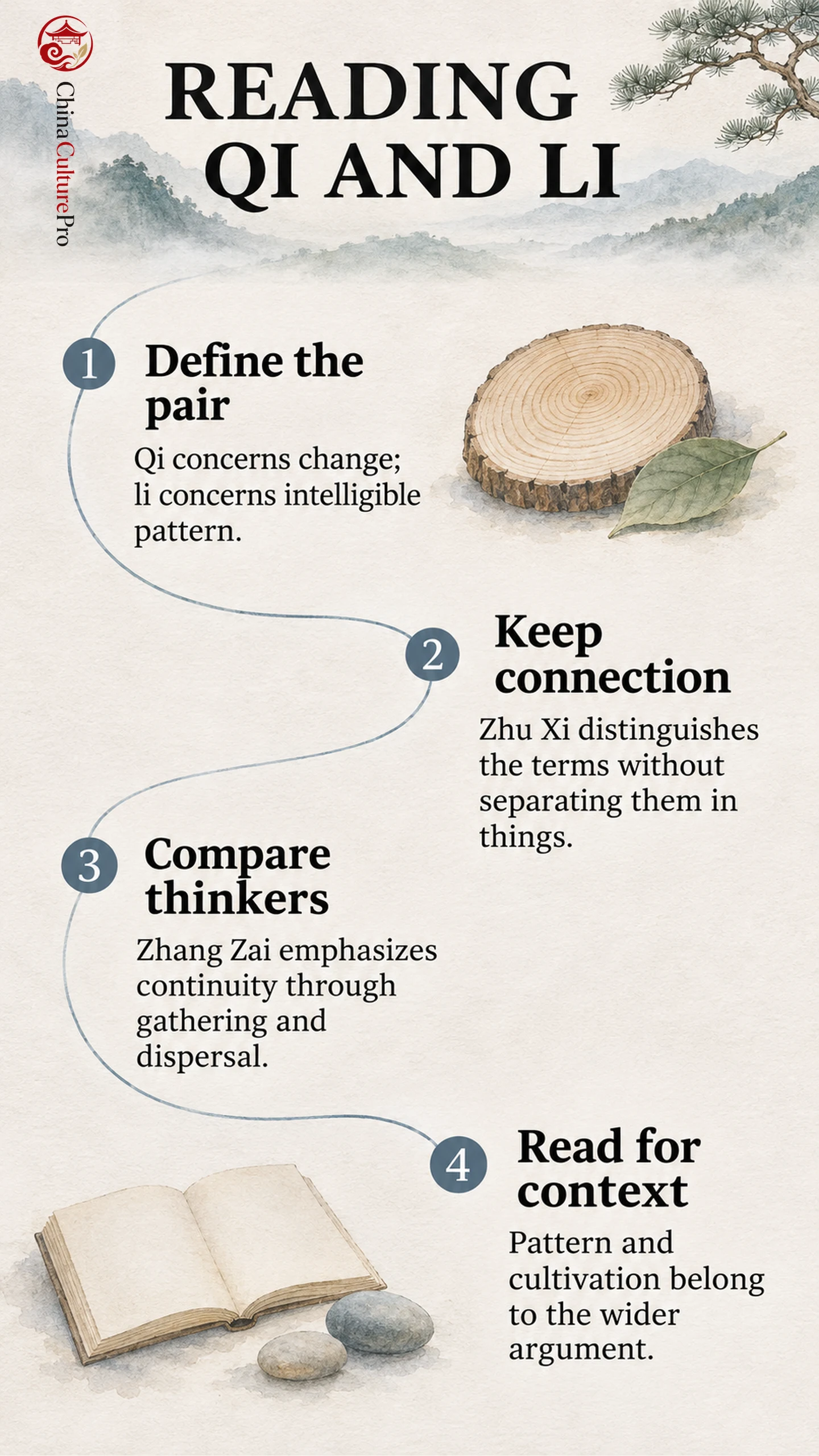
Qi(气,qì)and li(理,lǐ)are interrelated concepts used to explain the world in Chinese philosophy. In Song thought, qi commonly concerns the dynamic, material dimension of things, while li concerns their intelligible pattern or principle. Translations vary, so neither word should be reduced to a single modern English equivalent.[1]
- Qi: Accounts for formation, activity and change.
- Li: Accounts for the order or pattern through which things are intelligible.
- Relationship: Can be distinguished in explanation without being separated in concrete things.
This guide focuses on two named Song thinkers and their texts, not a doctrine shared unchanged by every Chinese philosophical tradition.
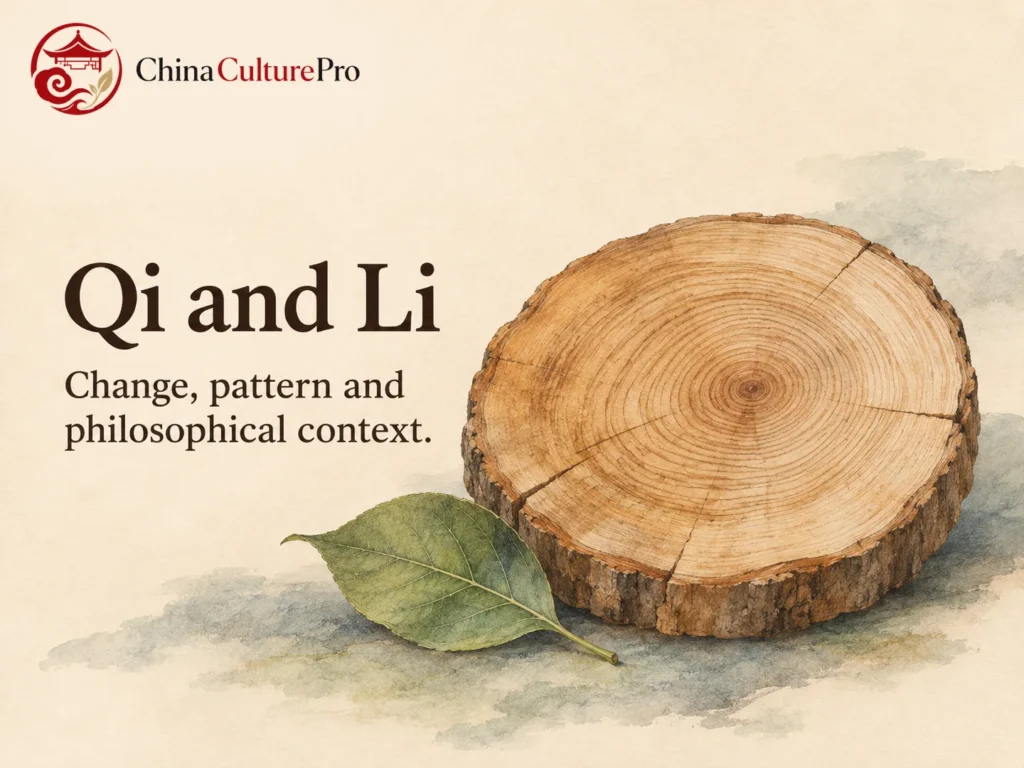
The grain of wood suggests order within something material: it is not an extra object floating beside the wood. That image helps introduce one philosophical question, although it cannot explain the whole system. This guide places the pair within Chinese philosophy and follows the different explanatory work each term performs.
Qi and Li as Distinct Explanatory Terms
The following definitions apply to the Song philosophical discussions developed below. They distinguish two aspects of an account without turning either concept into a modern scientific unit.
| 用語 | Working meaning in this guide |
|---|---|
| qi(气,qì) | The dynamic material dimension through which things form, interact and change; translated as material force, vital energy or cosmic vapor. |
| li(理,lǐ) | The intelligible pattern, principle or coherence of things and relationships, including their ethical significance. |
“Energy” makes activity visible but may suggest a modern physical quantity. “Principle” highlights order but can suggest a rule imposed from outside. Each translation needs the surrounding argument.[1] Neither translation establishes an experimentally measured equivalent.
Zhu Xi: Inseparable in Things, Distinguishable in Thought
Zhu Xi(朱熹,Zhū Xī)addresses the pair in recorded conversations collected in the *Zhuzi Yulei*(朱子语类,Zhūzǐ yǔlèi). One passage states that there is no qi without li and no li without qi. Other exchanges ask whether one comes first.[2]
The answers resist a simple chronological sequence. Li can be called prior when tracing why a thing has its particular intelligible character. Yet the discussion also says that li is not a separate thing: without qi it would have nowhere to attach. Saying “first” here is not equivalent to saying that li existed on one day and qi appeared the next.
Another exchange differentiates their roles. Qi can gather and produce concrete formations; li does not plan, feel or manufacture. Pattern is therefore not a small conscious agent directing matter from somewhere else.
These distinctions matter because both separation and collapse can mislead. If li floats outside the world, the claim of inseparability disappears. If li and qi become interchangeable words, the distinction between intelligible order and dynamic formation disappears instead. The conversations use the distinction while maintaining the connection.
For the broader setting of Zhu Xi’s thought, read the pair alongside his interest in learning and conduct, not only as a puzzle about what the universe contains.
Zhang Zai and a Different Emphasis on Qi
Zhang Zai(张载,Zhāng Zǎi)places a different emphasis on qi in the *Zhengmeng*(正蒙,Zhèngméng). Its opening discussion describes gathering and dispersal as changing forms. When qi becomes imperceptible, that does not mean it has become absolute nothingness.[3]
The text compares gathering and dispersal with ice freezing and melting in water. The point is continuity through changes of form: a visible configuration can cease without the underlying account requiring creation from nothing or disappearance into nothing.
That is the philosophical task of the comparison. It does not demonstrate that qi is chemically identical to water, or turn the ancient account into a statement of modern conservation laws. An image can clarify continuity without establishing a laboratory model.
Nor does this emphasis simply erase pattern. Zhang’s discussion describes processes as ordered rather than arbitrary. The contrast with Zhu concerns where explanatory weight falls, not a contest between someone who noticed order and someone who did not. Reading a named passage gives the wider history of qi in Chinese thought more precision.
Pattern, Ethics and Translation
Li in this discussion differs from ritual li(礼,lǐ). The Mandarin pronunciation is the same, but the characters identify different concepts: pattern or principle on one side, ritual propriety on the other. Both can matter in Confucianism without becoming interchangeable.
The distinction between li and qi also bears on human nature. In one influential account, the goodness of human nature does not guarantee that every actual response is already good. Differences in qi and the obscuring effects of partiality help explain why cultivation remains necessary.[4]
Gewu(格物,géwù), investigating things, connects learning with discerning patterns in particular situations. Wood grain and leaf veins offer concrete images of patterned things, while ethical discernment concerns how to respond appropriately in human relationships.[1] Physical texture alone does not supply a ready-made answer to every moral problem.
Read the vocabulary at the level of the argument being made: formation and change, intelligible order, or the cultivation of conduct. Moving between those questions is part of the philosophy, but silently replacing one with another makes the terms harder to understand.
FAQs About Qi and Li
Is qi the same as energy in modern physics?
No. “Energy” is one translation of a historical philosophical term; it does not establish equivalence with a modern measurable quantity.
Is li a separate object outside the world?
Not in the conversations discussed here. Zhu Xi distinguishes li from qi while insisting that li is not found apart from it.[2]
Is li meaning pattern the same as ritual li?
No. Pattern or principle is 理; ritual propriety is 礼. Both are pronounced lǐ in Mandarin, but the characters and concepts differ.
資料來源
[1] Kirill Thompson, Stanford Encyclopedia of Philosophy. Zhu Xi
[2] Wikisource. Zhuzi Yulei, volume 1: recorded discussions of li and qi
[3] Wikisource. Zhang Zai, Zhengmeng: Taihe chapter
[4] Franklin Perkins, Stanford Encyclopedia of Philosophy. Metaphysics in Chinese Philosophy, section 7