


Quick Answer: What Is Praying Mantis Kung Fu?
Praying mantis boxing (螳螂拳, tánglángquán) refers to Chinese martial traditions sharing an insect-inspired name and imagery.
- Northern and southern mantis need separate histories and curriculum descriptions.
- Hooking hands work within combinations of body movement, footwork and other methods.
- A named form identifies one piece of training, not the whole tradition.
The mantis image is a starting point for understanding these arts, not evidence of one identical system.
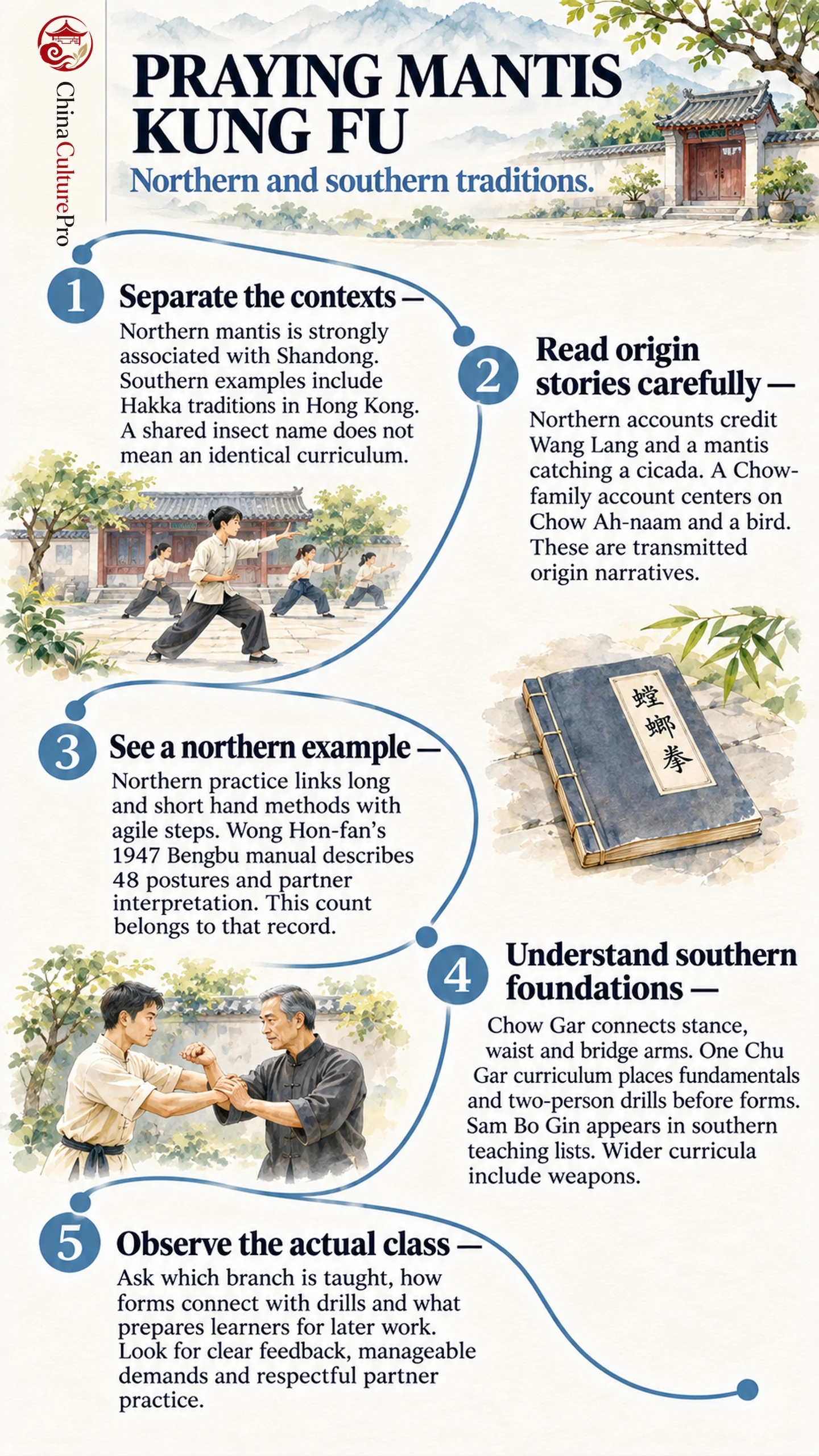
A mantis demonstration becomes easier to read when its tradition and curriculum are identified. The following training records place the insect imagery within a wider Chinese martial arts context.
Start with Northern and Southern Traditions
The north-south distinction concerns transmission and practice, rather than two versions of a universal mantis syllabus.
| 比較項目 | Northern traditions | Southern examples |
|---|---|---|
| Geographic context | Strong associations with Shandong (山东, Shāndōng).[1] | Hakka (客家, kèjiā) traditions documented in Hong Kong (香港, Xiānggǎng).[9] |
| Movement clues | Agile steps and linked long- and short-range hand methods.[3] | Bridge-hand contact and coordinated stance, waist and arm work in particular curricula.[5] |
| A named form | Bengbu (崩步拳, bēngbùquán), documented in a 1947 manual.[2] | Sam Bo Gin (三步箭, sānbùjiàn), or Three Step Arrow, in southern teaching lists.[6][7] |
These are orientation clues. Northern mantis includes close-range work, and southern practice has stepping and wider curricula. Identify the branch before making a more detailed comparison.[1][6]
Origin Stories and the Historical Record
A familiar northern narrative credits Wang Lang (王朗, Wáng Lǎng) with learning from a mantis catching a cicada. A 1947 manual repeats this story, including the addition of monkey-like footwork. It shows that this origin narrative was being transmitted by then; it is not an eyewitness account of the supposed founding encounter. Keep that difference between history and legend in view.[2]
Southern accounts carry other names and stories. One Chow-family account centers on Chow Ah-naam (周亚南, Zhōu Yànán) observing a mantis overcome a bird. Similar animal imagery does not establish a common founder or identical movements. Read it as a tradition’s explanation of its beginnings, rather than proof that every mantis art descends from Wang Lang.[4]
Northern Branches and the Bengbu Example
The Shandong tradition is especially associated with the Jiaodong (胶东, Jiāodōng) region. Branch names include Seven Star Mantis (七星螳螂, qīxīng tángláng), Plum Blossom Mantis (梅花螳螂, méihuā tángláng), Six Harmonies Mantis (六合螳螂, liùhé tángláng) and Taiji Mantis (太极螳螂, tàijí tángláng). The regional heritage record describes both extended and compact hand methods, elbows, seizing and throws, together with hardness and softness.[1]
Hooking and seizing are therefore part of a larger movement vocabulary. Timing and changes of angle connect rapid steps with continuous actions. A hook shown without its follow-up, body position or footwork gives an incomplete picture of northern practice.[3]
Bengbu provides a concrete historical example. Wong Hon-fan (黄汉勋, Huáng Hànxūn) published a manual in 1947 that describes this set as 48 postures and discusses its continuous performance and partner interpretation. His preface explains that he posed for new photographs and clarified some inherited posture names. The book is a record of teaching and editorial choices, not proof that every mantis branch has one immutable 48-posture version.[2]
Southern Mantis: Chow Gar, Chu Gar and Foundational Work
Chow Gar (周家螳螂, zhōujiā tángláng) is one southern context. Its posture vocabulary relates the shoulders, elbows, back, waist, stance and bridge arms. The useful focus is how these parts coordinate with contact and movement. Traditional descriptions of power express teaching aims; they do not establish invulnerability or a supernatural force.[5]
Chu Gar (朱家螳螂, zhūjiā tángláng) provides another curriculum example. Its published teaching account places fundamentals and two-person drills before form training. It lists Som Bo Gin—the same English-transcription family as Sam Bo Gin—among its forms, while distinguishing earlier and expanded repertoires. This is a particular teaching record, not a fixed list for all southern schools.[7]
A Chow Gar syllabus also includes Sam Bo Gin and paired drills, alongside later weapon material such as staff, paired blades and a straight sword. The form name alone cannot explain how a teacher links posture, repetition and partner feedback. Read such lists with the difference between hand methods and weapon training in mind.[6]
Both northern and southern traditions have a place in Hong Kong culture. A northern label describes a transmission context, not a rule that its practitioners must live in northern China. School training and public demonstrations help carry these arts beyond their earlier regional settings.[3][9]
What to Ask When Observing a Class
Use three questions to move beyond the familiar insect pose:
- Identity: Which branch and teacher’s curriculum does the class follow?
- Relationship: How does the instructor connect the named form with individual drills, stepping and partner work?
- Progression: What correction and practice prepare a learner for more demanding material?
The answers reveal more than a generic promise of mantis power. Ask about the actual lesson and suitable demands. One southern school explicitly accepts beginners without previous martial arts experience; willingness to learn and discussion of individual needs matter more than arriving with advanced skills.[8]
Clear expectations about contact and feedback belong within martial arts etiquette. They also make comparisons across Chinese styles more useful than matching hand poses.
FAQs About Praying Mantis Kung Fu
Are northern and southern mantis the same system?
The shared name does not establish an identical history or curriculum. Compare a specific northern branch with a specific southern teaching line.[1][7]
Is Taiji Mantis simply tai chi with mantis hands?
Taiji Mantis is a mantis branch name. The label alone does not establish that its curriculum is identical to tai chi (太极拳, tàijíquán) training.[1]
Is the hooked hand the whole method?
No. In northern practice, hooking belongs with seizing, rapid steps, changing angles and linked combinations.[3]
Can a beginner learn praying mantis kung fu?
Yes, beginner teaching exists. Ask the particular school how it introduces foundations and adapts the lesson to the learner.[8]
資料來源
[1] China Intangible Cultural Heritage Network. Praying Mantis Boxing: Laoshan heritage entry
[2] Wong Hon-fan; translated by Paul Brennan. Bengbu Boxing Set, 1947
[3] Hong Kong Intangible Cultural Heritage Office. Meet the Masters 2026: Northern Praying Mantis
[4] Chow Gar Hakka Southern Praying Mantis School of Excellence. 歷史
[5] Li Tin-loi’s Chow Gar teaching site. Posture and Principle
[6] Li Tin-loi’s Chow Gar teaching site. Chow Gar curriculum
[7] Chu Gar Southern Praying Mantis Association. Form Training Curriculum
[8] Chow Gar Hakka Southern Praying Mantis School of Excellence. Beginner teaching FAQ
[9] City University of Hong Kong. Hakka Kung Fu: Hologram of Hakka Styles