


Quick Answer: What Is the Nongzheng Quanshu?
The Nongzheng Quanshu (农政全书, Nóngzhèng Quánshū) is an agricultural compilation associated with Xu Guangqi (徐光启, Xú Guāngqǐ) of the late Ming dynasty (明朝, Míng Cháo). Here, nongzheng (农政, nóngzhèng) connects agricultural production with governing and securing livelihoods.[1]
- Organization: Sixty juan (卷, juàn), or textual volumes, arranged in twelve categories.[2]
- Range: Land systems, fieldwork, water, tools, crops, fibers, livestock, food preparation and famine provision.
- Reading task: Distinguish cited earlier texts from attributed comments, reported information and editorial arrangement.
Its historical arguments and plant descriptions should be read in context rather than adopted as present-day instructions.
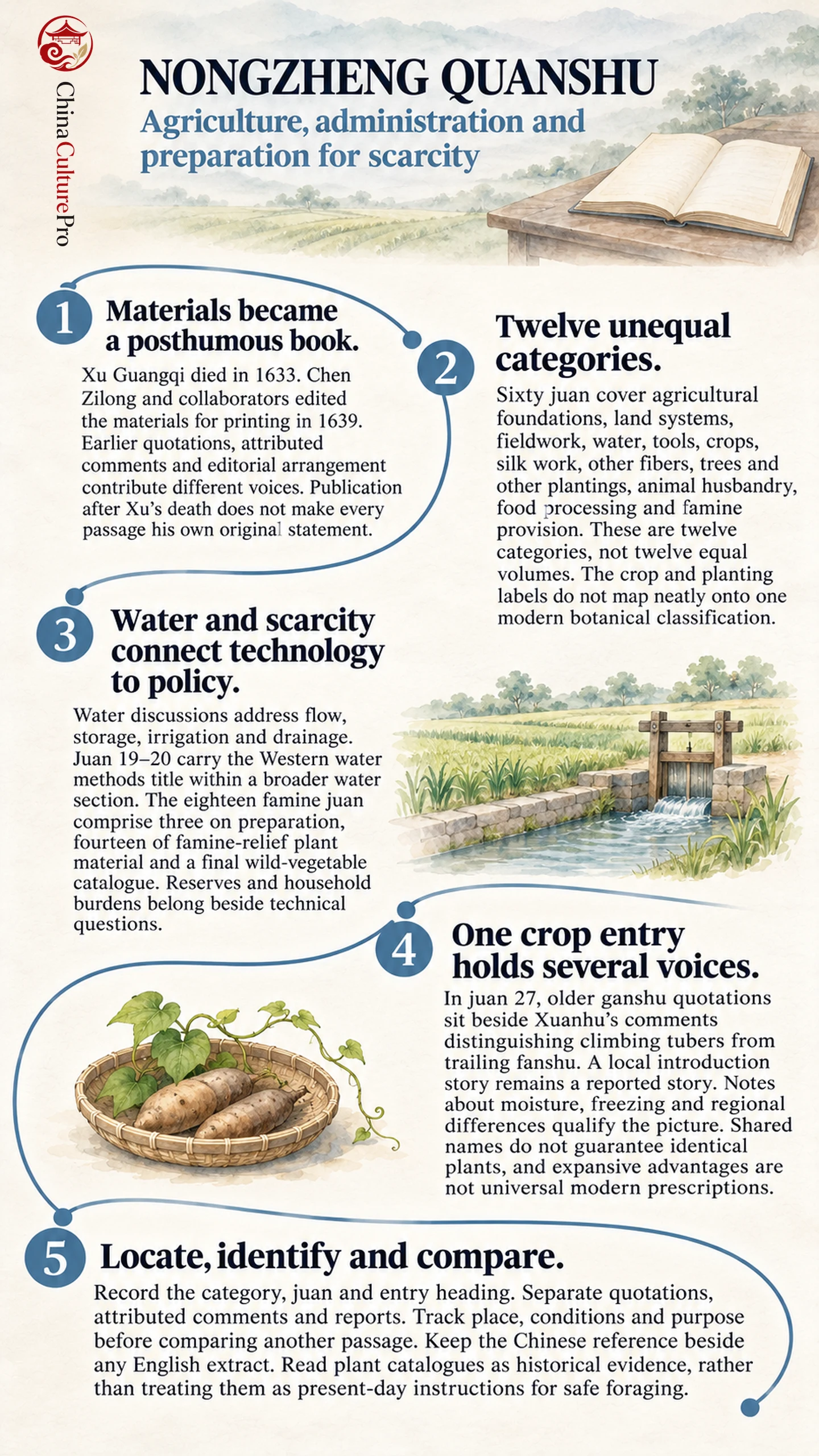
The Nongzheng Quanshu connects growing food with managing water, organizing resources and preparing for shortages. Its scale can seem daunting. A map of the categories and one carefully chosen crop entry reveal how practical observations sit within a larger concern for livelihoods.
Xu Guangqi’s Materials and the Posthumous Edition
Xu Guangqi (1562–1633) combined agricultural trials with collecting earlier writings. After his death, Chen Zilong (陈子龙, Chén Zǐlóng) and collaborators edited the materials for printing in 1639. Distinguish that posthumous edition from Xu’s unfinished work.[1]
Compilation is central to the reading task. An older source quoted inside an entry, a comment attributed to Xu and the arrangement of the printed collection are different kinds of contribution. The book preserves them together without turning every sentence into an original statement by its principal compiler.
Twelve Categories Across Sixty Juan
The categories are unequal in length. Use their names and juan ranges to locate a topic:[2]
| 類別 | Juan | Main subjects |
|---|---|---|
| Nongben (农本, nóngběn) | 1–3 | Farming’s foundations and public importance. |
| Tianzhi (田制, tiánzhì) | 4–5 | Land systems. |
| Nongshi (农事, nóngshì) | 6–11 | Fieldwork, reclamation, timing and signs. |
| Shuili (水利, shuǐlì) | 12–20 | Water management and related devices. |
| Nongqi (农器, nóngqì) | 21–24 | Agricultural tools and illustrations. |
| Shuyi (树艺, shùyì) | 25–30 | Grains, gourds, vegetables and fruits. |
| Cansang (蚕桑, cánsāng) | 31–34 | Silkworms, mulberries and silk work. |
| Cansang Guanglei (蚕桑广类, cánsāng guǎnglèi) | 35–36 | Other fibers, including cotton and hemp. |
| Zhongzhi (种植, zhòngzhí) | 37–40 | Trees and other plantings, including tea and dyes. |
| Muyang (牧养, mùyǎng) | 41 | Animal husbandry, with fish and bees among the subjects. |
| Zhizao (制造, zhìzào) | 42 | Food preparation and related processing. |
| Huangzheng (荒政, huāngzhèng) | 43–60 | Preparation for scarcity and famine-related material. |
The names reflect the collection’s own organization. In particular, Shuyi is a broad crop section, while Zhongzhi includes trees and miscellaneous plantings. Neither should be forced into a single modern botanical category. Sixty juan also need not be bound as sixty separate books.
Water Management and Preparation for Scarcity
The water section opens with an argument for preserving the relation between flowing rivers and water-storing lakes or wetlands. It criticizes sacrificing that capacity for narrow gains in land. Water management concerns drainage and storage as well as supplying fields; reclaiming every wet area is not presented as an uncomplicated benefit.[3]
Within the water category, juan 19–20 carry the Taixi Shuifa (泰西水法, Tàixī Shuǐfǎ), or Western water methods. The opening discusses a lifting device through its possible uses in irrigation and drainage. This strand sits within a wider collection of regional discussions and devices; it should not be expanded into a claim that all nine water juan are one European-derived text.[2][4]
The famine category begins in juan 43 with older discussions linking reserves, productive livelihoods, taxation and the burdens already placed on households. Its eighteen juan are not eighteen volumes of policy alone: three concern preparation, fourteen organize famine-relief plant material and the last contains a wild-vegetable catalogue. That arrangement connects administration with emergency subsistence while requiring different reading methods for each.[2][6]
Reading the Sweet-Potato Entry as a Layered Text
The ganshu (甘薯, gānshǔ) entry in juan 27 is a useful small-scale example. Earlier quotations are followed by comments under Xuanhu (玄扈, Xuánhù), Xu’s literary name. Those comments distinguish older climbing tubers from a recently introduced trailing fanshu (番薯, fānshǔ). Shared names across quotations do not guarantee that every passage concerns the same plant.[5]
An introduction story is explicitly presented as something local people report. It should not become a secure identification of the first person to introduce the crop. Later comments also consider moisture, freezing and differences between northern and southern conditions. Read that attention to circumstances alongside the entry’s more expansive claims for the crop’s advantages.[5]
The value of this example lies in the layered evidence: inherited names, attributed observations, transmitted stories and qualifications appear together. Separating them produces a more useful history of agricultural knowledge than treating the whole entry as either one firsthand experiment or a universally reliable planting prescription.
How to Navigate and Compare the Work
- Locate the topic: Record the category, juan and entry heading; distinguish the work’s textual divisions from a modern edition’s bindings.
- Identify the voice: Mark each named quotation, attributed comment and report before summarizing what the entry claims.
- Track conditions and compare: Note place, climate and purpose, then compare another entry or source without turning a local observation into a universal rule.
For comparative reading, choose a shared crop, tool or process in the Qimin Yaoshu (齐民要术, Qímín Yàoshù) or Tiangong Kaiwu (天工开物, Tiāngōng Kāiwù). Ask how the item is organized and attributed in each work. A broader history of Chinese agriculture can supply context, but it cannot replace the exact passage.
When using an English-language extract, retain the Chinese title and juan reference alongside the translator’s wording. An annotated edition is especially helpful for inherited plant names and source layers. This keeps interpretation tied to an identifiable text without assuming that a modern translation title describes its entire contents.
FAQs About the Nongzheng Quanshu
Does sixty juan mean sixty physical books?
No. Juan are textual divisions. The number of bound books depends on the edition and is a separate bibliographical question.
Did Xu Guangqi personally write every passage?
No. Earlier quotations, attributed comments and posthumous editing all contribute; the contents are not exclusively Xu’s original writing.
Can the famine-food sections be used as a modern foraging guide?
No. Historical common names, identifications and preparation claims need independent modern verification. The sections are evidence for past knowledge and emergency provision, not present-day plant-safety instructions.
資料來源
[1] Institute for the History of Natural Sciences, Chinese Academy of Sciences. Nongzheng Quanshu: compilation, publication and agricultural administration
[2] Public-domain Chinese text and later catalogue notice. Nongzheng Quanshu: catalogue notice and contents
[3] Public-domain Chinese text. Nongzheng Quanshu, juan 12: water management
[4] Public-domain Chinese text. Nongzheng Quanshu, juan 19: Taixi Shuifa I
[5] Public-domain Chinese text. Nongzheng Quanshu, juan 27: the ganshu entry
[6] Public-domain Chinese text. Nongzheng Quanshu, juan 43: preparing for famine