


Quick Answer: What Is the Difference Between Nephrite and Jadeite?
Nephrite (软玉, ruǎnyù) and jadeite (硬玉, yìngyù) are the two materials most commonly meant by jade. Nephrite consists mainly of interwoven amphibole fibers. Jadeite is a pyroxene mineral, and jadeite jade typically consists of intergrown grains. Both can be green or pale, so color alone does not separate them. [1][2][3]
- Hardness and toughness measure different things. Jadeite is generally harder on the Mohs scale. Nephrite’s interwoven structure gives it exceptional resistance to breakage. [2][3]
- Nephrite has a long history in China. It appears in Neolithic objects and in later carvings, including Qing pieces. [4][5][6]
- Jadeite became important in Qing China. Carvers could use different colors within the same piece, as the Jadeite Cabbage shows. [5][7][8]
Read the material on the label separately from its color and the date of the carving.
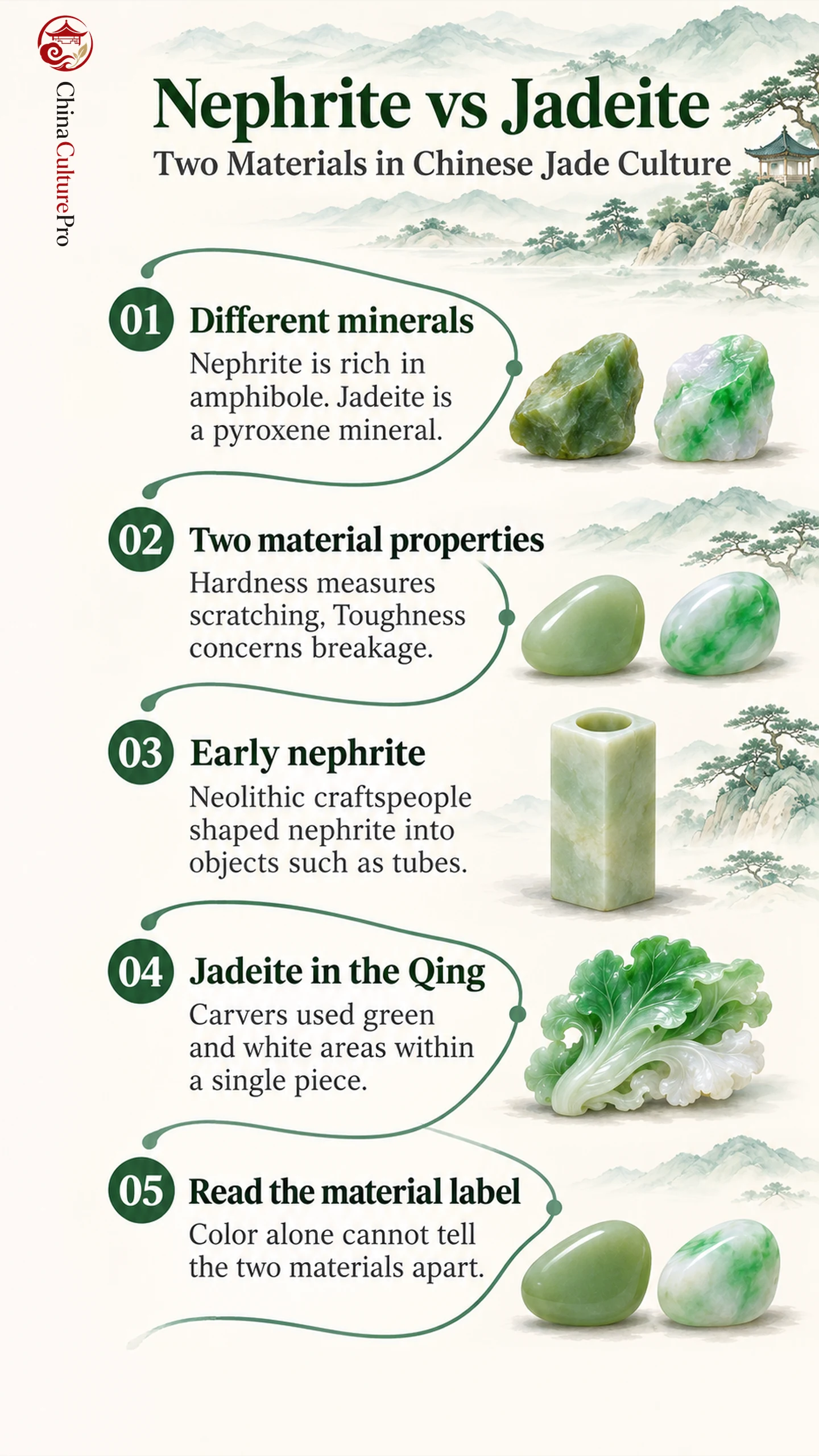
A pale carved tube and a green-and-white cabbage can both appear under the word jade in a museum. Their materials and dates help explain very different choices about shape, finish and color.
The Mineral Difference
Nephrite is a rock made up mainly of tightly interwoven amphibole, commonly minerals in the tremolite–actinolite series. Jadeite is a distinct mineral in the pyroxene family. A piece of jadeite jade is usually an aggregate, with many small intergrown grains rather than a single large crystal. The names describe the stone’s composition and structure. [1][3]
Chinese words and museum labels can use the broad name jade without specifying a mineral. The label may describe a historical category, a curatorial identification, or both. Gemological usage most often distinguishes nephrite and jadeite jade. The Gemological Institute of America also allows some green omphacite under the broad term in particular circumstances. [1][3][5]
The Chinese term feicui (翡翠, fěicuì) often refers to jadeite jade, but its use varies. The Gemological Institute of America notes that the term can cover materials dominated by related pyroxenes in some Asian markets. A catalogue that names the material gives more specific information than a broad term used in an exhibition title or a traditional name. [1]
Color, Hardness and Toughness
| Property | 軟玉 | Jadeite jade |
|---|---|---|
| Mineral structure | Interwoven amphibole fibers | Mainly intergrown pyroxene grains |
| Typical Mohs hardness | 6–6.5 | 6.5–7 |
| Toughness | Exceptional resistance to breakage from the interlocking fibers | Also notably tough |
| 顏色 | Can be pale or green, among other colors | Can be pale or green, with other colors such as lavender also found |
Hardness concerns resistance to scratching. Toughness concerns resistance to breaking or chipping. One material can have a lower hardness and still resist breakage very well. The word soft in the Chinese name for nephrite is relative. Nephrite still reaches 6 to 6.5 on the Mohs scale and can take a polished finish. [1][2][3]
Color variation within one piece is another clue about what a carver had available. It might help explain why a leaf or fold was placed in one area. It cannot determine the mineral on its own. [1][3][8]
Nephrite and China’s Early Jade Traditions
Nephrite appears in a long record of jade in Chinese culture. One object at the National Museum of Asian Art is a late Neolithic tube called a cong (琮, cóng), dated about 2250–1900 BCE and attributed tentatively to the Qijia culture. Its angular exterior surrounds a round bore. The material is identified as nephrite. [4][5]
Similar forms turn up in burials, including Liangzhu tombs. Their context establishes that they could be placed with the dead. The exact meaning and use of the forms remain open to interpretation. A known material and a documented archaeological setting answer different questions from a symbolic explanation. [4][5]
Nephrite remained important long after the Neolithic period. The Met catalogues an eighteenth-century Qing incense burner with cover as nephrite. Comparing it with an earlier tube shows how the same material label can appear on objects with very different shapes and dates. [4][6]
Jadeite in Qing China
The National Palace Museum connects an expansion in Qing jade work with access to Khotan nephrite and the arrival of jadeite from Myanmar. The two materials were available in the same broad period, as the surviving Qing objects show. [5][6]
The museum’s Jadeite Cabbage is a Qing carving that makes use of the stone’s varying color. Green areas became leaves and paler parts became the stalks. The carver also incorporated mottling and natural irregularities into the texture. The pattern of green and white could guide the composition before the first leaf was shaped. The white and green parts belong to the same carving. Compare that use of color with the covered incense burner, where the body and lid create a different way of appreciating the stone. The object names tell you about form and use, and the material field identifies which kind of jade is present. [7][8]
What an Object Label Can Tell You
A label may separate the material, date and place of manufacture. Read each field on its own. Nephrite or jadeite identifies what the object is made of. Qing identifies the period assigned to a carving. Green or white describes the appearance of the piece or part of it. Gemological testing can add evidence when visual properties overlap. For instance, Raman spectroscopy can separate jadeite from certain green omphacite with a similar appearance. [1][3][5][6]
The same visual words can appear outside jade. A museum might describe the surface of Chinese celadon as jade-like. In that case the effect comes from a fired glaze. The phrase describes its sheen and color, while the ceramic body is identified separately. [9]
FAQs About Nephrite and Jadeite
Can color tell nephrite and jadeite apart?
Both can be green or pale, and other colors also occur. Color can describe the stone and the carver’s choices, but material identification needs other evidence. [1][3]
Which jade was used in early China?
Nephrite is documented in Neolithic Chinese objects, including carved tubes. The term jade in a historical label may cover more than one kind of material. [4][5]
Did jadeite replace nephrite in the Qing dynasty?
Qing carvers used both. The Met’s covered incense burner is catalogued as nephrite, while the National Palace Museum’s cabbage is jadeite. [5][7][6]
資料來源
[1] Gemological Institute of America. Jade Description
[2] Gemological Institute of America. Jade Care and Cleaning Guide
[3] Jill M. Hobbs, Gems & Gemology. The Jade Enigma
[4] National Museum of Asian Art. Tube (Cong)
[5] National Palace Museum. Art in Quest of Heaven and Truth
[6] The Metropolitan Museum of Art. Incense Burner with Cover
[7] National Palace Museum. Jadeite Cabbage
[8] National Palace Museum. Jadeite Cabbage Exhibition Note
[9] National Museum of Asian Art. Acquisition: Four Chinese Celadon Ceramics