


Quick Answer: What Are Nantong Whistling Kites?
A Nantong banyao kite (南通板鹞风筝, Nántōng bǎnyào fēngzheng) is a flat kite from Nantong, Jiangsu. The painted surface carries wind-driven whistles called shàokǒu (哨口). A six-cornered frame is common, and larger designs can join several units. [1][3]
- Frame: A flat framework supports the painted covering and rows of whistles.
- Whistles: Tube and rounded chambers can give different sounds.
- Flight: Air moving over the whistle openings makes the kite audible from below. [1][2][3]
The number, placement and design of the whistles vary with the kite.
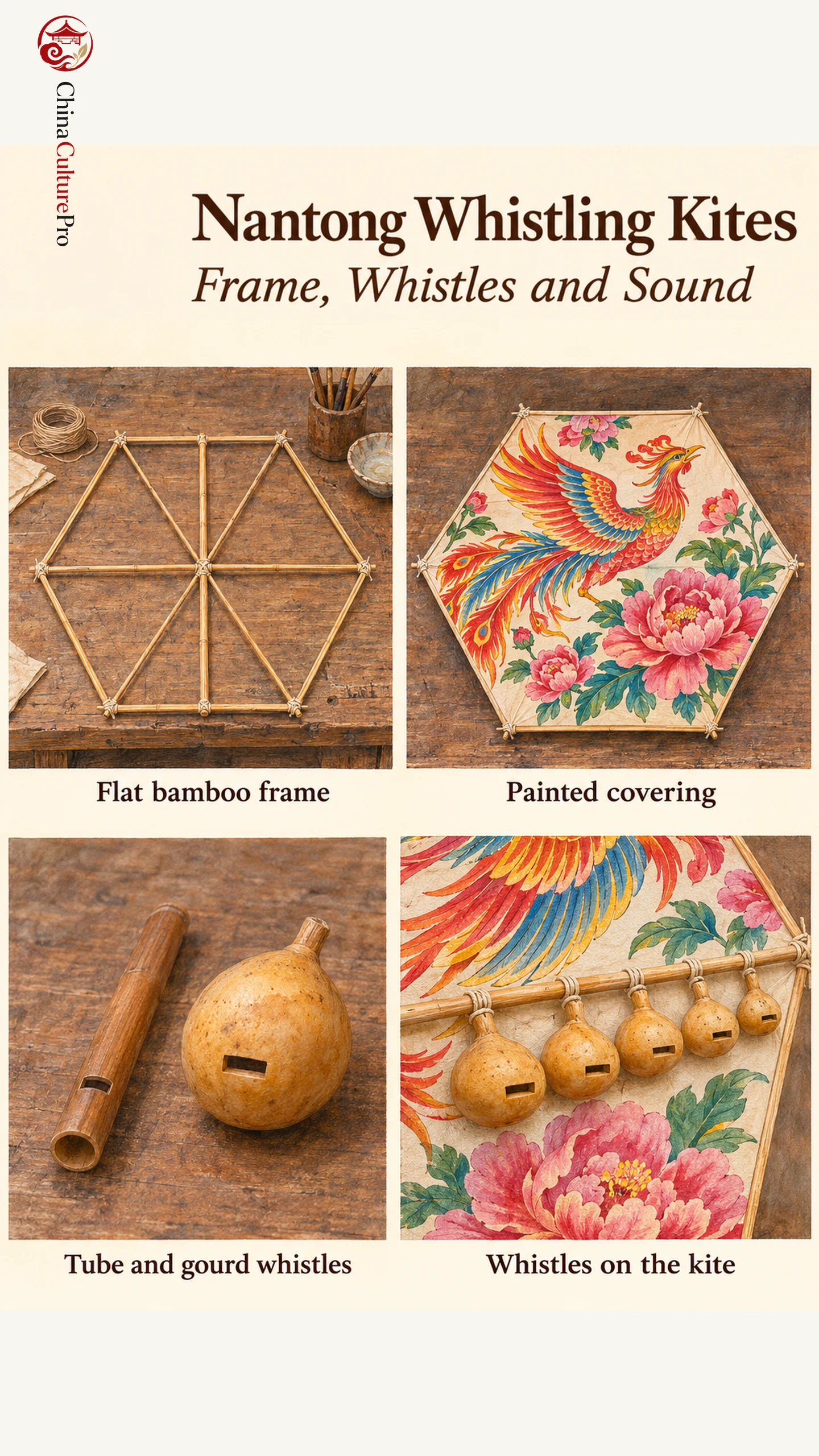
On a workshop wall, a banyao looks like a flat painting dotted with small attachments. In the air, the same attachments can produce a mixture of low and high notes. A well-planned row of whistles makes part of the pattern on the ground and part of the sound in the air.
A Flat Frame for Paint and Whistles
Banyao refers to the board-like form of the kite. Makers tie bamboo members together for a traditional frame and fit the kite’s covering across it. The national register describes square, rectangular and eight-cornered forms as well as the familiar six-cornered one. Repeated units can form linked arrangements with names such as Seven Stars. [1][3][7][8]
The covered frame gives the painter a surface for detailed figures and strong colors. The heritage inventory names subjects such as the Eight Immortals and a phoenix among peonies. Whistles are attached in groups or rows that share the face with the painting. The arrangement helps make the Nantong form recognizable among Chinese kites. [1][2][3]
How the Whistles Produce Different Sounds
A whistle has a shaped face with an opening and a hollow body. A carver can make the face from bamboo or wood. Some bodies are narrow tubes. Rounded versions can use a dried gourd, a fruit shell or a silkworm cocoon. As air passes the opening, it excites the air in the hollow chamber. [1][2]
Guo Chengyi, a Nantong kite maker, described judging the proportions of the opening and its edges. Size, shape and material can change the pitch, volume and tone. A large array can combine low, middle and high sounds, with the mix shifting as the wind changes. [1][2][3][7]
What Two Modern Kites Show
A three-meter anniversary piece shown at Nantong Kite Museum in 2025 combines seven hexagonal units, blue dragon imagery and 180 whistles. The museum account describes a folding carbon-fiber construction. It applies the linked-hexagon idea in a modern frame material. [4]
At the 2026 Rudong Kite Festival, maker Liu Jianfeng presented a different design. At 127 centimeters tall, Liu’s kite was smaller than the anniversary piece. Its face was divided into 331 tiny hexagons, each painted with a face, and the assembly carried 777 whistles. [4][5]
How Nantong Makers Pass On the Craft
Nantong Kite Museum reopened in September 2025 with a listening room that lets visitors compare high, middle and low whistle pitches. The buttons isolate the three pitch ranges. In flight, multiple whistles can sound together as the wind moves across the kite. [3][4]
Guo Chengyi led the teaching team for a Nantong University training course in 2026. Its closing exhibition brought together 50 kite works by participants. The exhibition brought together the traditional construction skills and new decisions about what to paint and how to arrange the parts. [6]
FAQs About Nantong Whistling Kites
Is every Nantong banyao kite a single hexagon?
A six-cornered frame is common. The register also describes other outlines and compound forms made by joining multiple units. [1][3]
What makes a Nantong kite whistle in flight?
Air passes over the shaped openings of the whistles attached to the kite. The forms and sizes of their chambers help produce different pitches and tones. [1][2][3]
When was Nantong banyao kite making nationally listed?
Nantong banyao kite making entered China’s first national intangible cultural heritage list in 2006. The register names Nantong’s municipal cultural center as the safeguarding institution. [1]
資料來源
[1] China Intangible Cultural Heritage Network. Kite Making: Nantong Banyao Kites
[2] Zhang Fenqin, Xinhua Daily via the China Intangible Cultural Heritage Network. The Sound of Nantong Banyao Kites
[3] Nantong Municipal Government. Nantong Banyao Kites
[4] Nantong Municipal Government. Nantong Kite Museum Reopens
[5] Nantong Municipal Government. Kites at the 25th Rudong Kite Festival
[6] Zhang Min, Nantong University School of Arts. Banyao Kite Making Course Exhibition
[7] Chinese Social Sciences Network. Nantong Kites
[8] Nantong Daily. Banyao Kite Making Demonstrations in Liuqiao