

Quick Answer: Who Was Meng Tian?
Meng Tian (蒙恬, Méng Tián) was a general of Qin Shi Huang (秦始皇, Qín Shǐhuáng). After Qin unified the rival states, Meng led a northern campaign and oversaw work on frontier fortifications.[1]
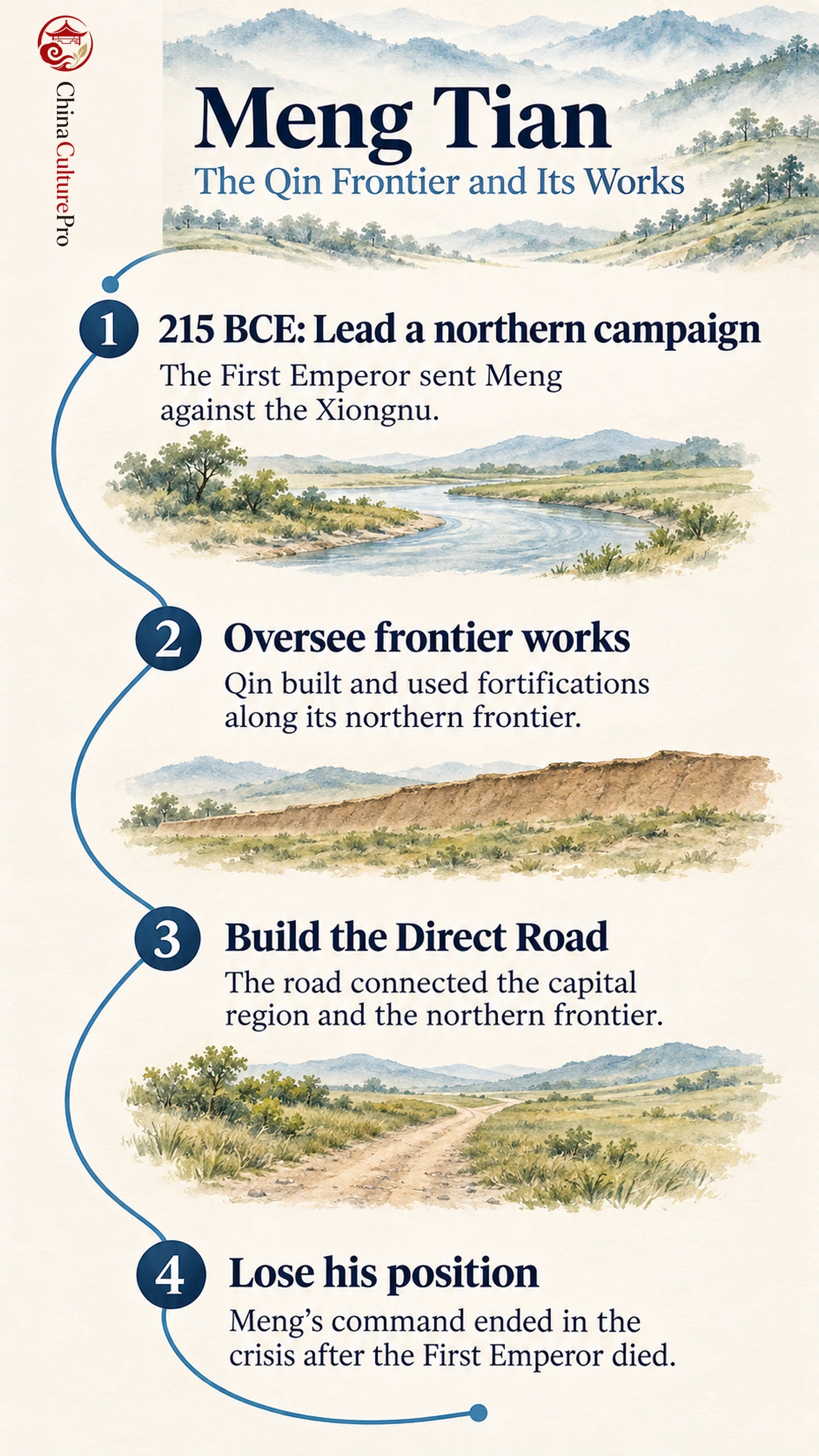
- Campaign: In 215 BCE, he led Qin forces north against the Xiongnu (匈奴, Xiōngnú).[3]
- Construction: He oversaw part of the early wall system. He also directed work on the Direct Road (直道, Zhídào).[1]
- Succession: Meng lost his position when the First Emperor died and a new ruler came to power.[2]
His work belongs to the early phases of Great Wall history. Different dynasties built or rebuilt sections over many centuries.[4]
A frontier wall and a road addressed different problems for the new Qin empire. Fortifications helped Qin hold new territory on the northern frontier. The road connected the capital region to the frontier. Both projects involved large demands on labor in the years after the conquests.
What Meng Tian Did on the Qin Frontier
The emperor sent Meng north several years after the founding of the Qin dynasty. The campaign brought Qin control to territory around the bend of the Yellow River. The imperial annals describe new administrative districts and fortifications after the advance.[2]
The work associated with Meng included new construction and the use of earlier defenses. Archaeological research distinguishes different stretches described in the historical records. The fortifications belonged to a network that changed as later dynasties built on other routes or reconstructed parts of the frontier.[3][4]
What We Know About the Direct Road
Sima Qian says the emperor ordered Meng to build a road between Jiuyuan (九原, Jiǔyuán) and Ganquan (甘泉, Gānquán). The project crossed difficult terrain and was unfinished when the First Emperor died.[1]
The endpoints are named in the texts, while the route between them remains debated. Historians and archaeologists have proposed different routes because the earliest sources give few details of the intervening ground.[5]
Sima Qian says he later traveled along the road. He uses his observations to criticize the demands the road and wall placed on people still recovering from the wars of unification.[1]
How the Qin Succession Ended Meng Tian’s Career
According to Sima Qian, the First Emperor’s death was concealed while Li Si and Zhao Gao backed the succession of Huhai (胡亥, Húhài). An order issued in the dead emperor’s name commanded his elder son Fusu (扶苏, Fúsū) and Meng to die. Fusu obeyed. Meng questioned the order and was imprisoned. The new government later compelled him to take his own life.[1]
FAQs About Meng Tian
Did Meng Tian Build the Great Wall?
He oversaw Qin frontier works, one part of the larger history of the Great Wall. The best-known masonry sections reflect later building, especially under the Ming.[4]
Did Meng Tian Invent the Writing Brush?
The invention is a legend. Archaeologists have found brushes from earlier in the Warring States period, before Meng’s time.[6]
When Did Meng Tian Die?
He died in the succession crisis following the First Emperor’s death in 210 BCE.[2]
資料來源
[1] Sima Qian. Records of the Grand Historian, Biography of Meng Tian
[2] Sima Qian. Records of the Grand Historian, Annals of the First Emperor
[3] Journal of East Asian Archaeology. The Archaeology of the Great Wall
[4] UNESCO World Heritage Centre. The Great Wall
[5] Charles Sanft. Debating the Route of the Qin Direct Road
[6] China Culture. Brushing Up a Legacy