


Quick Answer: Who Was Liu Yu?
Liu Yu (刘裕, Liú Yù, 363–422) was a general of the Eastern Jin (东晋, Dōng Jìn) who founded Liu Song (刘宋, Liú Sòng) in 420. He had exercised power at the Jin court for years before he became emperor.[1][2]
- Rise: He helped restore the Jin court after the takeover by Huan Xuan (桓玄, Huán Xuán).[2]
- Campaigns: He led northern expeditions against Southern Yan (南燕, Nán Yān) and Later Qin (后秦, Hòu Qín).[4]
- Reign: Known posthumously as Emperor Wu of Song (宋武帝, Sòng Wǔdì), Liu ruled from 420 to 422.[1]
The dynasty he founded was the first in the sequence known as the Southern Dynasties. Historians call it Liu Song to distinguish it from the much later Song dynasty.[5]
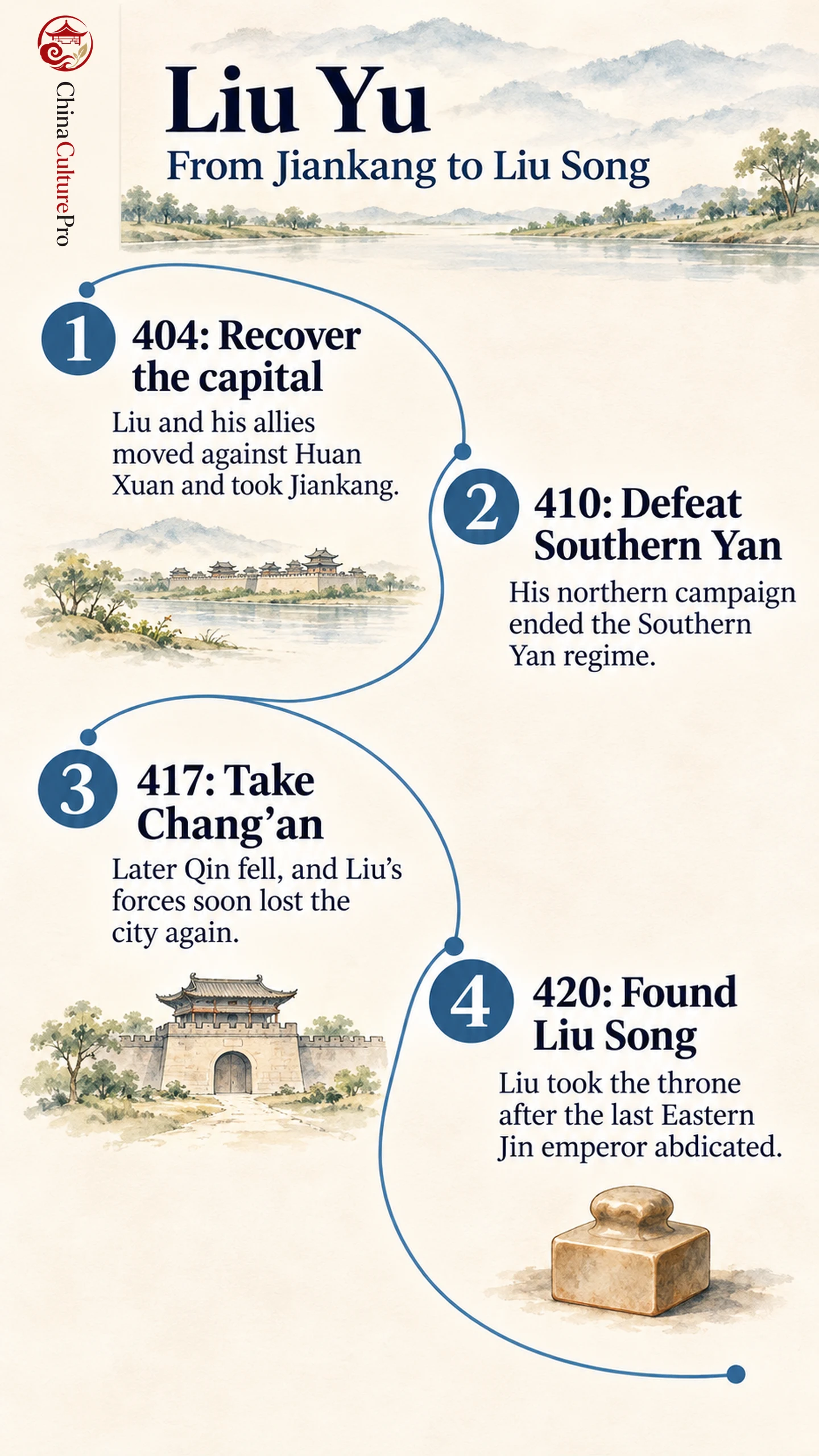
Liu Yu first rose by helping restore the ruling house that he later replaced. Sixteen years separate his move against Huan Xuan from his accession. During those years he became the effective ruler of the government still formally headed by a Jin emperor.
How Liu Yu Gained Power Under the Eastern Jin
The Book of Song describes Liu’s rise through military service. After Huan Xuan seized the throne, Liu and his allies moved against him in 404 and took control of the capital, Jiankang (建康, Jiànkāng). Fighting continued after Huan’s defeat, but the Eastern Jin emperor was ultimately restored.[2][4]
Liu had drawn important early support from the Northern Headquarters Troops, a force serving the Jin. Over time he brought other military leaders and influential families of the capital into his network. He could act as the government’s leading figure while a member of the Jin ruling house remained on the throne.[1]
What Liu Yu’s Northern Campaigns Achieved
In 409–410, Liu campaigned against Southern Yan in present-day Shandong and ended its rule. He later advanced into the territories of Later Qin. His forces took Luoyang in 416 and Chang’an in 417. The fall of Chang’an ended Later Qin.[4]
The two campaigns had different territorial results. Jiankang’s reach expanded, but Liu’s forces soon lost Chang’an. The northern victories strengthened his standing without reuniting the country under his rule.[4]
How Liu Yu Founded Liu Song in 420
In 420, Emperor Gong of Jin (晋恭帝, Jìn Gōngdì) formally abdicated in Liu’s favor. This ended Eastern Jin and brought Liu to the throne at Jiankang. The Book of Song preserves a formal decree that praises Liu for restoring the Jin and uses earlier transfers of power to justify his accession.[3]
The decree also appeals to signs from Heaven. This language shows how the new court presented a change of ruling house through ideas of political legitimacy associated with the Mandate of Heaven.[3]
FAQs About Liu Yu
How Long Did Liu Yu Reign?
Liu ruled as emperor for about two years, from 420 to 422. His influence over the government at Jiankang began much earlier.[1]
Was Liu Song the Same as the Later Song Dynasty?
Liu Song was a southern dynasty that lasted from 420 to 479. The prefix Liu identifies the ruling family and distinguishes it from the later Song.[5]
Where Was Liu Yu’s Capital?
Liu ruled from Jiankang, the former Eastern Jin capital. Its site is in present-day Nanjing.[6]
資料來源
[1] Andrew Chittick. The Southern Dynasties, The Cambridge History of China
[2] Shen Yue. Book of Song, Annals of Emperor Wu, Part One
[3] Shen Yue. Book of Song, Annals of Emperor Wu, Part Two
[4] The Cambridge History of China. The Six Dynasties, Eastern Jin Historical Narrative
[5] Metropolitan Museum of Art. Six Dynasties Chronology
[6] China Culture. Eastern Jin