


Quick Answer: Who Was Li Guang?
Li Guang (李广, Lǐ Guǎng) commanded troops and governed frontier districts under the Han dynasty. Sima Qian says that the Xiongnu (匈奴, Xiōngnú) knew him as the Flying General (飞将军, Fēi Jiāngjūn).[1]
- Reputation: The early biographies describe an expert mounted archer.[2]
- Military record: He fought in repeated frontier campaigns, and his final assignment came in 119 BCE.[3]
- Literary legacy: His story of shooting into a stone has a close parallel in a Tang frontier poem.[1][4]
His reputation outlasted a military career that included defeats and no marquisate.[1]
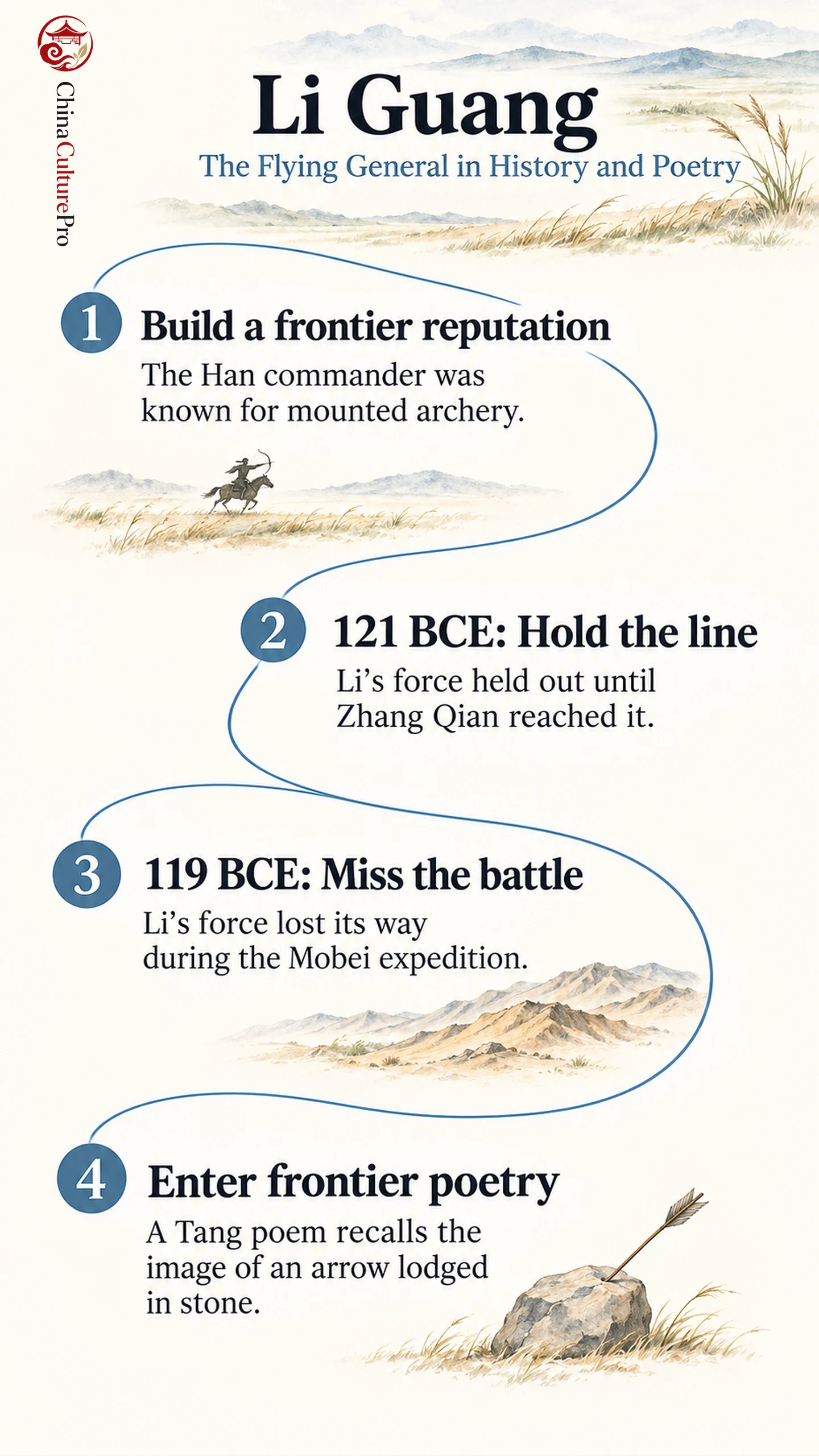
Li Guang was a commander soldiers wanted to follow. That reputation could help him hold a force together under pressure. Military awards depended on other measures, and the court still held a celebrated officer to account when a campaign failed.
How Li Guang Built a Frontier Reputation
Li first served under Emperor Wen. His mounted archery brought him to the court’s attention, and he went on to hold a series of frontier posts.[2]
Sima Qian contrasts Li with Cheng Bushi, who insisted on formal ranks, camp routines and careful records. Li used scouts but allowed his men more freedom in camp. Sima Qian says he shared rewards and waited for the troops to eat and drink first.[1]
Earlier, a defeat near Yanmen had shown how the court could treat a failed command. The Book of Han says Li was captured and escaped, but the court still sentenced him for his losses and capture. He paid to commute the sentence and was reduced to commoner status before returning to service.[2]
What Happened in His Last Two Campaigns
In 121 BCE, when Huo Qubing campaigned farther west, Li led cavalry out of Youbeiping (右北平, Yòuběipíng). A Xiongnu force surrounded him. He held out until Zhang Qian (张骞, Zhāng Qiān) reached him, but his force suffered heavy losses.[3]
Sima Qian describes Li forming a circle with his soldiers facing outward and keeping his composure as their arrows ran low. Li brought back the surviving troops without an award for the campaign.[1]
In 119 BCE, during the Mobei (漠北, Mòběi) expedition under Emperor Wu of Han, Wei Qing (卫青, Wèi Qīng) ordered Li to take a more circuitous route. His army lost its way and missed the main engagement. Wei Qing’s staff asked him to account for the delay before the report went to the emperor. Li took responsibility and died by suicide before the inquiry.[2]
How the Flying General Entered Poetry
Sima Qian tells of Li aiming at a stone he took for a tiger. The arrowhead sank in, but he could not repeat the feat once he knew what the object was.[1]
A Tang dynasty poem by Lu Lun (卢纶, Lú Lún) gives a version of that scene. At night a general draws his bow after hearing the grass move. At dawn the arrow is found in stone. The poem leaves the general unnamed and puts the discovery in its final line.[4]
FAQs About Li Guang
Who called Li Guang the Flying General?
Sima Qian attributes the name to the Xiongnu while Li held the post at Youbeiping. Later Chinese usage can also apply the expression to a formidable general more broadly.[6]
Did Li Guang ever become a marquis?
Li held high military and administrative posts without receiving a marquisate. His biography contrasts his reputation with the formal rewards won by some other officers.[2]
Is Wang Changling’s Flying General definitely Li Guang?
Li Guang is a familiar reading, but scholars debate whether Wang Changling (王昌龄, Wáng Chānglíng) meant one specific commander. Ming Yang reads the phrase as a more general image of a frontier general.[5]
資料來源
[1] Sima Qian. Records of the Grand Historian, Biography of General Li
[2] Ban Gu and others. Book of Han, Biographies of Li Guang and Su Jian
[3] Sima Qian. Records of the Grand Historian, Wei Qing and Huo Qubing
[4] Lu Lun. Frontier Song, On a Dark Night the Wind Stirs the Grass
[5] Ming Yang. The Flying General of Dragon City and Place Names in Classical Poetry
[6] Ministry of Education, Taiwan. Flying General