
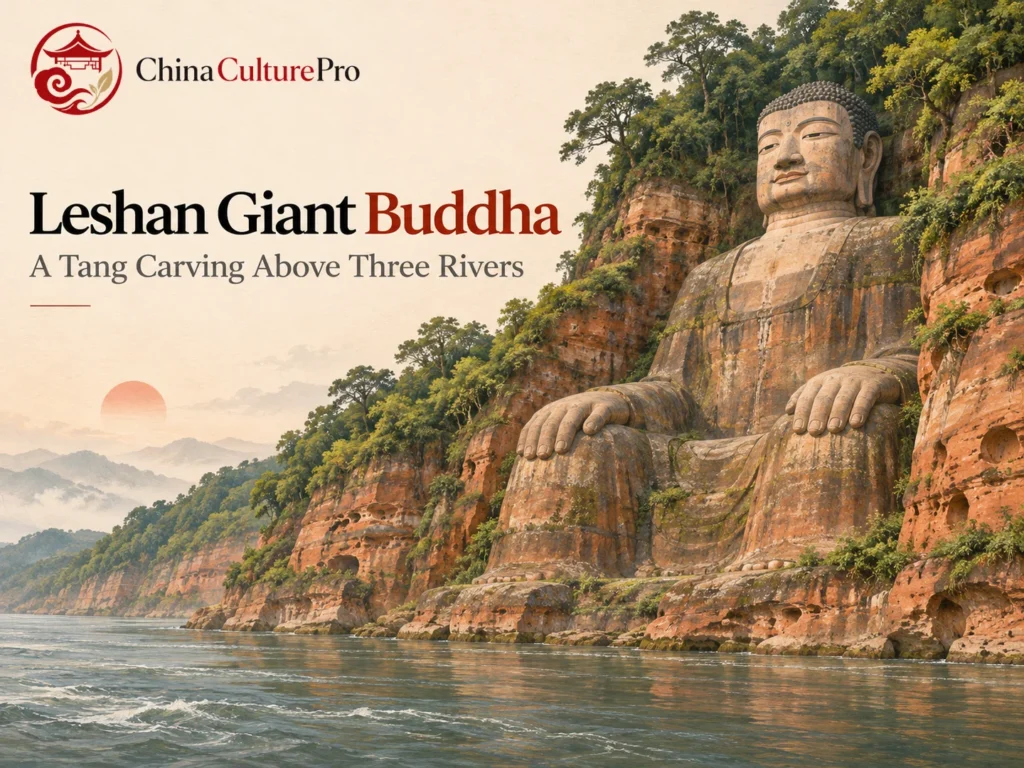

Quick Answer: What Is the Leshan Giant Buddha?
The Leshan Giant Buddha (乐山大佛, Lèshān Dàfó) is a seated stone image of Maitreya (弥勒佛, Mílè Fó) carved into a cliff in Sichuan. It stands about 71 meters high above the meeting of the Min, Dadu and Qingyi rivers. The work began in 713 and was completed in 803, during the Tang dynasty. [1][2][3]
- Sculpture: The body and its setting are read together because the statue was cut into the cliff. [1][2][3]
- Religious meaning: The sculptural tradition associates its commission with the monk Haitong and concern for people crossing turbulent waters. [4]
- Heritage: UNESCO inscribed the Leshan area with Mount Emei in one mixed cultural and natural World Heritage property in 1996. [1]
The monument is a Buddhist image in a transport landscape. Those two histories help explain its placement.

Facing the cliff from the river side, the shoulders and head pull your attention up the rock. The position also invites a question: why put a Buddha in view of traffic at this particular meeting of waters?
Three Ways to Read the Leshan Giant Buddha
| 比較項目 | What survives | 它告訴你甚麼 |
|---|---|---|
| Seated figure | A large Tang cliff carving of Maitreya. [1][2][3] | A figure and pose can be recognizable at the scale of a river bank. [2][3] |
| Confluence | The Min, Dadu and Qingyi rivers come together in the Leshan setting. [3] | The cliff and water formed part of the setting the sponsors chose. [1][3][4] |
| Rock and exposure | The monument is open to moisture and weathering. [3] | Water and the qualities of the stone still shape conservation. [3] |
How a Tang Image Took Shape in the Cliff
Work on the statue spanned decades. Its scale required treating the profile of a hillside as part of the sculpture. The upper body, hands and lower figure remained tied to the rock mass. Comparing this single monumental figure with Longmen Buddhist sculpture shows how cliff carving can organize a different kind of visual encounter at different sites. [1][2][3]
The cliff and open-air conditions continue to matter. A conservation study describes rock weathering in the humid river environment. Appearance is evidence of both carving and the changes that followed, so a freshly colored rendering cannot represent every surviving surface. [3]
Why the River Belongs in the Story
The story associated with Haitong links the project to dangers at the confluence. The story records a wish to protect travelers and calm dangerous water. It belongs to the history of religious meaning, rather than to a measured claim about river flow. From the position of a traveler or devotee, the river made the image part of a landscape used for transport and worship. The location tells us why the carving commands a face of rock that people could encounter from the water. [1][3][4]
Leshan is part of the history of Chinese sacred mountains through its connection with Mount Emei’s Buddhist landscape. It is a distinct place within the shared property. At Mount Qingcheng, by contrast, Daoist compounds are placed at different heights on a wooded mountain. [1][5]
FAQs About the Leshan Giant Buddha
Which Buddha does the sculpture depict?
It depicts Maitreya, the Buddha associated in Buddhist traditions with the future. The figure is shown seated. [2][3]
How long did it take to carve?
The dates commonly given are 713 to 803 CE, a span of about 90 years in the Tang dynasty. [2][3][4]
Is Leshan Giant Buddha on Mount Emei?
The two areas are geographically distinct. Their names appear together in one UNESCO World Heritage property. [1]
資料來源
[1] UNESCO World Heritage Centre. Mount Emei Scenic Area Including Leshan Giant Buddha
[2] Smarthistory. Giant Buddha of Leshan
[3] Heritage Science. Weathering of Large Open-Air Stone Relics at Leshan Giant Buddha
[4] Visit Beijing. Leshan Giant Buddha
[5] UNESCO World Heritage Centre. Mount Qingcheng and the Dujiangyan Irrigation System