
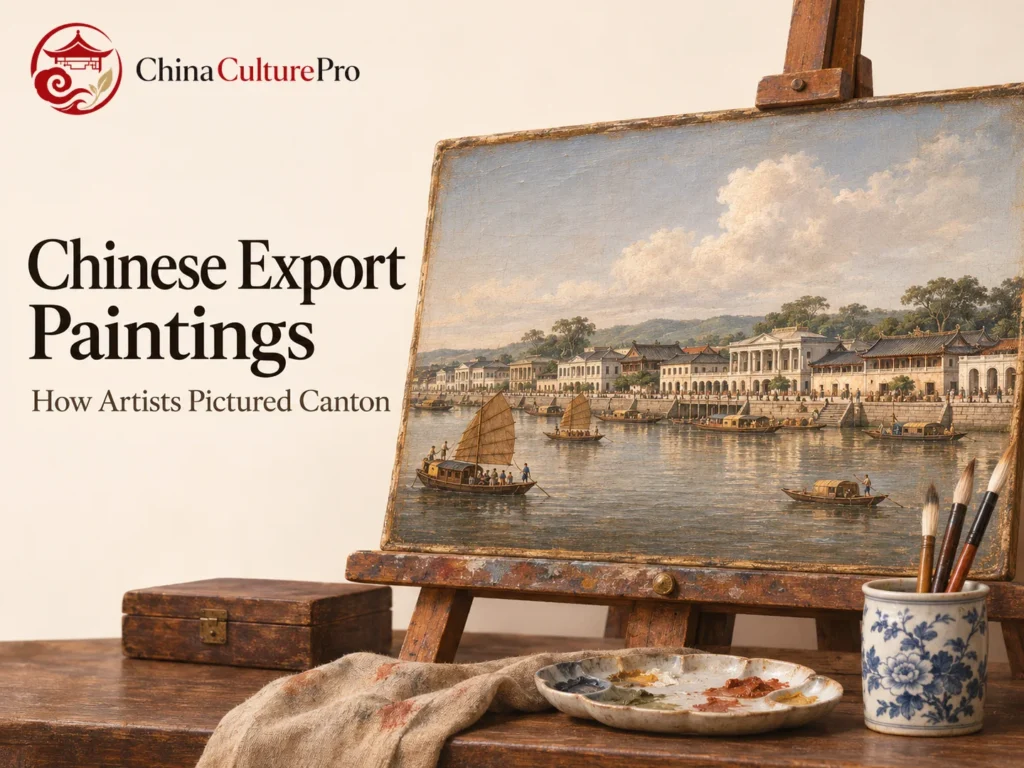

Quick Answer: What Are Chinese Export Paintings?
Chinese export paintings were made principally for overseas customers. At Canton, now Guangzhou, artists pictured the foreign trading compounds, boats and commodities that visitors knew from the Pearl River. Surviving works range from broad oil paintings on canvas to small paintings in gouache on pith.[1][2][3][4]
- Waterfront views: Buildings and flags locate foreign trading houses in the port.[1][4]
- Boat studies: A smaller picture can isolate a hull and its rigging for close inspection.[2]
- Reading clues: Medium, maker, ownership history and the painted scene can tell you different things about the same object.[4][5][6]
Read the image alongside its collection record. A flag may help date the view, while the object number identifies the work you are actually looking at.[4][6]
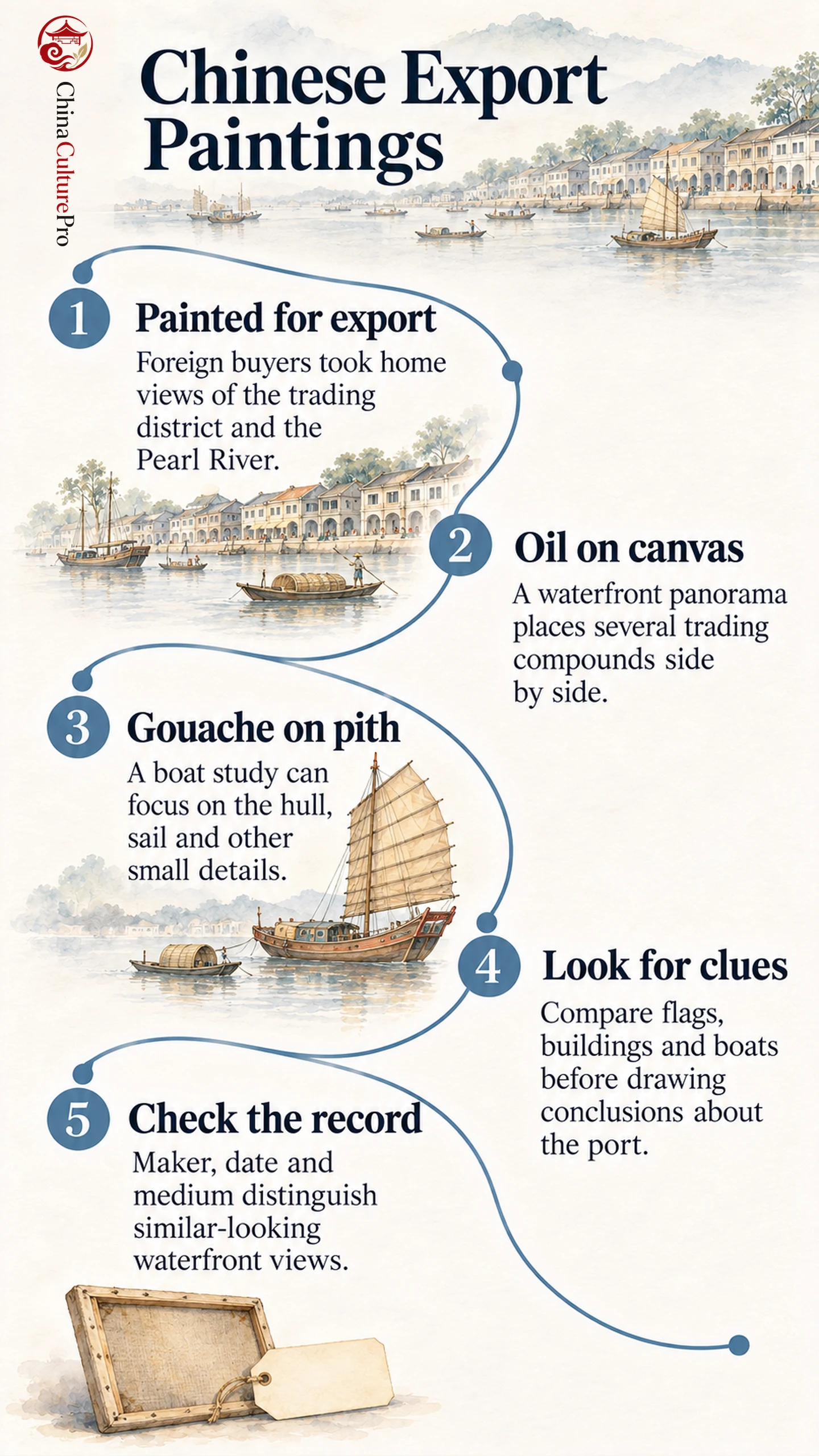
A flagpole in a Canton painting can identify a trading house. A smaller boat in the foreground can show how the port moved goods. Together they make a harbor scene worth reading closely.[4][6]
Why Canton Workshops Painted for Foreign Buyers
Overseas merchants conducted business from a narrow stretch of riverfront. Their factories were trading compounds containing offices, storage and living space. Paintings could give a merchant a recognisable view of the place where the business operated. A Philadelphia museum example made before 1803 descended in the family of merchant Anthony Morris Buckley, though how he acquired it remains uncertain.[4]
The waterfront also appeared on Chinese export porcelain. An oil painting spreads the view across a flat surface. A punch bowl wraps the scene around a vessel. For the later changes in where foreigners could trade and reside, see treaty ports and cultural exchange.[3][4][6]
Compare a Waterfront Oil and a Pith Painting
| Collection object | Medium and view |
|---|---|
| View of Foreign Factories, Canton, M3793 | An oil on canvas dated 1825–1835 and attributed to Lam Qua. Its broad scene puts the trading compounds together along a shared waterfront.[1] |
| Chinese junk and a sampan, PAJ0244 | A nineteenth-century Chinese School gouache on pith. The study brings two individual boats into focus.[2] |
Pith is cut from the inner tissue of a plant stem. Opaque gouache gives a boat’s painted surfaces a different appearance from oil on canvas. In a Scottish collection, several documented export paintings made on pith at Guangzhou are now too brittle to handle easily. When comparing reproductions, record the scale, medium and accession number before saving the image. The guide to finding and citing Chinese museum objects gives a reusable citation format.[1][2][3]
What Flags and Boats Can Tell You
In the Philadelphia painting, an American flag is prominent near the center. Below it, a Chinese junk carries an eagle on its stern. The prominence of those features suggests how a waterfront panorama could speak to a particular buyer. The boat also points to the local vessels that ferried cargo to and from ocean-going ships anchored farther downriver at Whampoa.[4]
Use flags with the buildings and the record of the object, including the maker. A comparable oil, ZBA1291, records the waterfront through the work of the British artist William Daniell. A shared subject can therefore appear in both Chinese export painting and a visiting European artist’s account.[5][6]
FAQs About Chinese Export Paintings
What were the Canton factories shown in these paintings?
The factories were compounds for overseas commercial agents, with rooms for trade, storage and accommodation. Their name used an older commercial sense of factory.[1][4]
Is pith paper ordinary paper?
Pith painting uses thin slices cut from the inner tissue of a plant stem. The material differs from paper manufactured from pulped fibers and can become brittle.[2][3]
Were all paintings of Canton made by Chinese artists?
European visitors painted the trade district as well. Check the cataloged maker and medium before treating two similar views as part of the same workshop tradition.[1][4][5]
資料來源
[1] MIT Visualizing Cultures, with Peabody Essex Museum. View of Foreign Factories, Canton, M3793
[2] Royal Museums Greenwich. Chinese junk and a sampan, PAJ0244
[3] National Museums Scotland. An introduction to the Chinese collection
[4] Philadelphia Museum of Art. The Factories of Canton, China, before 1803
[5] Royal Museums Greenwich. A View of the European Factories at Canton, ZBA1291
[6] Paul A. Van Dyke and Maria Kar-wing Mok. Images of the Canton Factories 1760–1822