
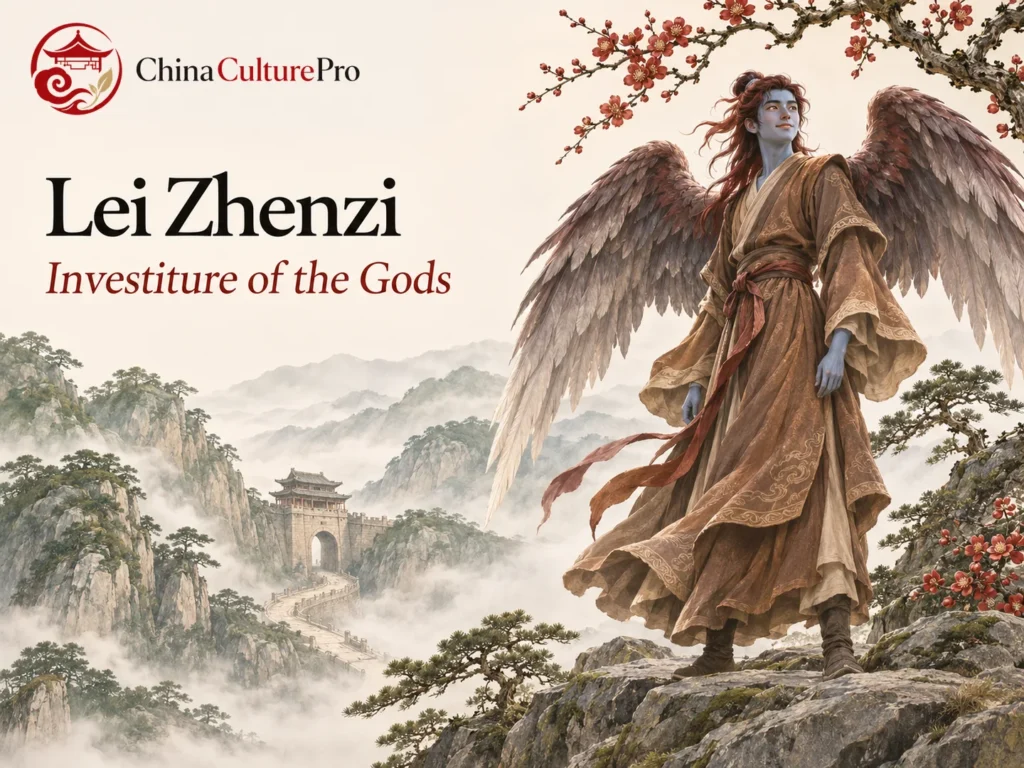

Quick Answer: Who Is Lei Zhenzi?
Lei Zhenzi (雷震子, Léi Zhènzǐ) is the winged adopted son of King Wen (周文王, Zhōu Wénwáng) in Investiture of the Gods (封神演义, Fēngshén Yǎnyì). An immortal raises him. After eating two supernatural apricots, he grows the wings that let him carry his father to safety.[1][2][3]
- King Wen adopts the infant after a thunderstorm.[1]
- His teacher calls his two wings wind and thunder.[2]
- The final chapter places him among seven figures who attain sacred status in their bodies.[5]
Thunder gives the character his name and an identifying sound. Other thunder figures have their own stories and attributes.[1][6][7]

When Lei Zhenzi comes to help his father, the two have been apart since his infancy. King Wen hears a voice before he recognizes the speaker. The novel uses the encounter to show how much the child has changed.
How Lei Zhenzi Becomes King Wen’s Son
In Chapter 10, King Wen’s party shelters from a storm. After the thunder, attendants hear a baby crying near a tomb and bring him to the ruler. King Wen accepts the child as his hundredth son. The immortal Yunzhongzi (云中子, Yúnzhōngzǐ) takes responsibility for raising him.[1]
The Apricots, the Wings and the Rescue
In Chapter 21, Yunzhongzi sends his pupil to help his father. On the mountain, Lei Zhenzi eats two red apricots. His appearance changes and he grows the wings of wind and thunder (风雷二翅, fēngléi èr chì). His teacher marks one wing as wind and the other as thunder, and they sound like a storm when he flies.[2]
King Wen is startled by the winged figure at Lintong Pass. Lei Zhenzi identifies himself by recalling the adoption. In the next chapter he carries his father to safety and then returns to his teacher. The flight fulfills the immediate duty that brought them together.[2][3]
Why Lei Zhenzi’s Ending Is Different
The war also includes a winged fighter named Xin Huan, who serves on Wen Zhong’s side. Chapter 43 places the two figures in the same scene. Wings and thunder alone therefore do not identify a figure even within this novel.[4]
Chapter 100 includes Lei Zhenzi, Nezha and five others among the figures who attain sacred status in their bodies. The ending describes their achievement separately from the previous chapter’s appointments of the dead.[5]
How to Read a Thunder God Image
Wang Chong’s Lunheng describes images of Lei Gong (雷公, Léi Gōng) with drums and a mallet. A work at the Asian Art Museum identifies its thunder deity by several drums above the head and a hammer and chisel in the hands. These details point to a different iconographic tradition from the novel’s story of an adopted child and two apricots.[6][7]
FAQs About Lei Zhenzi
Was Lei Zhenzi King Wen’s biological son?
In the novel, King Wen adopts him after attendants find him following a storm.[1]
How did Lei Zhenzi get his wings?
He eats two supernatural apricots on the mountain. His teacher gives the two wings their associations with wind and thunder.[2]
Is Lei Zhenzi the same as Lei Gong?
Lei Zhenzi’s adoption and rescue belong to the novel. The Thunder Lord identified by a set of drums has a distinct history in texts and art.[1][3][6][7]
資料來源
[1] Investiture of the Gods. Chapter 10, Chinese text
[2] Investiture of the Gods. Chapter 21, Chinese text
[3] Investiture of the Gods. Chapter 22, Chinese text
[4] Investiture of the Gods. Chapter 43, Chinese text
[5] Investiture of the Gods. Chapter 100, Chinese text
[6] Wang Chong. Lunheng, Discourse on Thunder
[7] Asian Art Museum. Thunder and rain gods, one of a pair