
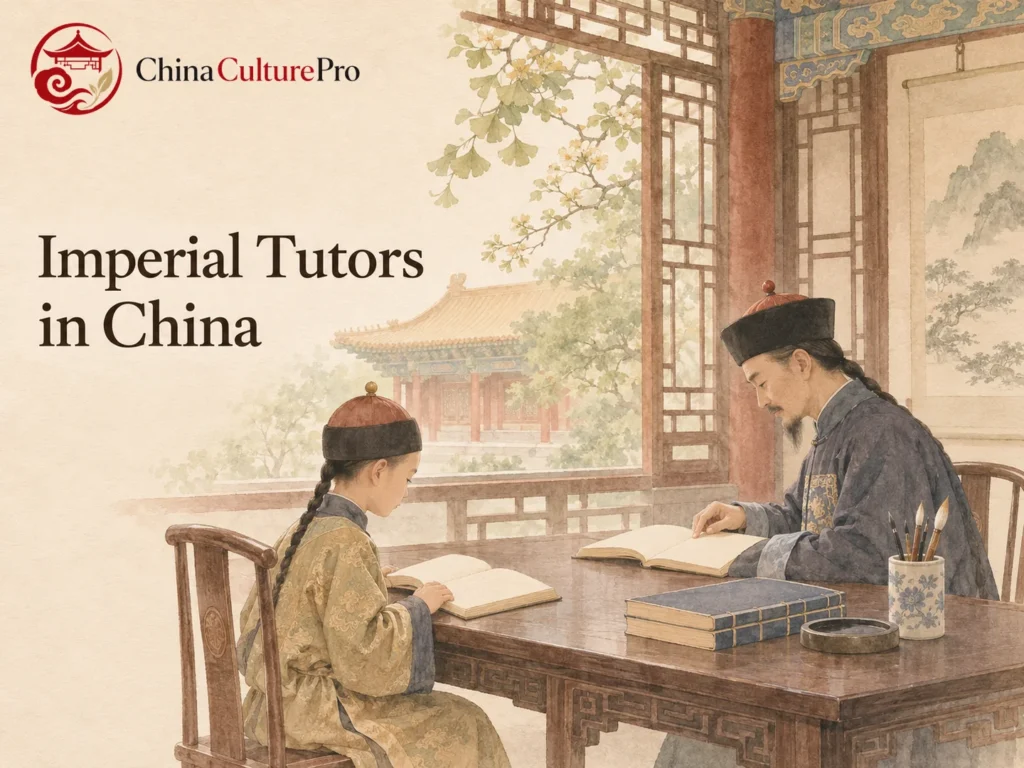

Quick Answer: Who Were Imperial Tutors in China?
Imperial tutors were officials and instructors appointed to teach members of the ruling family. Their assignments depended on whom they taught. The Ming supported its heir through institutions associated with the Eastern Palace (東宮, Dōnggōng). The Qing assigned tutors to princes and grandsons through arrangements that included the Imperial Study (上書房, Shàngshūfáng).[1][2][3]
- Ming heir: Court offices helped provide instruction, staff and books for the crown prince.[1]
- Qing princes: Instructors taught classical texts, languages and other skills, with different staff carrying different responsibilities.[2][3][4]
- Reigning emperor: Court scholars could also give lectures to an emperor as a separate assignment.[5][6]
An “imperial tutor” could therefore be a reader, teacher or supervisor. The expression covers several jobs in different institutions.[1][2][5]

A palace record may name the official who supervised lessons or the teacher who explained a book to a prince. A printed lecture for the emperor belongs to another setting. Each record reveals a different part of education at court.[1][2][5]
How the Ming Educated the Crown Prince
The Ming organized instruction for the heir through the Office of the Crown Prince’s Household (詹事府, Zhānshìfǔ) and related offices. The court arranged spaces for books and invited scholars to teach. The Palace Museum describes the early Ming Dabentang (大本堂, Dàběntáng) in the Eastern Palace. The court housed books there and invited scholars to teach the heir and other princes.[1]
This arrangement gave tutoring a place within the administration of the heir’s household. The household office, the two Spring Bureaus and the office that managed books supplied an institutional setting for instruction. A reference to an Eastern Palace office can therefore describe educational administration as well as teaching.[1][5]
Who Taught in the Qing Imperial Study?
Qing palace records distinguish tutors who taught particular subjects from officials who supervised the educational program. Some instructors came from the Hanlin Academy (翰林院, Hànlín Yuàn). Senior tutors could oversee instruction, while other teachers worked with princes and grandsons on readings or language skills.[2][3]
This structure helped coordinate a curriculum that included more than one kind of instruction. The Four Books (四書, Sìshū), Five Classics (五經, Wǔjīng) and dynastic history supported study of classical language and rulership. Manchu and Mongolian instruction had its own tutors. Archery was also part of training described for Qing princes. A description of one palace schedule should be read in its particular period.[2][3][4]
What Surviving Books Tell Us About Lessons
The palace printed the <em>Collected Works of the Hall for Delighting in Goodness</em> (樂善堂全集, Lèshàntáng Quánjí) in 1737. It collected the Qianlong emperor’s writing from his years as a prince. The prefaces include accounts by teachers and others associated with the royal household. One tutor’s preface names works including the <em>Book of Songs</em> (詩經, Shījīng) and <em>Records of the Grand Historian</em> (史記, Shǐjì). They give a historian evidence for a particular prince’s reading beyond a broad list of subjects.[3]
An official publication can preserve details about reading while presenting its subject as a diligent student. The account of the prince’s learning tells us which books his teachers valued. It does not describe the reading of every member of the imperial clan.[3]
How Lectures for the Emperor Differed
The Ming court held formal lectures called jingyan (經筵, jīngyán) for the emperor. Lecturers could explain passages from the classical books and historical examples. The Palace Museum also distinguishes rijiang (日講, rìjiǎng), regular lectures whose arrangements were less elaborate. These sessions put scholarship and interpretation before a reigning ruler.[5]
The Qing left records of its lecture activity as well. A Palace Museum collection holds a 1680 palace printing of an explanation of the <em>Book of Documents</em> associated with daily lectures. The volume is evidence of instruction prepared for the ruler. Other imperial court audiences could instead involve official reports or ceremonies.[5][6]
FAQs About Imperial Tutors in China
Did all imperial tutors come from the Hanlin Academy?
The Qing selected some readers and teachers from the Hanlin. Other roles included supervising education and teaching languages or skills. Staff varied with the court and assignment.[1][2][3][4]
Did Qing princes only study Confucian classics?
Classical texts and history were important. Instruction also included languages such as Manchu and Mongolian and training such as archery.[2][3][4]
Did having a tutor mean a prince was the heir?
Qing palace instruction could reach multiple princes and grandsons. An education record identifies a student’s instruction, while other evidence is needed to determine succession status.[2][3]
資料來源
[1] The Palace Museum. Office of the Crown Prince’s Household
[2] The Palace Museum. Tutors of the Qing Imperial Study
[3] The Palace Museum. A Study of Teaching Materials for Qing Princes
[4] Prince Kung’s Palace Museum. Education of the Qing Imperial Family
[5] The Palace Museum. Formal Imperial Lectures in the Ming
[6] The Palace Museum. Daily Lecture Explanations of the Book of Documents