
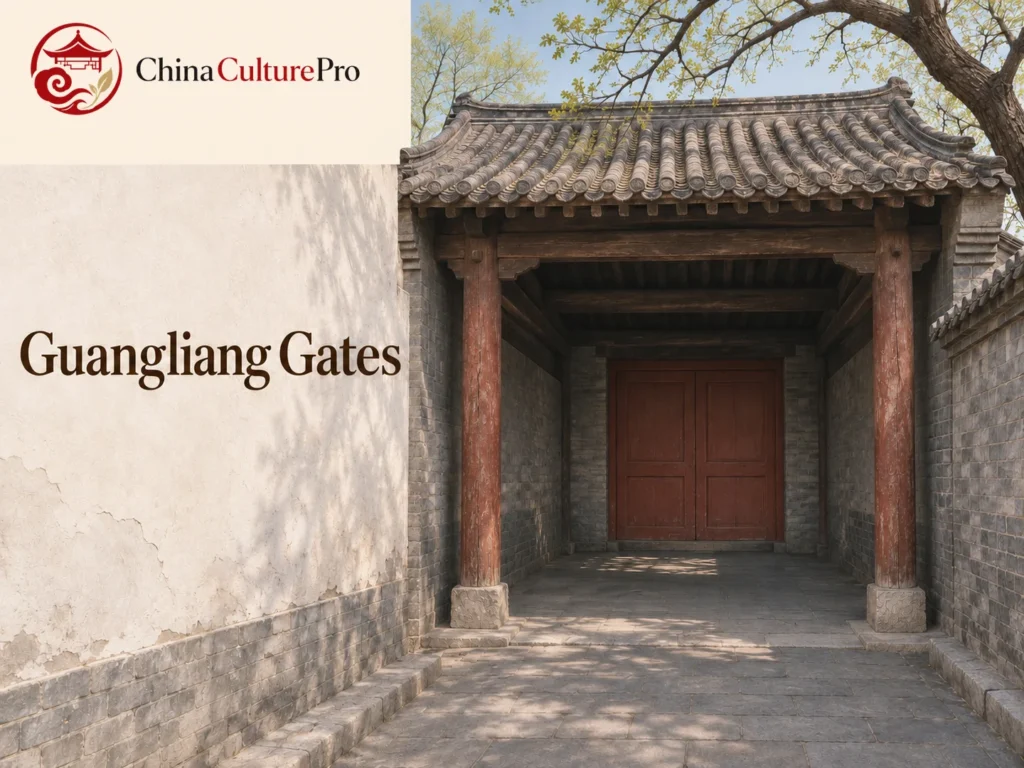

Quick Answer: What Is a Guangliang Gate?
A Guangliang gate (广亮大门, guǎngliàng dàmén) is a roofed street entrance to a traditional Beijing courtyard house. Its door leaves are set back between the middle posts of the gatehouse. From the lane, you pass under the roof before reaching the doors.[1][2][3]
- Look for a roofed bay: The entry has enough depth to read as a small room.[2][3]
- Find the door leaves: They sit at the middle post line of the gatehouse.[1][2]
- Read it from the side: The distance between the front posts and the doors helps distinguish it from other courtyard gates.[1][2]
Paint and door fittings can vary. The depth and the door position identify the form.[1][2][3]
Even with its doors shut, a Guangliang gate leaves a sheltered recess visible from the lane. The door line divides the covered passage into an approach and the section on the courtyard side.[1][2]
How the Recess Shapes the Entrance
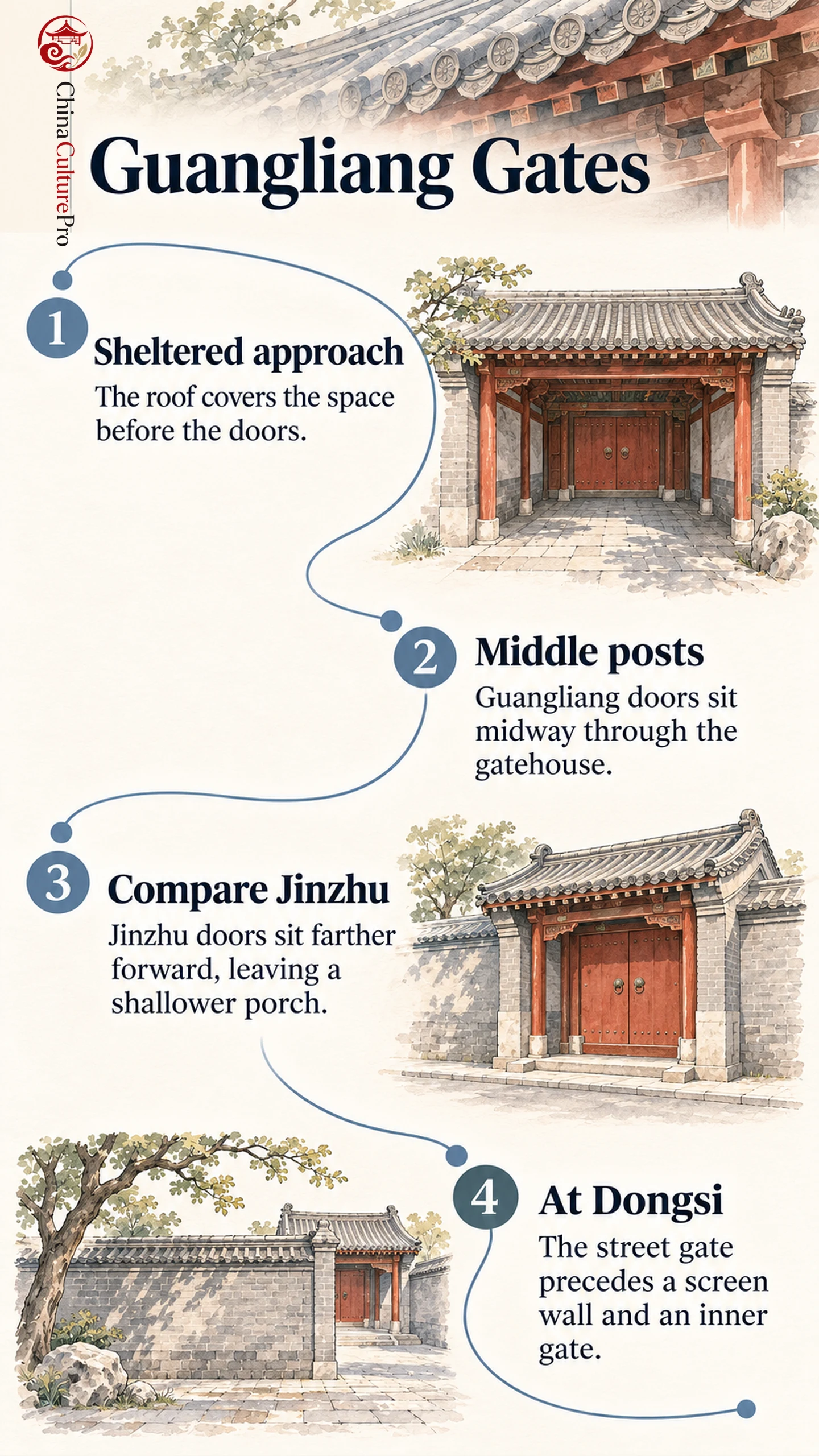
The front posts mark the streetward edge of the roofed structure. The middle posts stand farther in. Beijing’s historic-district design guidelines place the doors approximately halfway through the depth of the gatehouse. The recess on the street side creates a shaded approach, and the passage continues under cover behind the door line.[1][2]
In some examples, short screen walls fan out at either side to frame a broader space in front of the gate. Beijing’s municipal guide associates the type with high-status households while noting that its paint could be restrained. A deep entrance may look imposing without bright painted beams.[1][3]
Guangliang and Jinzhu Gates Compared
A Jinzhu gate (金柱大门, jīnzhù dàmén) also has a roofed bay, but its leaves sit between posts closer to the street. The official housing guide places the doors at the forward inner post line. As a result, the porch before the doors is shallower than in a Guangliang gate.[1][2][3]
From the lane, look diagonally along one side of the passage. Look for the line of the doorframe relative to the street-facing posts and the middle posts. A straight-on view may show two gates with similar rooflines without revealing how far their doors sit behind the eaves.[2][3]
For a third comparison, Beijing’s gate guide places the door leaves of a Manzi gate between the front eave posts. The three positions run from the street edge through the forward inner posts to the middle posts of the gatehouse.[1][2][3]
Examples in Beijing’s Hutongs
At Dongsi Hutong Museum, the Guangliang street gate leads toward a brick screen wall and a turn into the front court. Across that court stands a flower-pendant gate (垂花门, chuíhuāmén) leading into the principal courtyard. The route helps explain the different roles of an outer street gate and an inner threshold in a Beijing courtyard house.[4]
At 43 Lishi Hutong, municipal restoration coverage from 2019 identifies the repaired street entrance as a Guangliang gate. The restored gate shows the scale of the entrance bay at a house fronting a narrow lane.[5]
FAQs About Guangliang Gates
Is Guangliang gate written more than one way in Chinese?
Beijing’s preservation guidelines also give 广梁门 as a name for 广亮门. Both refer to the same recessed gate form.[1]
Do elaborate paint or carvings identify a Guangliang gate?
The middle position of its door leaves is the structural clue. The finish can be comparatively plain.[1][3]
Does a Guangliang gate always face the courtyard’s central axis?
In Beijing courtyard houses it can stand to one side of the street frontage. The main axis becomes clear after you enter the compound.[2][4]
資料來源
[1] Beijing Municipal Commission of Planning and Natural Resources. Design Guidelines for Historic District Preservation
[2] Beijing Municipal Commission of Housing and Urban-Rural Development. Traditional Courtyard Gate Types and Sections
[3] Beijing Municipal Government. Gatehouses in Beijing Hutongs
[4] Visit Beijing. Dongsi Hutong Museum
[5] Beijing Municipal Government. Restoration of the Gate at 43 Lishi Hutong