
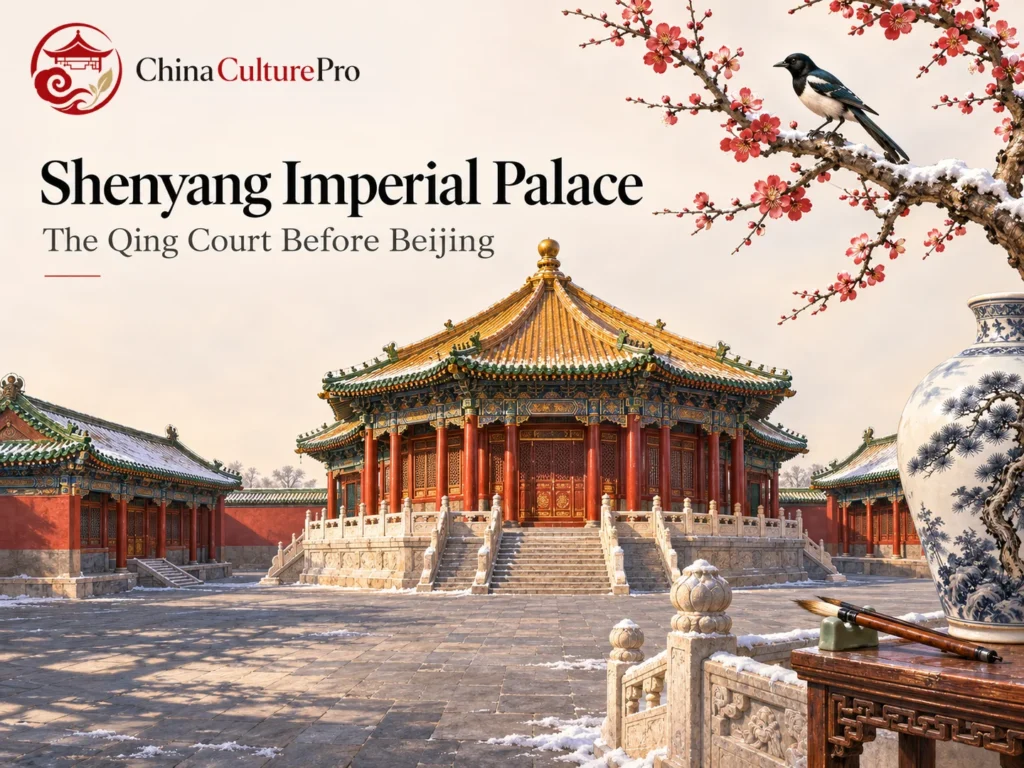

Quick Answer: Why Does Shenyang Imperial Palace Matter?
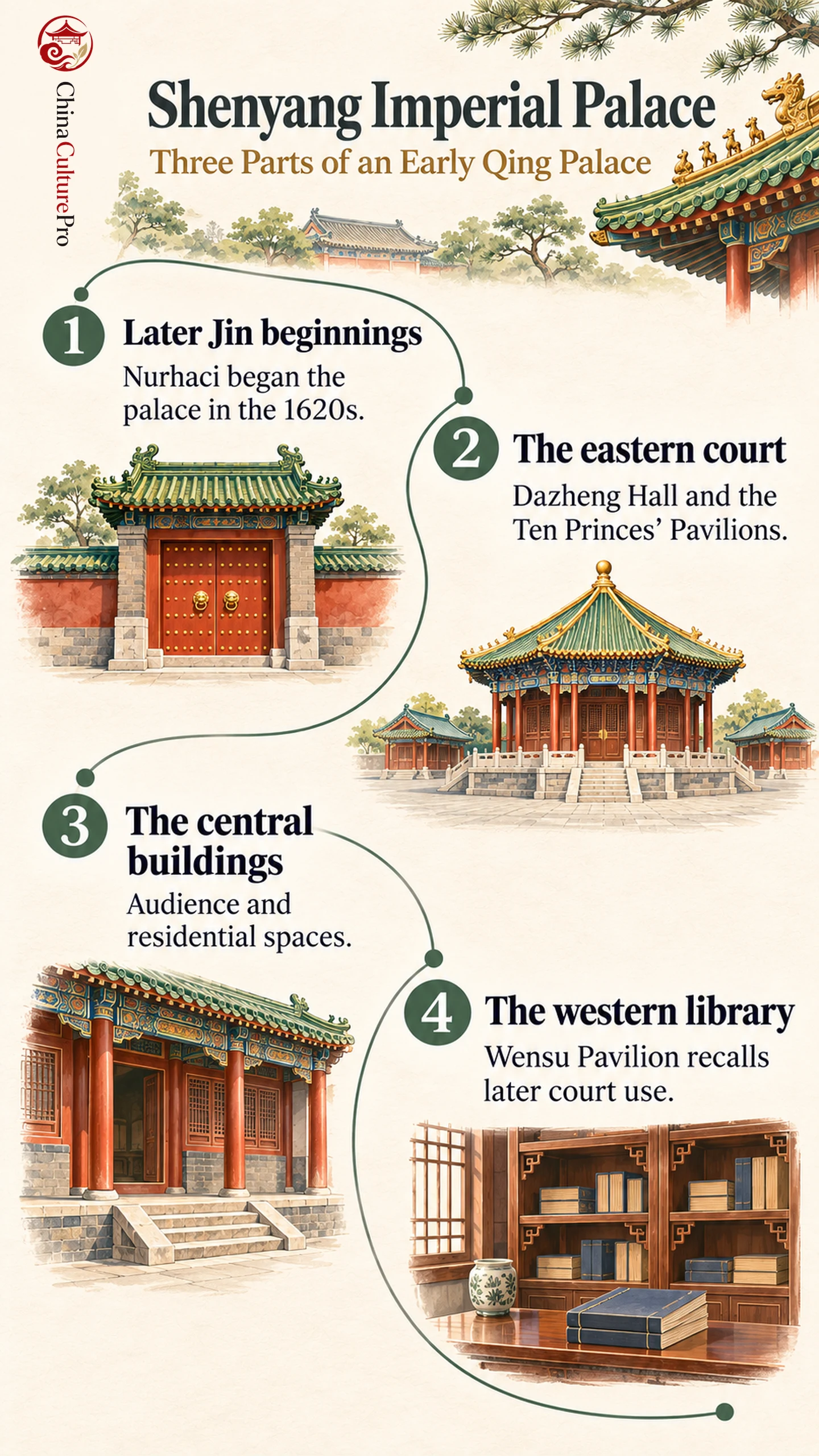
Shenyang Imperial Palace (沈阳故宫, Shěnyáng Gùgōng) preserves the court complex begun under Nurhaci in the 1620s, when Shenyang was a Later Jin capital. Dazheng Hall (大政殿, Dàzhèng Diàn) and the surrounding pavilions give a visible starting point for the rise of the Qing court. Later additions record its role after the capital moved to Beijing in 1644. [1][2][3]
- Early court: Nurhaci’s portion includes an octagonal hall and pavilions arranged in a long court. [2][3]
- Court life: The central buildings preserve distinct approaches to audiences, residences and access. [3]
- Later use: Emperors used the complex during return visits. The western part includes a library. [1][2][3]
The palace contains parts from successive periods. Its history extends beyond the court’s move to Beijing.
Standing in front of the eastern hall, look to both sides. The pavilions help define the space, and the form of the hall directs attention toward its own place within the court. That arrangement offers a clue to a different political setting from Beijing’s.
Three Parts of Shenyang Imperial Palace
| 部分 | 例子 | 比較項目 |
|---|---|---|
| Eastern buildings | Dazheng Hall and the Ten Princes’ Pavilions. [2][3] | An octagonal hall, long court and row arrangement. [3] |
| Central buildings | Chongzheng Hall and adjoining court and residential spaces. [3] | The way halls and residential buildings mark different kinds of access. [3] |
| Western buildings | Wensu Pavilion and related later buildings. [1][3] | The place of a major library within the palace’s later development. [1][3] |
The first phase began in the 1620s. Later court and library buildings preserve other moments in the palace’s use. UNESCO dates the complex’s buildings across more than a century and identifies 1783 as the late end of its range. [1][2][3]
How the Palace Shows an Early Qing Court
Nurhaci moved his seat to Shenyang from Liaoyang in 1625, according to the Shenyang Palace Museum. The buildings he began belong to the Later Jin phase. The court developed further before it established itself in Beijing as the Qing dynasty. [2][3]
Take the eastern court as one example. The relationship between the commanding hall and the rows of pavilions makes an arrangement for political and ceremonial gatherings visible. The palace is a distinct palace shaped by its earlier political setting. Its enduring importance lies partly in what it preserves of early Manchu court traditions. [1][3]
What Changed After 1644
The Forbidden City in Beijing became the principal imperial palace in 1644. Shenyang’s buildings continued to matter as a place where Qing emperors stayed on eastern visits, and later building expanded its different uses. Wensu Pavilion shows a role for books and collections in a site often approached through ceremony and politics. [1][2][3]
UNESCO includes the Shenyang and Beijing ensembles within one property. The shared listing recognizes distinct buildings associated with related dynastic history. Their location, age and political functions remain useful points of comparison. [1]
FAQs About Shenyang Imperial Palace
Is Shenyang Imperial Palace the Forbidden City?
Shenyang’s palace is a different complex. The Forbidden City is in Beijing. The two palaces are recognized together in one UNESCO World Heritage property. [1]
Which ruler began the palace?
The Shenyang Palace Museum credits Nurhaci with beginning the palace after moving the Later Jin capital to Shenyang in 1625. [2]
Did the palace cease to be used after the capital moved?
The Shenyang Palace Museum records its later use during eastern visits by Qing emperors. Later construction also included the western library buildings. [1][2][3]
資料來源
[1] UNESCO World Heritage Centre. Imperial Palaces of the Ming and Qing Dynasties in Beijing and Shenyang
[2] Shenyang Palace Museum. Prologue
[3] ICOMOS. Advisory Body Evaluation of Shenyang Palace