


Quick Answer: What Does Gewu Mean?
Gewu (格物, géwù) is usually translated as “investigation of things.” It appears in the Great Learning (大学, Dàxué) in a sequence that links learning to the cultivation of conduct. Later commentators disagreed over what it means to investigate or rectify a thing.[1][2][3]
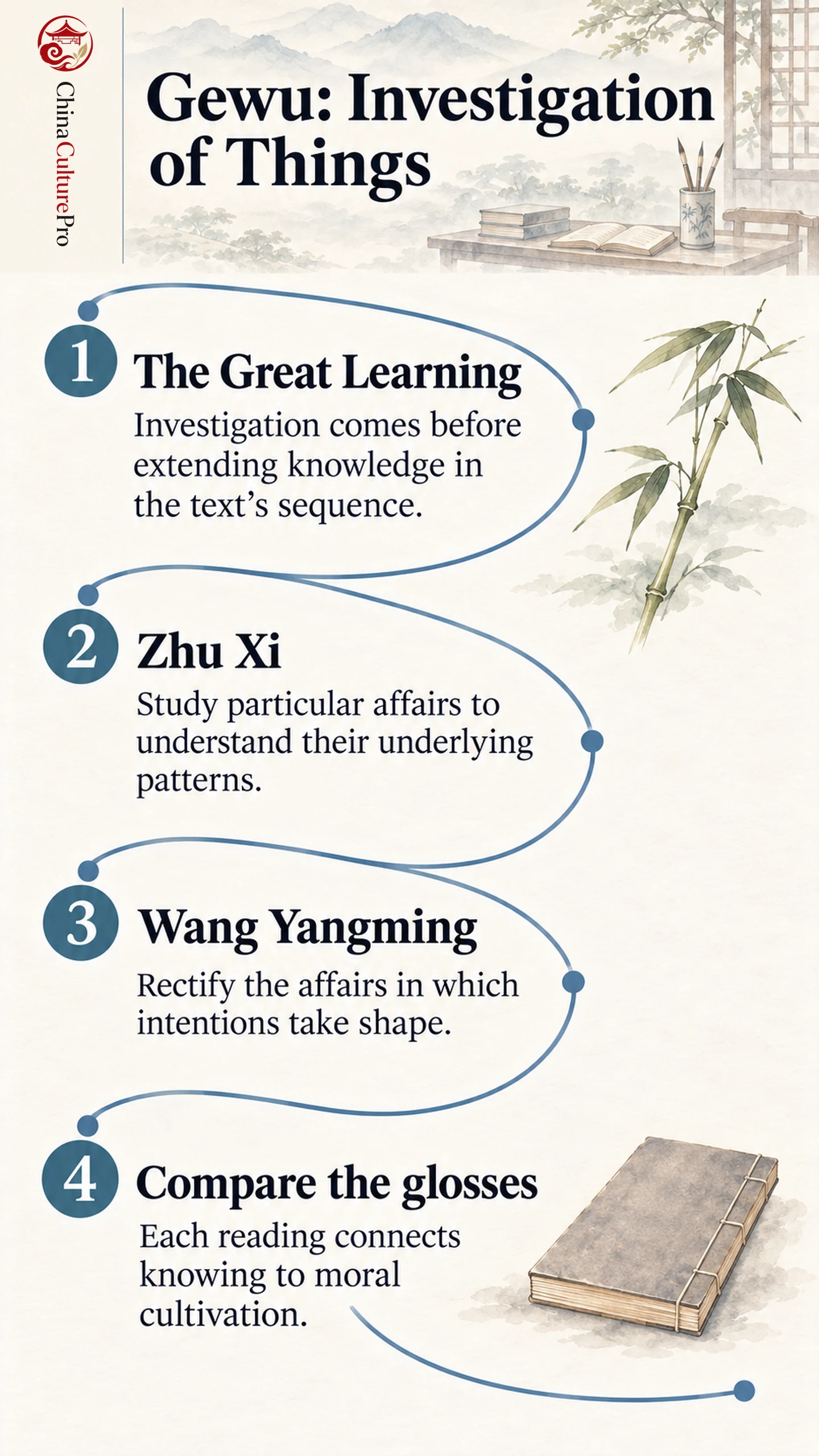
- The text: The opening places gewu before extending knowledge and making intentions sincere.
- Zhu Xi (朱熹, Zhū Xī): Learners engage with particular things and affairs in order to understand their patterns.
- Wang Yangming (王阳明, Wáng Yángmíng): Learners rectify affairs in which their thoughts and intentions are active.[1][2][3]
Both readings concern the relation between knowing and moral cultivation. The disagreement is about how that relation works in a concrete case.
A phrase can seem straightforward until two commentators ask the reader to do different things with it. Gewu is such a phrase. Seeing what each commentator treats as an object of learning is more helpful than trying to settle its meaning with a dictionary alone.
Where Investigation Appears in the Great Learning
The opening of the Great Learning links the investigation of things to the extension of knowledge. It proceeds through making intentions sincere, rectifying the heart-mind, cultivating oneself and ordering larger relationships. The sequence connects personal work with the welfare of a household and wider political community.[1]
The phrase is short, and the sequence leaves room for questions. Does a learner first examine a situation to discover how to respond? Is an intention that enters into the situation already part of what needs to be rectified? Later commentators give different answers. The related idea of sincerity also makes clearer why the sequence concerns conduct as well as information.[1][2][3]
Zhu Xi: Learn the Patterns of Things and Affairs
For Zhu Xi, engagement with particular affairs gives a learner the opportunity to understand the patterns present in them. Principle li (理, lǐ) names pattern or principle in this tradition. A learner builds on what is already understood and pursues an account adequate to the case. Through many such encounters, the learner can see connections that were less clear in isolation.[2][3]
An example would be examining what makes a promise binding in a particular relationship. The learner has to ask what was understood, who relies on the promise and which duties the case brings into play. This is a modern illustration of why attention to particulars matters. The goal in Zhu’s account includes better ethical judgment, alongside an understanding of the patterns or principles in things.[2]
Wang Yangming: Rectify the Affairs at Hand
Wang Yangming reads gewu as rectifying things. The things at issue include matters toward which the mind is directed. A dishonest intention about a promise is part of the affair, rather than an entirely separate problem discovered after the promise has been studied. To rectify the affair is to address how one is already involved in it. Someone may recognize an obligation and still look for a way to avoid it.[3]
This reading connects to innate knowing (良知, liángzhī). Wang’s account asks how moral awareness is present and acted upon in the case at hand. It also helps explain why his reading is often discussed alongside the unity of knowing and acting.[3]
What Changes When You Read the Two Together?
The same promise can bring both questions into view. A Zhu Xi reading emphasizes inquiry into what the obligation involves in the particular situation. A Wang Yangming reading asks how the person’s intention and action express or evade what they already recognize as right. Both accounts connect learning with conduct. They differ in what the learner takes up first and how the learner understands the affair being corrected.[2][3]
FAQs About Gewu
Was investigating bamboo Zhu Xi’s method?
An anecdote about Wang Yangming describes an unsuccessful effort to discern a pattern in bamboo. It illustrates Wang’s encounter with Zhu Xi’s teaching and should be read alongside Zhu’s broader treatment of inquiry into affairs and ethical judgments.[2][3]
Why is gewu translated as both investigation and rectification?
The English terms reflect different readings of what the learner does. Investigation emphasizes reaching an understanding of patterns. Rectification emphasizes setting right an affair and the intention active within it.[2][3]
Is gewu a form of modern scientific investigation?
Zhu Xi’s account values sustained inquiry into particular cases. Its aims and framework include moral understanding and classical learning, which give it a different scope from a modern experimental method.[2]
資料來源
[1] Robert Eno. The Great Learning and the Doctrine of the Mean
[2] Stanford Encyclopedia of Philosophy. Zhu Xi
[3] Stanford Encyclopedia of Philosophy. Wang Yangming