

Quick Answer: What Are Feng Shui Plants?
In modern feng shui (风水, fēngshuǐ) guides, plants can express wishes for growth, resilience or prosperity. The common names often carry those associations, even when similar names refer to different plants.[1][3][4][5]
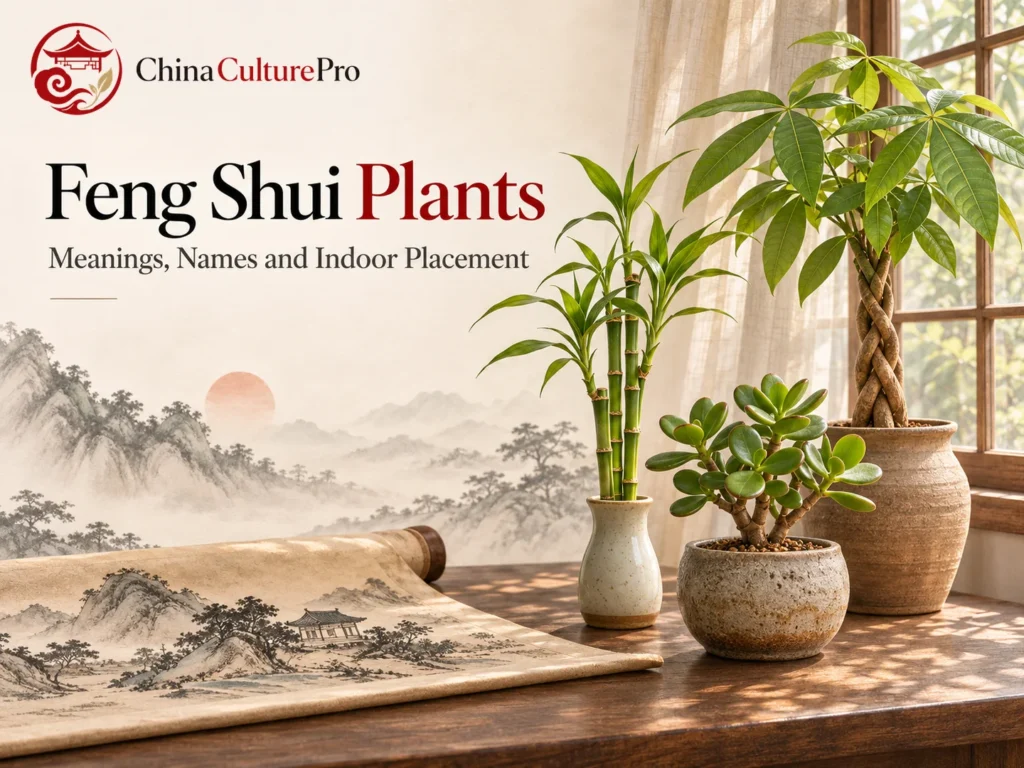
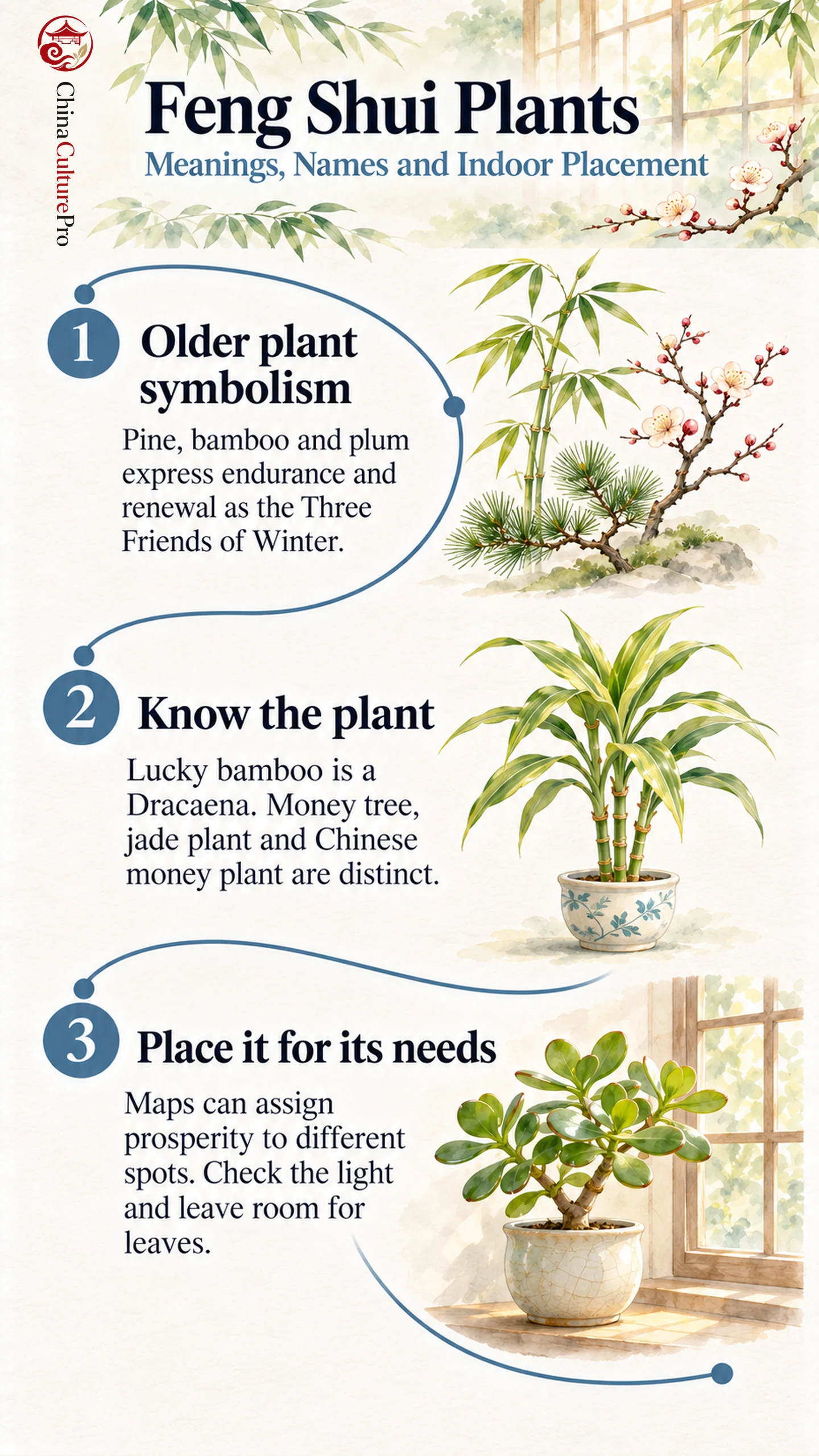
- Lucky bamboo (富贵竹, fùguìzhú): A tropical Dracaena with upright stems. Its common name evokes bamboo.[1][3]
- Money tree (发财树, fācáishù): A common shop name for a tropical tree often sold with braided stems.[1][4]
- Jade plant (玉树, yùshù): A succulent with rounded, fleshy leaves sometimes likened to coins.[1][5]
A plant can carry a wish for prosperity. Its placement should also suit the light and available space.[1][3][4][5]
A braided money tree and a compact jade plant may both be sold as money plants. One label can therefore lead to two different plants with different light and watering needs.
How Plant Symbolism Differs From a Room Rule
Chinese paintings and gardens have long used plants to express values or evoke a season. Pine, bamboo and plum together form the Three Friends of Winter (岁寒三友, Suìhán Sānyǒu). Pine and bamboo keep their foliage through winter, and plum blossoms as the season turns. Together they suggest endurance and renewal. See more about plants in Chinese gardens.[2]
An image of bamboo in a painting belongs to that world of plant imagery. The cut stems sold as lucky bamboo borrow a resemblance and a favorable name from bamboo. They are a different plant for a different setting.[1][2][3]
Four Names to Check on a Plant Label
Start with the botanical name or identifying features. This is especially helpful for money tree plants, because the label “money plant” can appear on several unrelated species.[4][5][6]
| Common name | Botanical identity and placement clue |
|---|---|
| 富貴竹 | Dracaena sanderiana has cane-like stems and strap-shaped leaves. Bright indirect light suits it indoors.[3] |
| Money tree | Pachira aquatica has leaflets spreading from a common point and may be sold with braided stems. Provide indirect light and a potting mix that drains.[4] |
| Jade plant | Crassula ovata has thick oval leaves and stores water in its tissues. It suits a brighter spot and a freely draining mix.[5] |
| Chinese money plant | Pilea peperomioides has round, flat leaves on long stalks. It grows well in filtered light and a moist, well-drained mix.[6] |
Where to Put a Plant You Want to Keep
In some modern guides, a plant is placed in a “wealth area” read from a bagua (八卦, bāguà) map. Bagua maps differ in how they assign sectors. A compass-based grid and an entrance-aligned grid can point to different spots.[1][7]
Check the light where the pot will stand with the curtains or blinds set as you usually keep them. A jade plant may suit a bright window better than a dim corner. Leave room for the pot and the full spread of the leaves where people walk past. Consider this when adding greenery to a living room or using a plant in bathroom feng shui.[3][4][5]
FAQs About Feng Shui Plants
Is Lucky Bamboo a Real Bamboo?
The plant sold as lucky bamboo is Dracaena sanderiana. Its upright canes resemble bamboo. It belongs to the asparagus family, while true bamboos are grasses.[3]
Are Spiky Plants Bad Feng Shui?
Some modern guides prefer rounded leaves and avoid very pointed forms. That is an interpretive choice. In a narrow walkway, consider whether the plant’s shape will actually get in the way.[1]
Does a Feng Shui Plant Belong in the Wealth Corner?
Some interpretations put one there as a sign of growth. The location depends on the mapping convention. Pick a suitable spot for the plant even if that is somewhere else.[1][3][7]
資料來源
[1] FengShui.info. Plants
[2] The Metropolitan Museum of Art. 中國園林
[3] NC State Extension. Lucky Bamboo: Dracaena sanderiana
[4] NC State Extension. Pachira aquatica
[5] NC State Extension. Jade Tree: Crassula ovata
[6] NC State Extension. Pilea peperomioides
[7] Ole Bruun. Cosmological Principles, Schools of Interpretation and the Feng Shui Compass