

Quick Answer: Who or What Is Feilian?
Feilian (飞廉, Fēilián) is a name with several uses in early Chinese sources. In poetry and commentary it is linked with the wind. In a description of Han sites it names a composite animal. The *Records of the Grand Historian* also gives a form of the name to a human ancestor in the Qin genealogy.[1][2][4]
- Wind: A ritual text associates Feilian with the Wind Lord (风伯, Fēngbó).
- Creature: One description combines a deer body and a sparrowlike head.
- Genealogy: A fast runner serves the last Shang king.
Read the surrounding action to decide which Feilian a source means.

A wind attendant, an animal on a belvedere and a gifted runner can all be called Feilian. The connection with speed and wind makes the name memorable, but the sources tell separate stories.
Feilian and the Wind Lord
The “Wind Lord” section of Ying Shao’s *Comprehensive Meaning of Customs* discusses sacrifice to the wind and cites a line from the poem *Li Sao* in which Feilian hurries in attendance.[1] The ritual discussion links the name with wind. The poetic scene puts the figure in motion without giving it an animal anatomy.
Another reader may meet the Wind Lord in the story of Chiyou, who calls on the Wind Lord and Rain Master in the battle account. Feilian’s name belongs to an interpretive tradition about wind figures, so check whether your text names Feilian or uses the title Wind Lord.
What the Composite Creature Looks Like
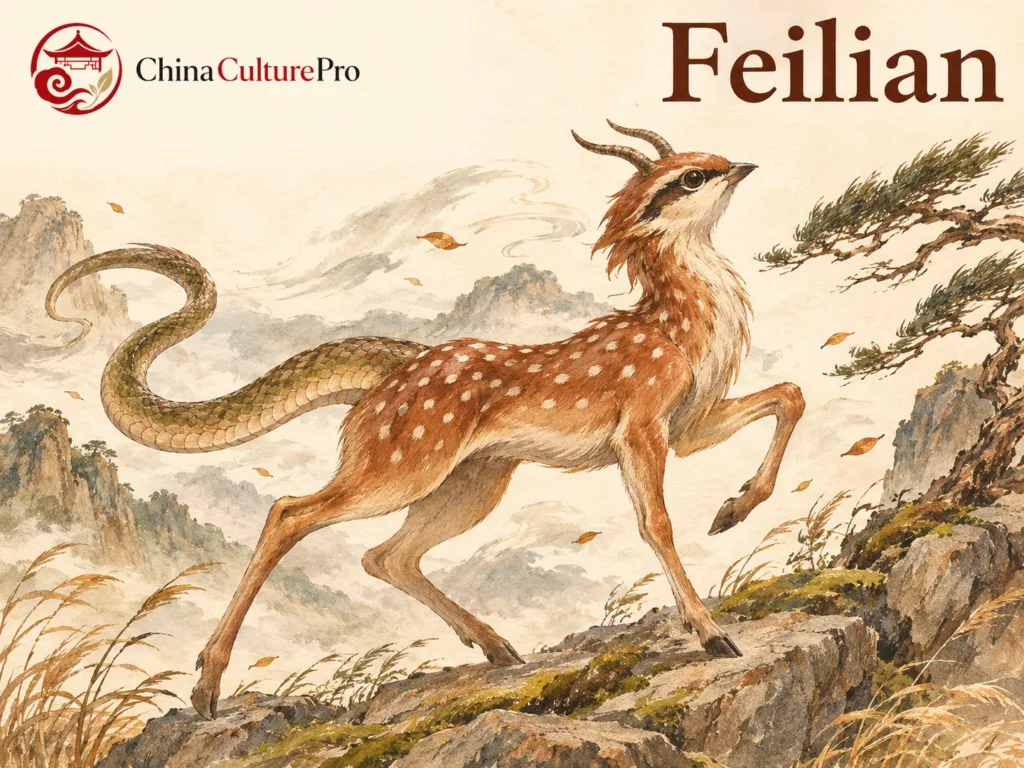
The *Sanfu Huangtu*, a description of sites around the Han capital region, tells of a bronze Feilian associated with a belvedere. It describes a deerlike body, a sparrowlike head, horns, a snake tail and markings like those of a leopard. It calls the creature a wondrous bird capable of bringing wind.[2] The building account connects this unusual shape to a named object rather than to a standard portrait of the Wind Lord.
One volume of the Qing imperial encyclopedia preserves two descriptions side by side. One gives the creature a deer body and bird head, while the other reverses the combination to a bird body and deer head.[3] The difference changes the outline of the creature before any painter chooses a color, posture or setting.
In an illustration, begin with the head and the body. If the image combines a birdlike head, horns, a spotted quadruped and a curling tail, it follows the description of the bronze more closely. A different combination may follow the other description.
The Other Feilian in the Qin Annals
The *Annals of Qin* writes the name with a variant first character, 蜚. Its Feilian excels at running. His son Elai (恶来, Èlái) is noted for strength, and both serve the last Shang king.[4] The text uses the two abilities to characterize people in the Qin ancestral narrative.
The father and son provide a useful test. Their presence together points to the genealogy. A casting, building name or wind sacrifice points to the other accounts.
How to Identify Feilian in a Text or Picture
Wind, flight and a rapid journey occur in many myths. A flying dragon is a different motif, and Feiyi is the name of other creatures. The spelling in English alone gives less information than the characters, context and a source’s stated form.
For Feilian, check whether the text is describing a ritual, identifying an animal or tracing a family line. Those three questions are enough to keep the principal uses apart.
FAQs About Feilian
Is Feilian always the Wind Lord?
Feilian is associated with wind in ritual interpretation. The name also appears for an animal and for a person in separate sources.[1][2][4]
Does the animal Feilian have wings?
The belvedere description specifies a birdlike head, deer body and snake tail. It gives no wing count or explicit wings. A different tradition gives Feilian a bird body.[2][3]
Who is Elai in the Feilian story?
Elai is Feilian’s son in the Qin genealogy. The account distinguishes the son’s strength from the father’s speed.[4]
資料來源
[1] Ying Shao. Comprehensive Meaning of Customs: Wind Lord
[2] Chinese Text Project. Sanfu Huangtu: Feilian Belvedere
[3] Imperially Commissioned Collection of Books and Illustrations. Birds and Beasts, Volume 53
[4] Sima Qian. Records of the Grand Historian: Annals of Qin