


Quick Answer: What Is the Feifei Beast?
Feifei (朏朏, fěifěi) is a creature of Mount Huo in the central mountains of the Shan Hai Jing (山海经, Shānhǎi Jīng), the *Classic of Mountains and Seas*. The passage likens it to a small catlike animal and gives it a white tail and a mane. It says that keeping the creature can put an end to worry.[1]
- Place: The entry belongs to the Central Mountains.
- 外觀: The white tail and longer hair are useful clues.
- Story: The claimed effect belongs to the bestiary’s account of the creature.
The short description leaves artists room to choose the coat, size and exact shape.
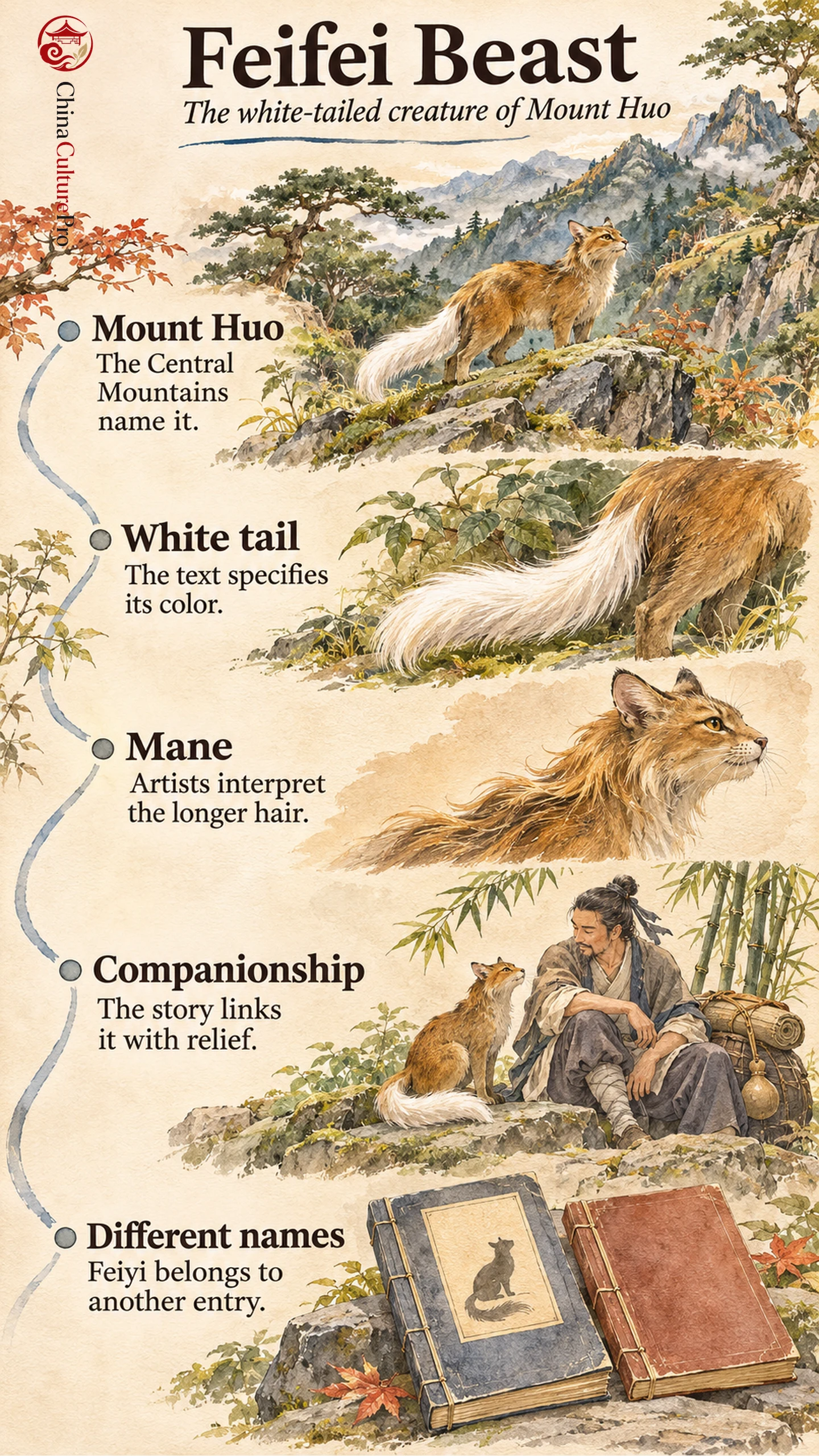
A small beast with a pale tail could be drawn in several ways. The Mount Huo entry gives readers just enough to recognize Feifei and leaves the rest to artists and readers.
What the Mount Huo Passage Says
The entry places the beast on Mount Huo, among a sequence of mountains described in terms of their distances, plants and animals. It gives the creature’s comparison to a familiar animal, its tail color, its longer hair and a claim about the effect of keeping it.[1] The parallel is often translated as a wildcat or catlike animal. The comparison gives readers a shape to imagine and leaves its species unspecified.
The description marks the tail as white. A translation or drawing may give a more definite shape to the longer hair, such as a ruff behind the head or a raised line along the back. The text leaves that choice relatively open. It also gives little indication of scale, behavior in the wild or the rest of the coat.[1]
The place name calls for similar care. An expanded commentary collects several places called Mount Huo and discusses possible identifications.[3] The animal can be placed in the book’s sequence even when a modern location is uncertain.
How the Short Description Became a Picture
The Qing imperial collection of books and illustrations places Feifei among its entries on birds and beasts, reproduces the Mount Huo passage and includes an image. It also quotes the *Lin Shu*, which imagines finding Feifei and roaming with it to ease sorrow.[2] The encyclopedia shows how a short mountain entry could give rise to an illustration and a literary reference.
Start with the tail and the outline of the hair when reading an image. Then check whether the artist made choices about the shape of the ears, coat markings or habitat. A familiar house cat, a wild-looking creature and a stylized brush drawing can all use the same identifying clues without claiming a single standard appearance.
The association with worry belongs to the story. In the later literary passage, the wish to be with Feifei becomes a way of talking about sadness. Neither account gives evidence about an actual animal or a treatment.[1][2]
Keeping Feifei and Feiyi Apart
The similar English spelling can cause confusion with Feiyi (肥遗, féiyí). In a Western Mountains passage, the Feiyi of Mount Taihua is a serpent with six feet and four wings. Its appearance is associated with drought.[4] Compare the name in characters and the mountain before using a drawing to decide.
Other animals in the book have similarly compact descriptions. Lu Shu offers another example of an entry whose form and stated effect should be read together. For Feifei, the combination of a catlike shape, white tail and keeping the animal is more informative than any one feature alone.
FAQs About the Feifei Beast
Does the source say Feifei has a white coat?
The Mount Huo passage specifies a white tail. The color of the rest of the coat is left open.[1]
Is Feifei supposed to remove sorrow?
The text attributes relief from worry to keeping it. Later writing uses that claim as a literary image of companionship.[1][2]
Is Feifei another name for Feiyi?
The names have different characters and refer to different creatures. The Mount Taihua Feiyi is a winged serpent associated with drought.[1][4]
資料來源
[1] Chinese Text Project. Classic of Mountains and Seas: Central Mountains, Passage Twelve
[2] Imperially Commissioned Collection of Books and Illustrations. Birds and Beasts, Volume 124
[3] Chinese Text Project. Expanded Commentary on the Classic of Mountains and Seas, Volume Five
[4] Chinese Text Project. Classic of Mountains and Seas: Western Mountains, Mount Taihua