

Quick Answer: What Was the Equal-Field System?
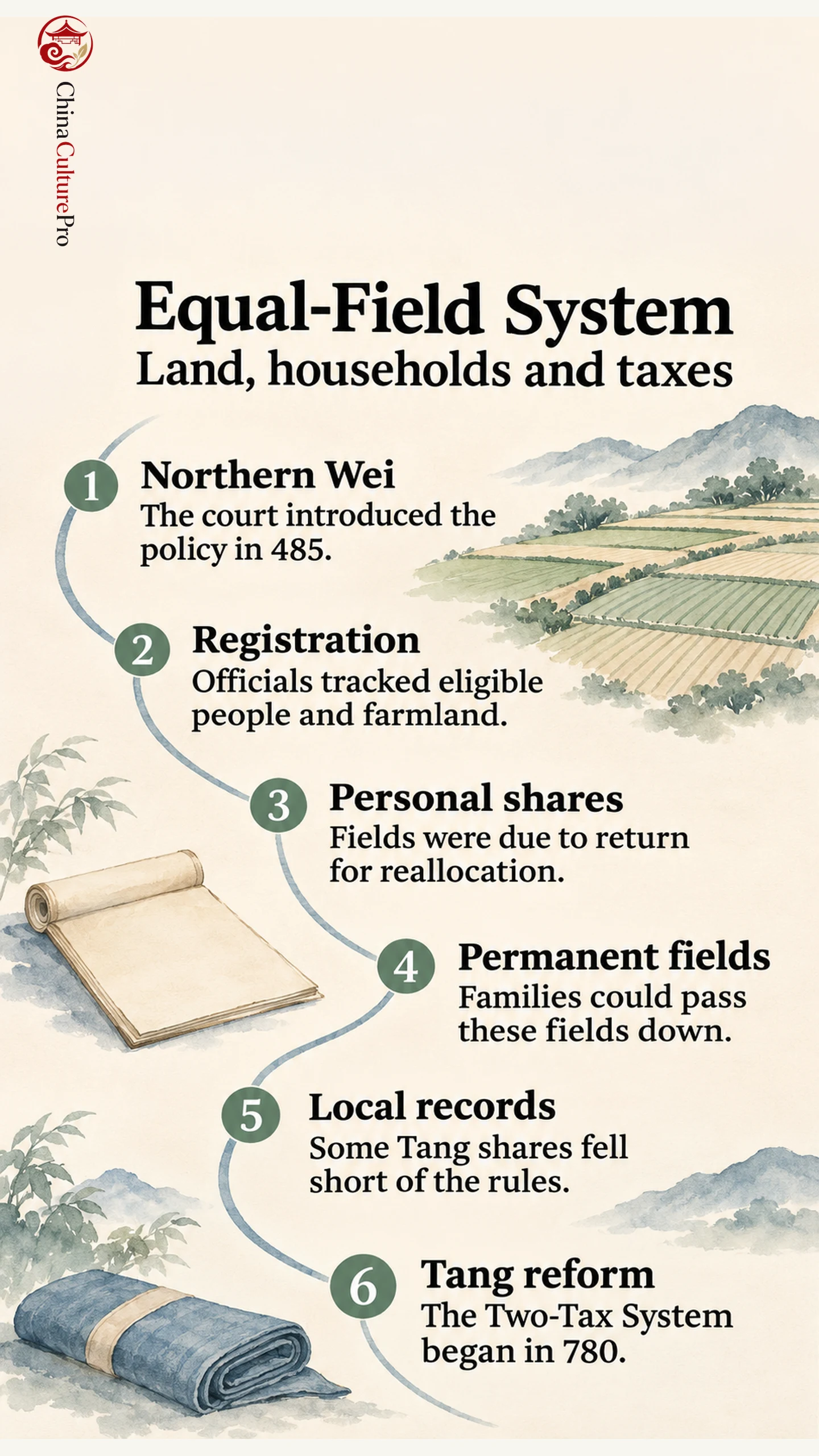
The equal-field system (均田制, jūntiánzhì) was a set of rules for allotting farmland to registered people in imperial China. The Northern Wei introduced the policy in 485. The Sui and Tang carried forward revised versions, linking the land available for cultivation to the households that owed taxes and service.[1][2][3]
- Allocation: Officials used registers to determine eligibility and the share a person could claim.[2]
- Tenure: Under Tang rules, some fields were supposed to return to the authorities for reallocation, while families could keep others across generations.[2][3]
- Obligations: The Tang linked allotments to grain, textiles and labor service.[4]
Shares differed by legal category, and the actual allocation depended on the land available in each locality.[2][3]
In a sixth-century register from Dunhuang, officials recorded farmland returning to their control after a holder died. They could then give it to another household. Tang registers from the same region show how hard it could be to supply a full share.[2]
Why the Northern Wei Linked Land and Registration
The Northern Wei’s rulers wanted more cultivators on the tax and service rolls. The policy could give farming households access to unused or abandoned fields and make officials responsible for tracking land and people together. It also gave the court a way to enlist people who might otherwise remain under the authority of powerful local families.[1][2][5]
Eligibility shifted over time. Historian Eiji Sagawa distinguishes between the 485 policy and later provisions in 492 that added grants for enslaved people. An allotment for an enslaved person increased the land available to the household that controlled that labor. Wealthy families also kept substantial holdings, and implementation relied on officials drawn from established elites.[1][2][5]
The Sui kept the basic approach after reunifying the empire in 589, while revising eligibility and linking allotments to local military units. Read against a Chinese historical chronology, the Sui revisions show how northern institutions continued after reunification.[1][2]
Two Kinds of Fields in Tang Law
A Tang allocation could contain two kinds of field. The legal difference was clearest when the named holder died. One share went back to the authorities for reassignment. The other could remain with the family.[2][3]
| Field category | 典型用法 | What the rules provided |
|---|---|---|
| Personal-share fields (口分田, kǒufēntián) | Grain cultivation | The share was due to return to the authorities for redistribution after the holder died. |
| Permanent fields (永業田, yǒngyètián) | Mulberry or other crops associated with textile production | The family could pass the holding to the next generation. |
The permanent share gave a household a reason to invest in a crop such as mulberry, whose leaves fed silkworms. The personal share gave officials a way to reassign arable land as the eligible population changed. Both depended on household registration that was current enough to track changes in eligibility.[2][3]
What the Land Registers Show
A register from Dunhuang in 547, under the Western Wei, shows the return and reassignment of fields. It gives a case in which officials did carry out the rules. Dunhuang was also a frontier garrison, so its paperwork reflects a locality where officials had particular reason to track cultivators and people liable for military service.[2]
Later registers from Dunhuang and Turfan show a different pattern. Households in the surviving records could hold their full permanent share, yet hold only part of the personal-share land prescribed for them. The shortfall mattered because a legal share could exceed the supply of fields available to assign. In much of southern China, established landholdings also limited where officials could put the northern rules into practice.[2][3]
From Allotment Duties to the Two-Tax Reform
The Tang levy tied to allocation was called zuyongdiao (租庸調, zūyōngdiào). The three elements were grain, labor service and textiles. In some circumstances cloth could stand in for a different obligation. In Turfan, those same textiles also served as a means of payment. Tang authorities could use tax cloth to buy grain and pay soldiers there.[2][4]
Administration of allotment and return was already difficult before the An Lushan Rebellion. The war further disrupted the old arrangements. In 780, the Tang adopted the Two-Tax System (兩稅法, liǎngshuìfǎ), with summer and autumn collection deadlines and assessments based on household assets and land. The reform changed the basis of taxation. Local allotment records follow a more uneven timeline.[2][3][4][6]
FAQs About the Equal-Field System
Did everyone get the same amount of land?
Eligibility and shares depended on legal status and the rules in force at the time. Actual holdings could also fall below the amount specified in the regulations.[2][3][5]
Could a Tang household inherit its allotment?
It could pass on the permanent share. The rules called for personal-share land to return to the authorities for redistribution after the holder died.[2][3]
Did the equal-field system end in 780?
The Tang’s tax reform in 780 is a useful marker. Implementation of the older allotment rules had weakened before then, with the change taking different forms in different regions.[3][4]
資料來源
[1] Richard von Glahn, Cambridge University Press. The Chinese-nomad synthesis and the reunification of the empire (485 to 755)
[2] Richard von Glahn, in Registration and Recognition. Household Registration in Imperial China
[3] Journal of Chinese Humanities. Northern and Southern Dynasties and the Course of History Since Middle Antiquity
[4] Valerie Hansen and Rong Xinjiang, Journal of the Royal Asiatic Society. How the Residents of Turfan used Textiles as Money, 300–755
[5] Eiji Sagawa, Shigaku Zasshi. The Aims and Development of the Juntian System of the Northern Wei
[6] Shinichiro Watanabe, Rakuhoku Shigaku. The Composition of the Two-Tax System in the Tang Dynasty