

Quick Answer: What Is the Centre of Heaven and Earth at Dengfeng?
Dengfeng (登封, Dēngfēng), in Henan, is home to eight groups of historic monuments around Mount Songshan (嵩山, Sōngshān). Their World Heritage title refers to an old idea of a “centre of heaven and earth” (天地之中, tiāndì zhī zhōng). The sites show how the area’s importance was expressed through worship, education and astronomical work.[1][2]
- Ritual. Three Eastern Han stone que (阙, què) gateways marked approaches to sacred places.[1][2]
- Astronomy. The Dengfeng Observatory (登封观星台, Dēngfēng Guānxīngtái) used the sun’s shadow for measurements tied to the calendar.[2][3]
- Learning and religion. Songyang Academy (嵩阳书院, Sōngyáng Shūyuàn) and Shaolin Temple belonged to different institutions within the same mountain region.[1][2]
The World Heritage property is made up of separate places built over many centuries. The title preserves the area’s historical association with a sacred centre.[1]

The monuments around Mount Songshan occupy separate sites, with different building types and uses. Their buildings tell several stories. A pair of stone piers marks a threshold, a long ruler records a shadow, and halls and courtyards supported particular forms of learning or worship.
Eight Groups Around Mount Songshan
| Monument group | What the group helps explain |
|---|---|
| Taishi Que (太室阙, Tàishì Què) and Zhongyue Temple | A sacred approach and imperial rites tied to the central mountain |
| Shaoshi Que | An Eastern Han stone gateway associated with the western peak |
| Qimu Que | A shrine approach with an inscribed and carved stone gateway |
| Songyue Temple Pagoda | Buddhist tower architecture in brick |
| Shaolin Temple architectural complex | A monastery, its associated early Buddhist buildings and a burial landscape |
| Huishan Temple | The institutional history and buildings of a separate monastery |
| Songyang Academy | Learning and the patronage of an academy |
| Zhougong Sundial Platform and Dengfeng Observatory | The long association of the region with observations and calendar making |
The eight groups form one heritage property. Several contain buildings from different periods, so the date of a gateway, temple or pagoda applies only to the structure being discussed.[1][2]
How Eastern Han Gates Marked a Ritual Approach
A que is a pair of freestanding structures flanking an approach. At Taishi Que, the stone piers stand on either side of the route. You can read the open interval between them as the threshold. It marks the passage toward a sacred precinct without needing a roofed doorway.[2][4]
The Taishi gateway dates to 118 CE. Dengfeng’s other Han gateways, Shaoshi and Qimu, also preserve carved images and inscriptions. A text can establish the occasion of its carving, while its position tells you where the inscribed surface stood within the approach.[2][4]
What the Observatory Measured
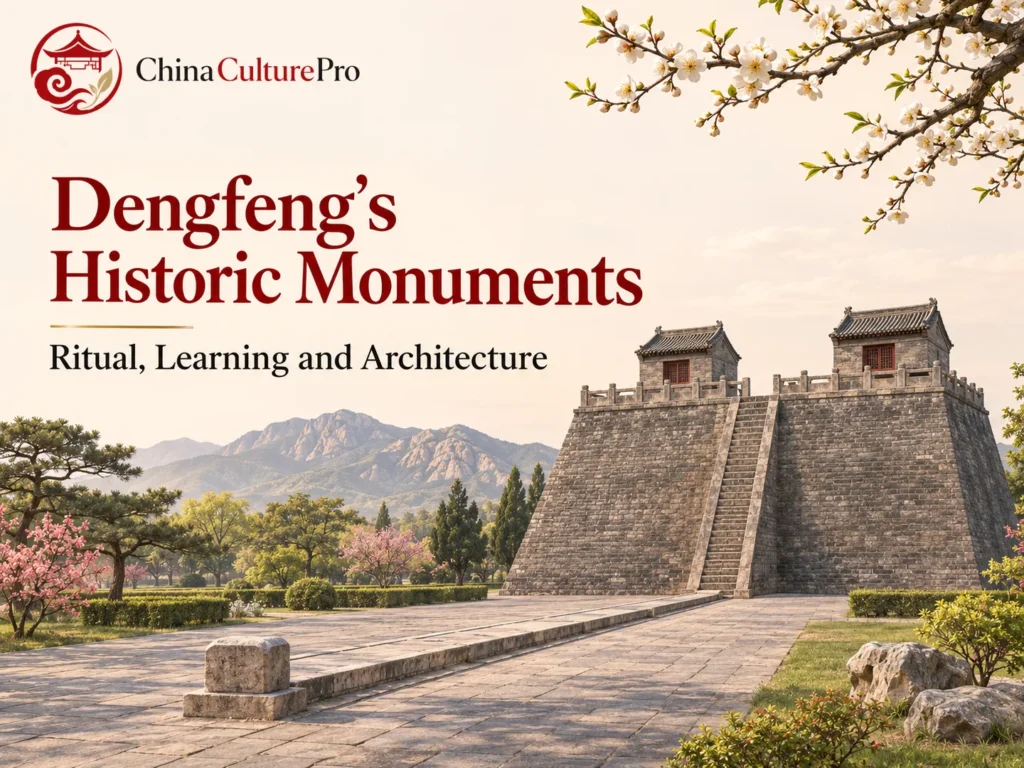
The Yuan-era observatory has a tall brick platform with a bar that cast a shadow across a long stone measuring surface. The shadow’s length changed as the sun climbed higher or lower in the course of the year. Comparing measurements at local noon helped astronomers determine seasonal turning points such as the solstices.[2][3]
The adjoining Zhougong Sundial Platform and the Yuan observatory preserve different layers of the area’s association with observation. The later instrument is associated with the astronomer Guo Shoujing. Its height and horizontal measuring surface help explain a practical method in Chinese astronomy that the phrase “centre of heaven and earth” by itself does not describe.[1][2][3]
Learning at Songyang Academy and Worship at Shaolin
Songyang Academy represents a tradition of study and transmission of classical learning. The monuments of Shaolin Temple show another use of the mountain through Buddhist ritual, monastic life and memorial architecture. Both belong in the heritage property because institutions gathered around the mountain, even though their work and use of space differed.[1][2][4] The temple and family sites at 曲阜 provide another example of how Confucian institutions used architecture, there through commemoration and lineage.
FAQs About Dengfeng’s Historic Monuments
Is “the centre of heaven and earth” a single building?
It is the historical idea behind the World Heritage grouping. Eight groups of monuments express different aspects of the mountain region’s role.[1]
Are the Han gateways part of the Yuan observatory?
The stone gateways marked ritual approaches in the Eastern Han period. The observatory is a later instrument for astronomical measurements.[1][2][3]
Is Shaolin the entire World Heritage property?
No. The Shaolin architectural complex is one group. The wider property also includes other temples, an academy, gateways and the observatory.[1][2]
資料來源
[1] UNESCO World Heritage Centre. Historic Monuments of Dengfeng in The Centre of Heaven and Earth
[2] World Heritage nomination and advisory evaluation. Dengfeng component sites and their functions
[3] ICOMOS and International Astronomical Union. Heritage Sites of Astronomy and Archaeoastronomy
[4] Dengfeng Municipal People’s Government. Mount Songshan’s stone gates, observatory and academy