

Quick Answer: What Does Dao Mean?
Dao (道, dào), also spelled Tao, is commonly translated as “way” or “path.” In Chinese philosophy, it can concern how people should live, how things proceed or the source and course of the world. Its meaning depends on the text and argument.[1][2]
- Word: An ordinary path provides a starting image for guidance and conduct.
- Traditions: Confucian and Daoist thinkers both discuss Dao, with different concerns and interpretations.
- Translation: “The Way” is useful English, but does not identify one identical doctrine everywhere.
- Context: The word is not automatically interchangeable with a god, a physical energy or a religious institution.
A concise definition can orient a reader; the surrounding passage establishes what is being claimed.
“The Way” can sound like a single hidden object waiting to be discovered. Chinese texts use dao more widely: for paths, guidance, ways of living and accounts of the world. The surrounding argument tells us which question the word is answering.
Why Dao Means Way, and Why It Is Also Written Tao
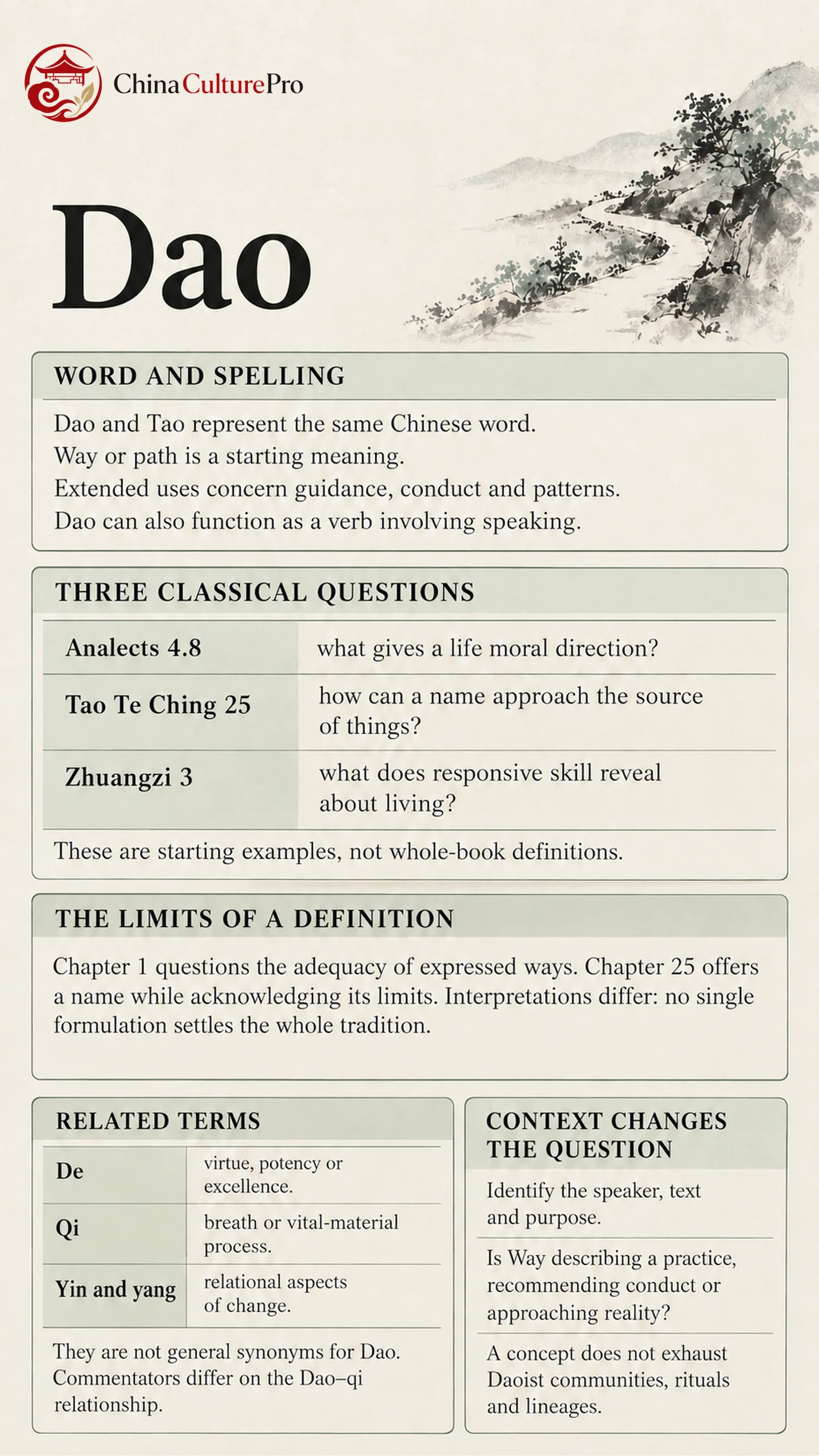
Dao and Tao represent the same Mandarin word through different romanization conventions. Dao uses Pinyin; Tao remains familiar in older English spellings and titles. A book called the Tao Te Ching (道德经, Dàodéjīng) is not describing a different concept merely because another edition writes Daodejing.[2]
A path offers a concrete image: it leads somewhere and can be followed. Extended uses of dao concern methods, guidance, patterns and appropriate conduct. A discussion of how a community ought to live is therefore using a different sense of “way” from a direction to a particular street, while preserving a connection with guidance.[1]
The word can also function as a verb involving speaking or telling. That range matters when interpreting classical sentences; an English noun cannot reproduce every role the Chinese word can play. Capitalizing “Dao” or “Way” is an English editorial choice that often signals philosophical importance, not a distinction written into the Chinese character itself.[2]
It is useful to begin with this shared vocabulary before assigning the term exclusively to one school. Chinese philosophy contains disagreements about the right way of life as well as inquiries into the course of the world.
Three Classical Settings, Three Different Questions
The Analects (论语, Lúnyǔ), Tao Te Ching and Zhuangzi (庄子, Zhuāngzǐ) put the vocabulary of the Way to different uses. Cook Ding (庖丁, Páo Dīng), the skilled figure in the third example, helps show how a philosophical question can be expressed through a story.[3][4][5]
| Passage | What the setting shows | Question it opens |
|---|---|---|
| Analects 4.8 | The value of hearing the Way is presented as a question about how one should live. | What understanding could give a life moral direction? |
| Tao Te Ching 25 | The name Dao is offered for something prior to heaven and earth that ordinary naming does not capture. | How can language approach the source or course of things? |
| Zhuangzi 3 | Cook Ding follows the openings of the ox; his listener hears a lesson about caring for life. | What can responsive skill reveal about living? |
In Analects 4.8, hearing the Way is valued so highly that the speaker imagines dying that evening without regret. This is a statement about its importance, not a practical recommendation to shorten a life. Read within Confucian thought, it belongs beside questions of learning, right conduct and becoming a better person.[3]
The other two passages broaden the questions differently. Chapter 25 of the Tao Te Ching moves beyond a social code to something described as preceding heaven and earth. Cook Ding’s story concerns conduct in contact with the patterns of a situation: his skill follows openings, and he slows down at a difficult place. The lesson is conveyed through attention and movement rather than a formal definition.[4][5]
These are starting examples, not exhaustive summaries of three books. The Analects, Tao Te Ching 及 Zhuangzi each contain further settings that can complicate a first interpretation.
Why a Short Definition Cannot Settle the Dao
Chapter 1 of the Tao Te Ching immediately makes language a problem. A way that can be expressed or specified is contrasted with a constant or enduring Way. Chapter 25 then presents Dao as a name offered for what the speaker cannot simply identify by an ordinary name. The text uses words while questioning their adequacy.[4]
This does not make the word meaningless. It asks readers to consider what a verbal formulation leaves out. “Source,” “course,” “way” and “ground” highlight different aspects, and none should silently become a picture of a large object somewhere outside the world.
Scholarly interpretations differ. Some emphasize a creative cosmic reality; others stress a conceptual ground or natural patterns of guidance. Commentarial traditions also understand the relationship between Dao and the processes of the cosmos differently. A modern introduction should disclose that range instead of declaring one interpretation the meaning accepted throughout Chinese history.[6]
Nor does the limits-of-language argument prohibit discussing conduct. The classic itself continues to address rulers, desire and relationships. The question is how such guidance relates to what cannot be fully captured by a fixed name.
Dao, De, Qi and Yin and Yang
Several related terms often appear near Dao. Their connections do not make them interchangeable.
- de (德, dé): virtue, potency or excellence through which a way is expressed.[2]
- qi (气, qì): breath or vital-material process used in traditional accounts of things and their changes.[7]
- yin and yang (阴阳, yīnyáng): relational categories used to describe contrasted and interdependent aspects of change.[2]
De can concern the character or efficacy associated with following a way. It is not always reducible to a list of moral virtues in the ordinary English sense. Qi belongs to explanations of the constitution and activity of things, including life and change. Translating it as “energy” does not, by itself, establish identity with the measurable quantity of modern physics.[2][7]
Some interpretations connect Dao closely with primordial qi; others resist treating Dao as a substance. That disagreement is why “Dao is energy” is an inadequate universal definition. A guide to qi in Chinese thought can examine its uses without collapsing them into the vocabulary of the Way.[6]
Similarly, yin and yang describe relations and transformations. A familiar divided-circle symbol is not a complete definition of Dao, and recognizing it does not settle what a particular author means by the Way.
Reading Dao in Context
When the word appears, identify whose voice is speaking and what question is at stake. A character in a story, a teacher advising a disciple and a commentator explaining a cosmic process do not perform the same task. Ask whether “way” is describing a practice, recommending conduct or approaching an account of reality.
An ordinary English analogy helps: “the way home” and “the right way to treat a friend” both use “way,” but need different explanations. This analogy does not translate a classical passage on its own. It makes the need for context visible.
Finally, distinguish a concept from a whole tradition. 道家思想 includes communities, rituals, lineages and religious texts, as well as philosophical discussion of Dao. Explaining the word neither exhausts those histories nor establishes what every member of a community believes.[8]
FAQs About Dao
Are Dao and Tao different concepts?
No. They are different romanizations of the same Chinese word. An author may use one spelling while offering a distinctive interpretation, but the spelling itself does not create a separate concept.
Is Dao a god?
It should not automatically be understood as a personal creator god. Classical and later interpretations differ, while Daoist religious traditions include deities and ritual life. The meaning of Dao in a passage and the beliefs of a religious community require separate attention.[6][8]
Is Dao the same as qi?
The terms are not general synonyms. Qi concerns traditional accounts of breath, constitution and dynamic processes; Dao can concern a way, source or course. Some commentators connect them closely, while others interpret their relationship differently.[6][7]
Can someone follow Dao without being Daoist?
The term also appears in Confucian and other Chinese philosophical discussions. What counts as following it depends on the teaching under consideration; using the word does not by itself establish religious membership.[1][8]
資料來源
[1] Key Concepts in Chinese Thought and Culture. Dao (Way)
[2] David K. Jordan. Chinese Philosophical Terms
[3] James Legge, translator. The Analects, Part 1
[4] James Legge, translator. Tao-te Ching, Part 1
[5] Columbia University, Asia for Educators. Zhuangzi, Chapter 3: The Secret of Caring for Life
[6] Alan K. L. Chan. Laozi
[7] Franklin Perkins. Metaphysics in Chinese Philosophy
[8] Fabrizio Pregadio. Religious Daoism