
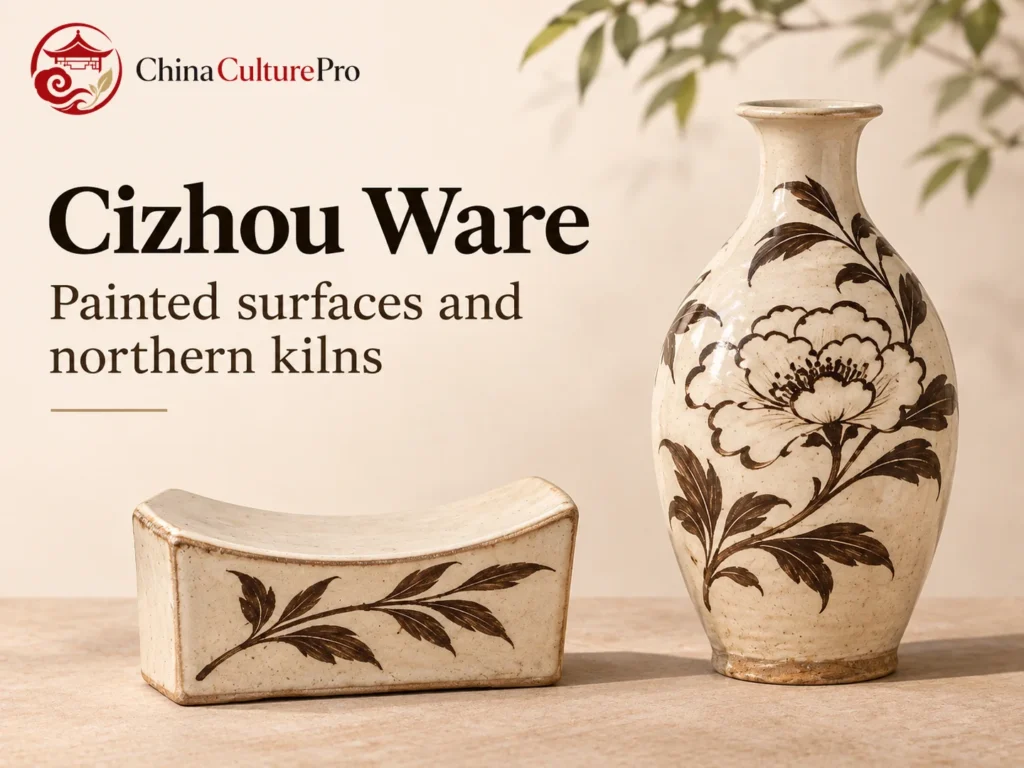

Quick Answer: What Is Cizhou Ware?
Cizhou ware(磁州窑,cízhōuyáo)is a northern Chinese ceramic tradition named after the historical Cizhou area in Hebei. The name also covers related products from a wider network of northern kilns. [1]
- Familiar appearance: Dark painted motifs contrast with a pale clay-coated ground. [2]
- Materials: A vessel’s clay body, surface coating and glaze perform different jobs. [2]
- Decoration: Brush painting, cutting through coloured coatings and other techniques all occur. [3][5]
- Forms: Bottles, bowls, cups, vases and pillows connect the tradition with practical use. [4]
The well-known black-on-white look is one part of a varied group. “Cizhou type” does not automatically identify one exact workshop, date or decoration method.
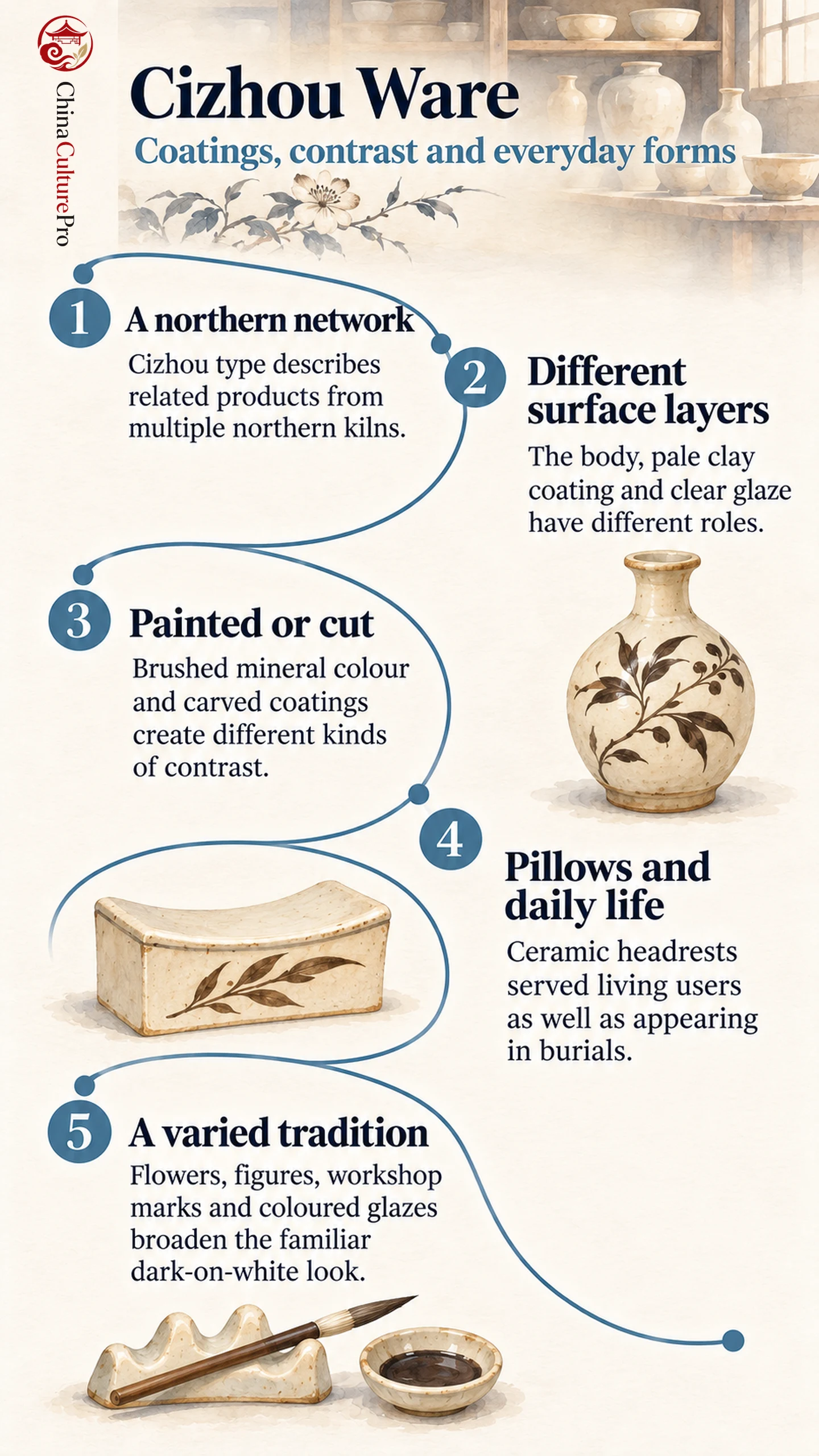
A brush-drawn flower can look almost like ink on paper, yet its surface is part of a fired ceramic. On another vessel, a similar light-and-dark design may have been cut out of clay coatings. Understanding Cizhou means separating that visual resemblance from the materials beneath it.
Cizhou and the Northern Kiln Network
Cizhou’s name is associated with Ci County in Hebei, while related wares were made across northern China, including Henan and Shanxi. Guantai and Pengcheng are important centers within the Hebei tradition. A regional ceramic name therefore need not refer to a single kiln building. [1][2]
The best-known historical forms belong especially to the Song, Jin and Yuan periods, but the wider tradition extends beyond them. A Pengcheng bowl catalogued as Cizhou type, F1898.467, is dated to the late sixteenth–early seventeenth century. Its brown and white coatings under a clear glaze show a later use of related surface techniques. [8]
Read the ware name together with the stated production place and date. Those fields provide more information than the name alone.
Clay, White Slip and Transparent Glaze
On a characteristic painted example, three materials combine to produce the finished surface. [4]
| 層次 | 主要作用 | What it contributes visually |
|---|---|---|
| Clay body | Forms the walls, base and overall structure of the vessel. | The body may remain visible where surface coatings stop. |
| White slip(化妆土,huàzhuāngtǔ) | A pale clay coating covers the body and supplies a ground for decoration. | A cream or white surface can conceal a darker underlying clay. |
| Transparent glaze | Covers the decorated surface and becomes a glass-like coating through firing. | The underlying pattern remains visible through the glaze. |
A Yuan dragon-and-phoenix jar illustrates the sequence: a pale coating was applied to the formed body, mineral colour was brushed over it, and a transparent glaze completed the surface before firing. The white ground and the clear covering are different materials, despite appearing together on the finished pot. [2]
A white coating does not change a darker body into white porcelain. Many catalogue entries specify stoneware; the coloured pillow discussed below is instead classified as earthenware. [3][6]
The distinction belongs within the broader question of pottery versus porcelain.
Painted Designs and Decoration Cut through Slip
Baidi heihua(白地黑花,báidì hēihuā)means black decoration on a white ground. The painted version uses mineral colouring material applied with a brush before the transparent glaze. Iron-bearing colour can produce the familiar dark brown or black marks; the resemblance to ink painting does not mean ordinary writing ink was used. [2]
Tihua(剔花,tīhuā)is decoration produced by cutting away parts of a surface layer. One documented pillow has an ochre coating beneath a white one. Removing selected white areas reveals the contrasting colour below; finer incised lines add detail. [3]
A different approach cuts through a black coating to reveal a pale ground. The visible result depends on which layer is removed. This contrast is important: white motifs on a dark field and dark motifs on white need not be produced by the same sequence. [5]
Brush marks and cut edges therefore tell different stories about making. The wider role of iron in ceramic colour is discussed in Chinese iron glazes.
Ceramic Pillows, Vessel Forms and Everyday Use
The ceramic pillow(瓷枕,cízhěn)is a distinctive Cizhou form. It provides a firm headrest rather than the compressible support of a stuffed cushion. Surviving shapes include geometric boxes, animals and more sculptural designs. A twelfth-century example takes the form of a reclining tiger. [7]
Such objects are found in tombs, but archaeological and textual evidence also supports use by the living. A burial context is not sufficient to conclude that the whole object category was made only for funerals. [7]
An unusual pillow dated 1063 takes the form of four mountain peaks. Its interpretation proposes that it could lie flat for use and stand upright for display during the day. That second role is a curatorial explanation of this particular form. [3]
Bottles, bowls, cups and vases broaden the tradition beyond headrests. Their profiles and uses offer another path into Chinese ceramic shapes. [4]
Flowers, Stories and Workshop Marks
Floral scrolls, birds, landscapes and figures give Cizhou surfaces a broad pictorial vocabulary. One pillow attributed to the Zhang family workshop depicts landscapes with Daoist figures and a tiger. Its catalogue dates it to the thirteenth–fourteenth century, within a Jin-or-Yuan attribution. [4]
A different thirteenth-century pillow has a bird perched on bamboo, palmette-like decoration on its sides and a stamp meaning Zhang-family pillow(张家枕,Zhāngjiā zhěn)on the base. That stamp identifies a workshop association, while the painted image performs a separate decorative job. [1]
Keep three observations distinct: the image’s subject, the workshop association recorded by a stamp and the catalogue’s assigned date. A family workshop label does not necessarily identify the individual decorator.
For further context, ceramic patterns 及 porcelain marks answer different parts of that reading task.
Beyond Black and White: Coloured Examples
Black or brown against cream is a familiar starting point, but it does not exhaust Cizhou-type decoration. An archived exhibition of ceramic pillows included incised, impressed and cut designs, along with painted colour. [5]
The bean-shaped peony pillow GK608 is a useful counterexample to an all-black-and-white definition. Its body was coated in pale clay, incised and decorated with sancai(三彩,sāncǎi)glazes. The collection classifies it as earthenware with three-colour lead glazes and dates it to the twelfth–thirteenth century. [6]
Its material description is part of the evidence, rather than an inconvenient exception to replace with “stoneware.” Chinese lead-glaze history supplies the wider technical context.
Within Chinese ceramics, comparisons with Ding ware 及 Jun ware help distinguish surface coating, cut decoration and glaze effects without making one regional tradition a standard for all the others.
FAQs About Cizhou Ware
Is the White Surface Always White Porcelain?
No. A pale clay coating can cover a darker body. Many examples are stoneware, and individual records may identify other materials; the surface colour alone does not settle the classification. [3][6]
Are the Dark Designs Made with Ordinary Ink?
The familiar painted decoration uses mineral ceramic colour, including iron-bearing materials, beneath a glaze. Its brushwork may resemble ink painting, but the materials and firing process are different. [2]
Were Ceramic Pillows Used Only in Burials?
No. They occur in tombs, but evidence also supports their use as functional objects by living people. An object’s findspot and the uses of its wider type are separate questions. [7]
Does Cizhou Type Name One Exact Kiln?
No. Related products came from multiple northern centers. An object’s catalogue may provide a more specific place, such as Pengcheng, alongside its Cizhou-type classification. [1][8]
資料來源
[1] Montreal Museum of Fine Arts. Cizhou Pillow, 1957.Ed.2
[2] Lü Chenglong / Palace Museum. Cizhou white-ground jar with black dragon and phoenix designs
[3] National Museum of Asian Art, Smithsonian. Teaching China: Pillow, F1974.2
[4] Metropolitan Museum of Art. Zhang family workshop: Pillow with landscapes featuring Daoist figures and a tiger, 2009.428
[5] Tokyo National Museum. Cizhou-Type Ceramic Pillows, 2010 exhibition
[6] Kyoto National Museum. Bean-Shaped Pillow with Peonies, GK608
[7] Princeton University Art Museum. Pillow in the form of a Tiger, 2019-109
[8] National Museum of Asian Art, Smithsonian. Bowl, Cizhou-type ware, F1898.467