


Quick Answer: What Is a Chinese Menkan?
A menkan (门槛, ménkǎn) is the threshold across the bottom of a traditional Chinese doorway. It is a horizontal frame member, often made of timber and sometimes of stone. In a raised example, someone entering steps over it as they pass into the room or courtyard.[1][2]
- Find the sill: Look across the doorway at floor level.[1][2]
- Find the pivots: Separate blocks at the sides can support the door’s turning axis.[1][3]
- Read the crossing: Historical etiquette sometimes gave the act of stepping over a sill special significance.[2][4]
Look at the doorway as a whole. The sill, the door leaves and the blocks near their ends each occupy a different position.[1][3]
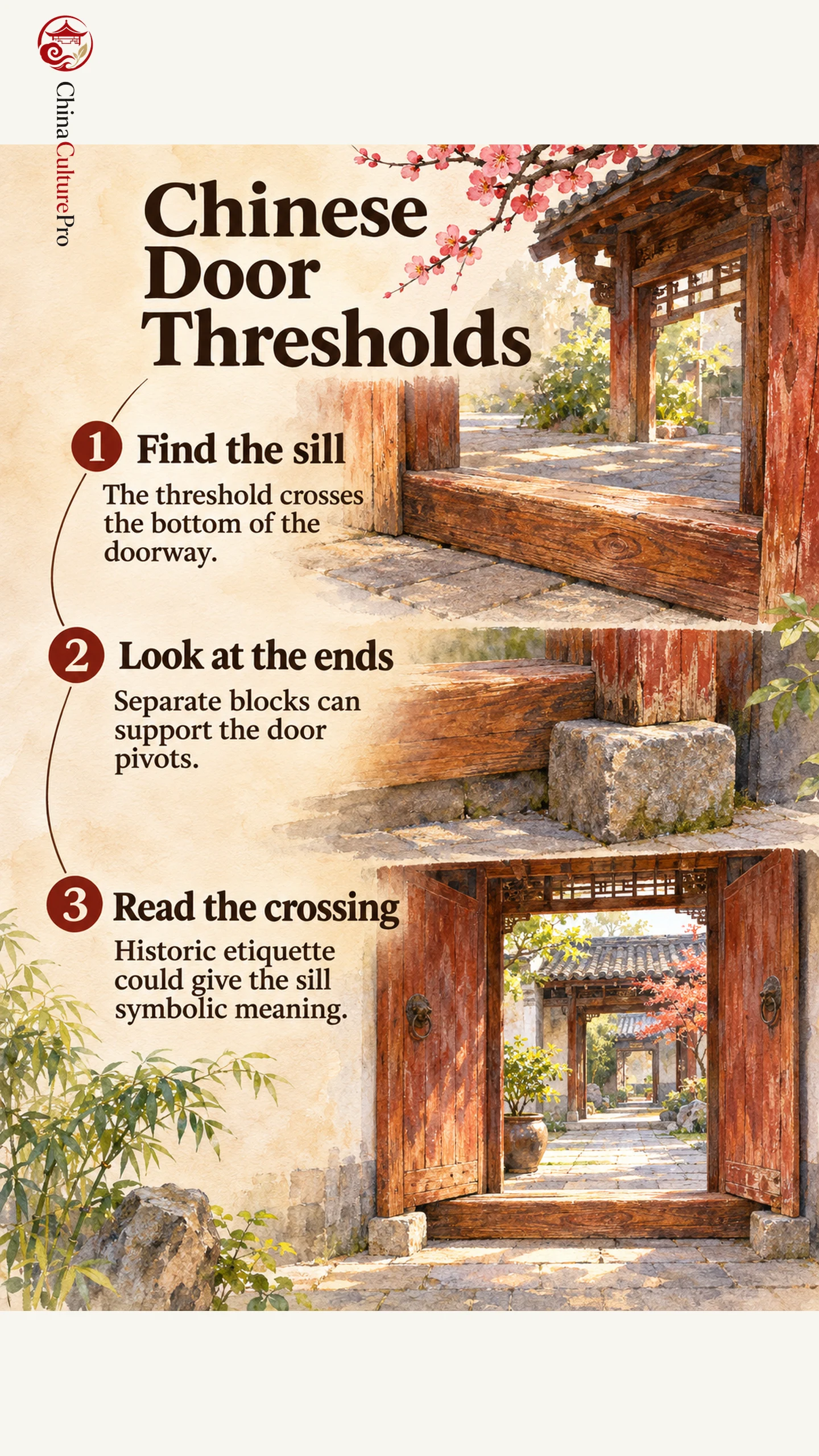
A threshold can be easiest to see when the doors are open. Its raised edge shows where the opening begins, even when the space beyond it is in shadow.[1][2]
Where the Threshold Sits and What It Does
The Shenyang Palace Museum glossary defines the lower sill as the horizontal member installed next to the ground. With the door closed, the raised sill can narrow the gap at the foot of the leaves. That helps limit the entry of wind and dust.[1][2]
Doorways vary in height, material and purpose. A large ceremonial entrance can make the change between outside and inside particularly visible. A smaller doorway can have a less pronounced sill. The component’s location identifies it even when its scale changes.[1][2]
How to Tell a Threshold From a Pivot Block
In traditional Chinese architecture, the threshold runs across the opening. A door pivot block (门枕, ménzhěn) sits near an end and receives the door’s lower turning axis. The block can also be visible outside the frame, where its exposed surface may be carved.[1][3]
The Palace Museum catalogues a pair of stone lion pivot blocks dated to 1087, in the Liao dynasty. The carved lions mark the support pieces at the sides of a door. If you see a raised beam with carved stones at either end, follow the beam across the opening to identify the threshold and then look for the separate pivot supports.[3]
Why Crossing a Threshold Could Carry Meaning
The “Qu Li” section of the Book of Rites includes an instruction for officers passing through their ruler’s gate: they should avoid stepping on the sill. The traditional commentary explains it as part of proper conduct on entering and leaving that gate. The threshold is part of a passage where the visitor’s manner of movement expresses respect.[4]
The word also came to describe a figurative limit or barrier. The physical doorway helps explain that extension. In both uses, the word identifies the boundary at the point of entry.[2]
FAQs About Chinese Thresholds
Were all thresholds made of wood?
Traditional thresholds could be wooden or stone. Look at the sill itself, since neighboring door blocks may use a different material.[1][2][3]
Does the threshold hold the door pivot?
In a doorway with a separate pivot block, that block receives the lower axis. The threshold crosses the bottom of the opening.[1][3]
Does a high threshold reveal the owner’s rank?
A raised sill can contribute to the formality of an entrance. Identifying a particular doorway’s status requires evidence about the building and its use.[2][4]
資料來源
[1] Shenyang Palace Museum. Traditional Architecture Conservation Glossary
[2] Academy of Chinese Studies. Traditional Chinese Doors and Thresholds
[3] Palace Museum. Stone Lion Door Pivot Blocks
[4] Book of Rites with Commentary. Qu Li, Chinese Text Project