


Quick Answer: How Does Chinese Stroke Order Work?
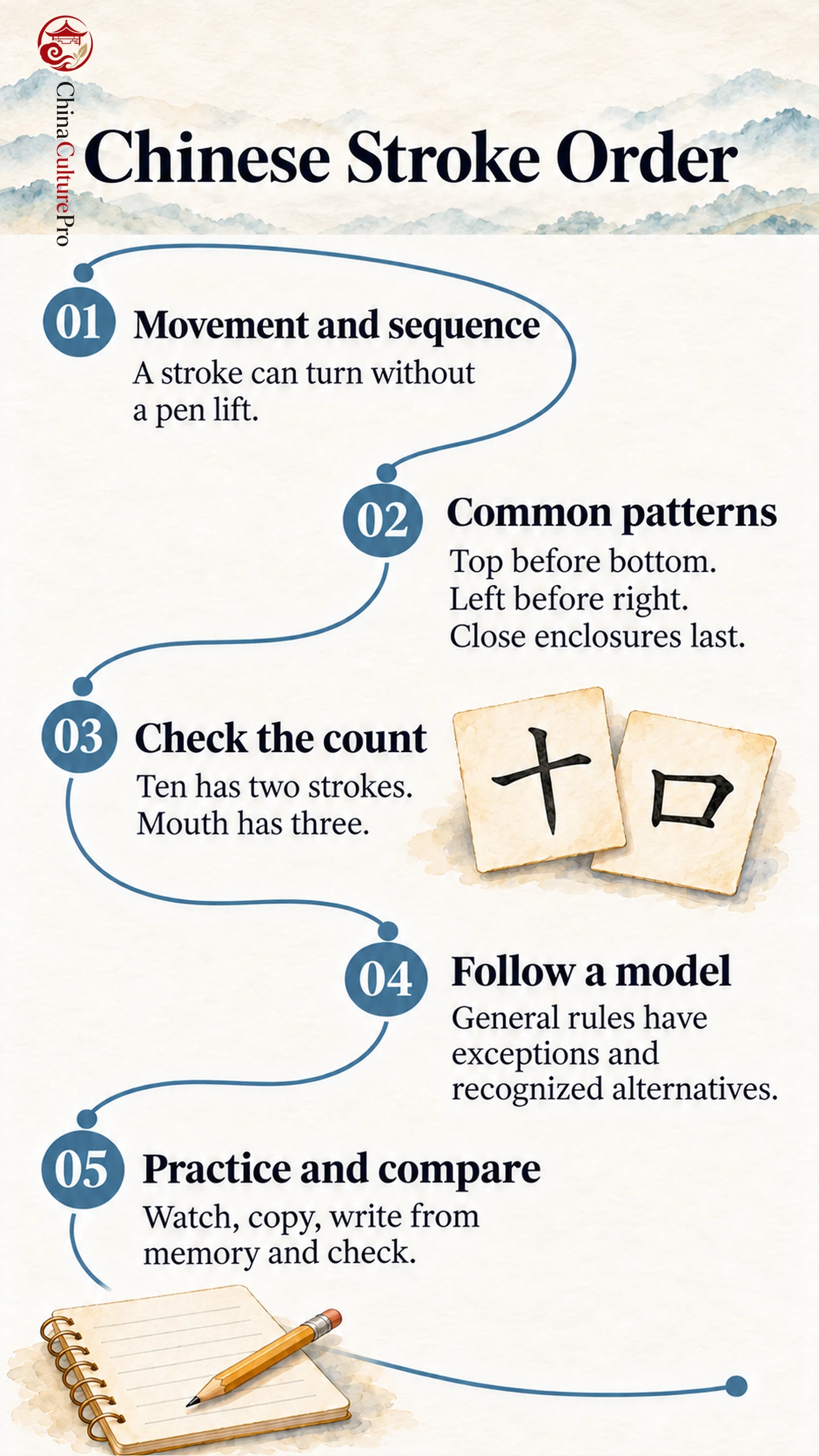
Chinese stroke order (笔顺, bǐshùn) is the sequence used to write a character. An individual stroke (笔画, bǐhuà) is one continuous movement of the pen, which may turn or end with a hook.
- Direction: A movement has its own starting point and direction.
- Sequence: Common patterns include top before bottom, left before right and an enclosure’s closing line last.
- Examples: 十 has two strokes, while the box-shaped 口 has three.
- Checking: General principles help, and a character-specific model resolves uncertain cases.
Learn the movement sequence alongside the finished shape.
A character can look correct after being drawn in several ways. Stroke order records the sequence of movements used to build it within Chinese writing. The distinction becomes easier to see when you watch a bent stroke continue through a corner or leave an enclosure open until its contents are complete. It also supports accurate counting when you use a radical index. [1][2][3]
Direction, Sequence and a Single Stroke
Direction describes how one movement travels across the page. Sequence describes which movement comes next. A short rising line, for example, can move upward even though the overall character is commonly built from top to bottom. These two scales of organization work together. [1]
| Stroke and term | 方位 |
|---|---|
| Horizontal stroke (横, héng) | Move from left to right. |
| Vertical stroke (竖, shù) | Move from top to bottom. |
| Left-falling stroke (撇, piě) | Move from upper right toward lower left. |
| Right-falling stroke (捺, nà) | Move from upper left toward lower right. |
| Rising stroke (提, tí) | Move from lower left toward upper right. |
A stroke can change direction without a pen lift. Counting only the straight sections of a finished character can therefore produce the wrong total. Watch where the model lifts the writing tool, especially at bends and hooks. This matters in both handwriting and dictionary stroke counts. [3]
Common Principles With Simple Examples
Treat the following as recurring patterns. Each example shows the particular structure where the principle is useful. The character’s full composition still controls how its parts fit together. [2][4]
| 原則 | 例子 | 留意重點 |
|---|---|---|
| Top before bottom | 三, sān, three | The three horizontal strokes proceed downward. |
| Left before right | 川, chuān, river | The side-by-side strokes proceed across the character. |
| Horizontal before a crossing vertical | 十, shí, ten | The horizontal comes before the vertical. |
| Left-falling before right-falling | 人, rén, person | The leftward diagonal is followed by the rightward diagonal. |
| Enclosure before contents, closing line last | 回, huí, return | Begin the outside, write the inside and finish the bottom closure. |
| Center before balanced sides | 小, xiǎo, small | Begin with the middle movement, then add the side strokes. |
The last two rows help explain why “left to right” cannot be applied to every mark independently. A central line can establish a symmetrical form, and an outer frame can be started before its final side is added. [4][6]
Following the Movements in Ten and Mouth
In 十, write the horizontal line from left to right. Lift the pen, then draw the vertical line downward through it. The finished character has two strokes and one crossing. The crossing itself adds no new stroke. [3]
In 口 (kǒu, mouth), begin with the left vertical. The second stroke travels across the top and turns downward along the right side without a pen lift. The final stroke closes the bottom. Its four visible sides are produced by three movements. The bent second movement explains the difference between a stroke and a straight segment. [3]
Compare that empty box with 回. The outer enclosure is started, the smaller interior form is written, and the bottom outer line is added last. The character provides a compact demonstration of how an enclosure is organized around its contents. [2][6]
When a General Rule Is Not Enough
A bottom horizontal that acts as a base can be held until later. In 土 (tǔ, earth), the order is horizontal, vertical, then the bottom horizontal. This is one reason to learn a principle together with an example instead of turning it into an absolute prediction. [3]
Teaching standards can also recognize alternatives. The Taiwan Ministry of Education’s stroke-order FAQ presents two accepted sequences for selected characters, including 方. Its school-teaching model identifies a preferred sequence while acknowledging a commonly used alternative. When studying with a course, use the model that the course specifies and check a discrepancy against the same reference. [5]
The teaching examples here concern regular script (楷书, kǎishū), the clear forms commonly used in teaching. More connected calligraphic writing can require attention to how movements join and flow. A beginner’s numbered model is useful for understanding construction before exploring those stylistic decisions. [5]
A Short Practice Routine
Use one character at a time so you can compare the movement and the result. A reliable animation or numbered example is more helpful for sequence than an ordinary printed font, which shows only the completed shape. [6]
- Choose one character and a reliable stroke-by-stroke model.
- Watch the sequence once before copying.
- Write slowly, lifting the pen only at a stroke boundary.
- Cover the model and write the character from memory.
- Compare the sequence and proportions, then correct one specific point.
Separate your feedback into order and shape. You may remember every pen lift yet need to adjust the spacing. You may also produce a balanced form while using a different sequence. Naming the specific difference makes the next attempt easier to evaluate.
Begin with a few clear examples such as 十, 三 and 口. After you can reproduce their movements, try a character with an enclosure or repeated component.
FAQs About Chinese Stroke Order
Is a box written with four strokes?
The character 口 has three strokes. Its top and right sides form one continuous bent stroke, so the number of visible sides differs from the stroke count.
Is horizontal before vertical an absolute rule?
It is a useful pattern for many crossings. Other structures can place a bottom horizontal later, as in 土, so consult the sequence for the whole character.
Can two stroke orders both be acceptable?
Some teaching references recognize alternatives for particular characters. Follow the standard used by your course and consult that reference when two demonstrations differ.
資料來源
[1] Princeton University. Basic Strokes
[2] Taiwan Ministry of Education. Basic Rules of Stroke Order
[3] Julian K. Wheatley. Learning Chinese: A Foundation Course in Mandarin, Sample
[4] Ghent University. General Rules of Stroke Order of Chinese Characters
[5] Taiwan Ministry of Education. Stroke Order Learning Program: Frequently Asked Questions
[6] Carl Polley. Stroke Order