

Quick Answer: What Is Chinese Ginseng?
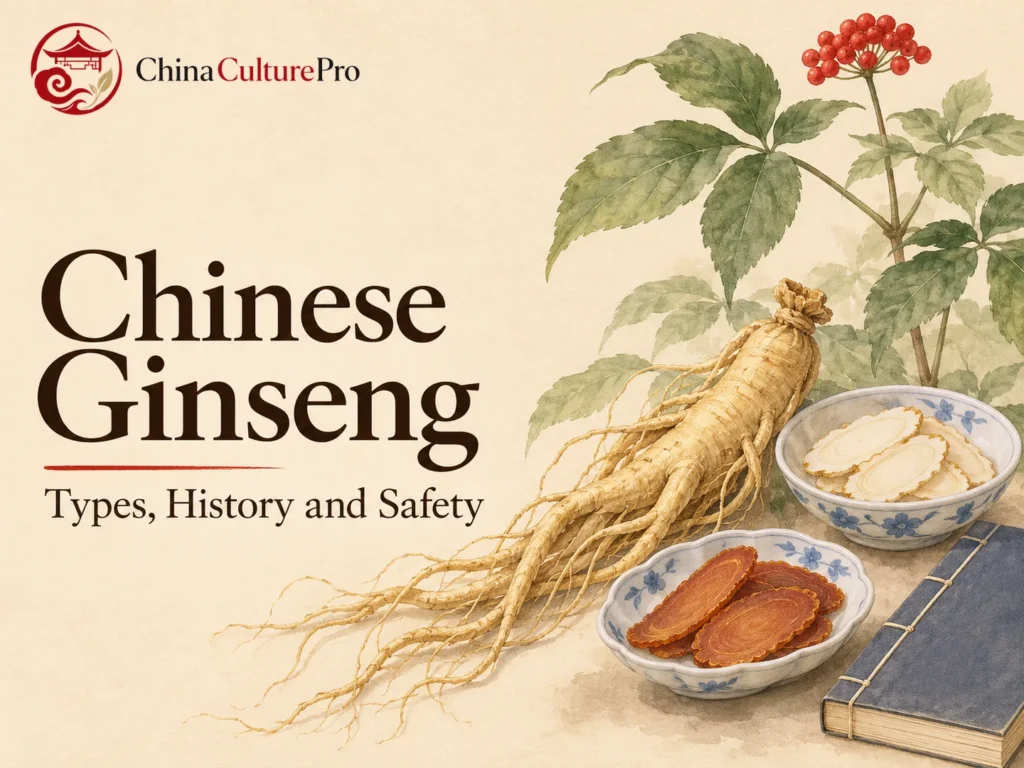
Chinese ginseng (人参, rénshēn) usually means Panax ginseng, an East Asian plant whose root has a long place in Chinese medical traditions.
- Species: Related products may come from different species or genera.
- Preparation: Processing names and national origins convey different information.
- Culture: The root connects traditional medicine with cultivation, commerce and international exchange.
- Evidence: Traditional prestige does not establish a universal energy or health benefit.
Read the plant name and preparation together. The word “ginseng” alone is not enough to identify what a product contains.[1][2][3][4]
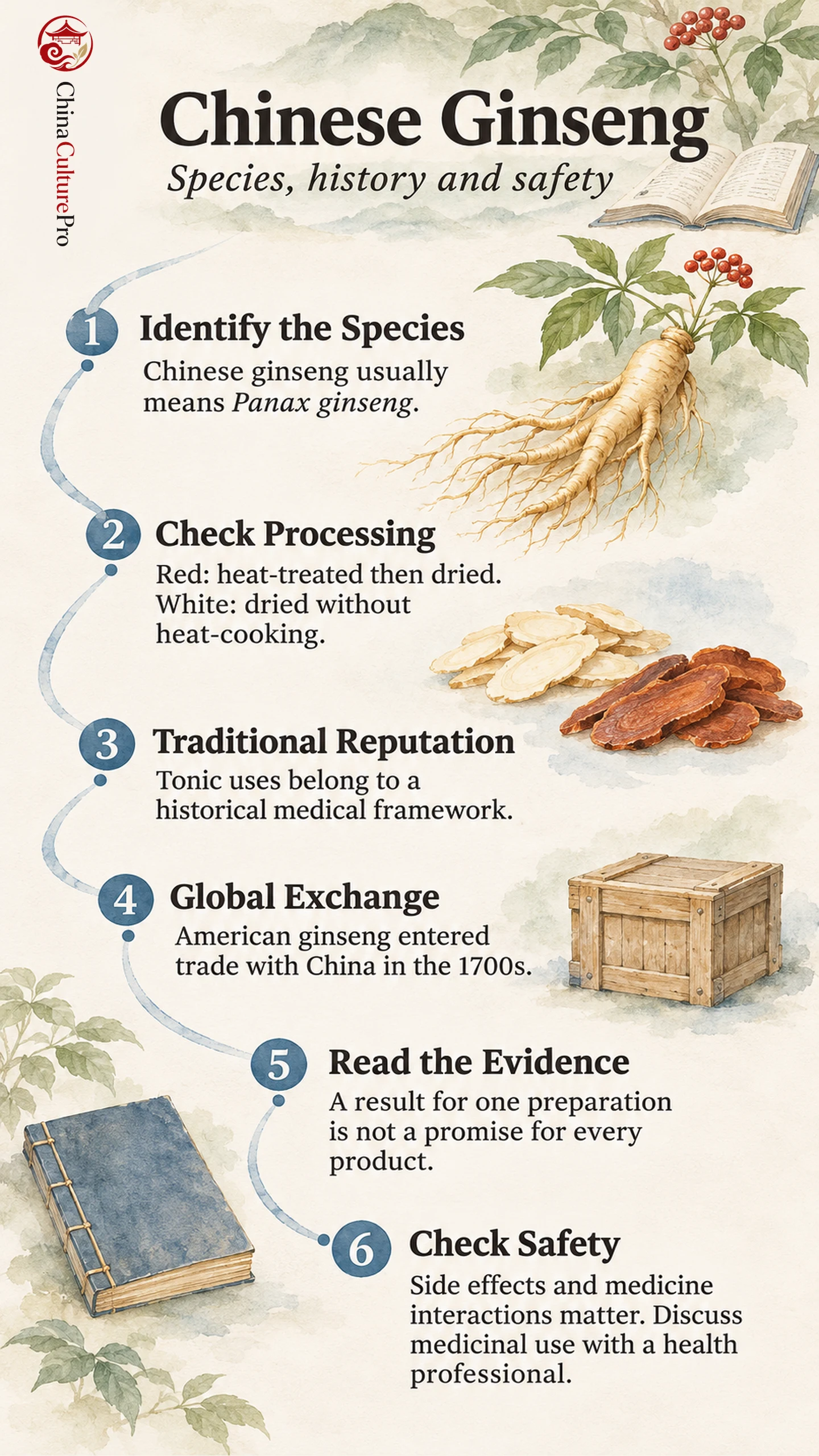
Ginseng labels often mix several kinds of information: a country, a plant species, a processing method and a claim about quality. Separating those labels is the best starting point for understanding the root’s role in Chinese herbal medicine.
Species Names and Processing Names Are Different
Panax ginseng is an accepted species in the ivy family, Araliaceae. Its native range includes northeastern China, Korea and the Russian Far East. A botanical range describes where a species occurs naturally; it does not tell you where a packaged root was grown.[1]
American ginseng (西洋参, xīyángshēn) is Panax quinquefolius. The plant commonly called Siberian ginseng or eleuthero is Eleutherococcus senticosus, rather than a true Panax ginseng. Similar common names do not make these plants interchangeable.[2]
Red ginseng (红参, hóngshēn) and white ginseng (白参, báishēn) are preparation terms. The basic distinction is heat processing before drying, not whether the root comes from China or Korea.[3]
| 標籤 | 所指類別 | 不能由此證明甚麼 |
|---|---|---|
| Chinese, Asian or Korean ginseng | Common names associated with Panax ginseng | A separate species for each country |
| American ginseng | Panax quinquefolius | That every product was grown in North America |
| Siberian ginseng | Eleutherococcus senticosus | Membership in the genus Panax |
| Red ginseng | Root heat-treated, commonly steamed, then dried | A universally stronger treatment |
| White ginseng | Root dried without heat-cooking | That every white root has been peeled |
White ginseng may be peeled or unpeeled. The preparation vocabulary also includes fresh, sliced and other forms. These are useful product descriptions, but they cannot replace an exact species name or a study of the actual preparation.[2][3]
Why the Root Became Culturally Important
In traditional medicine, ginseng has been used as a tonic, with purposes such as restoring strength or stamina. A traditional use describes a medical intention and cultural reputation. It is distinct from a modern finding that a product reliably produces that outcome.[2]
The history also reaches beyond East Asia. Commercial collection of American ginseng for export to China began in Montreal in 1718, with Indigenous gatherers central to the trade. Over time, the North American species became incorporated into Chinese materia medica. Its later cultivation in China shows why the word “American” can describe botanical identity without guaranteeing a present-day growing location.[5]
In 1784, the Empress of China sailed toward Canton with a large cargo of American ginseng. That voyage was a milestone in trade between the newly independent United States and China, rather than the beginning of international ginseng exchange. Earlier routes had already linked North American gathering communities, European merchants and Chinese markets.[4][5]
These histories help explain why ginseng can carry several meanings at once: medicinal material, valuable commodity and a link between distant communities. A luxury presentation box tells you something about how a root is marketed or given, but it is not a clinical outcome measure.
What Modern Research Can and Cannot Establish
Most clinical trials of Asian ginseng have been relatively small and short. A 2023 review suggested a small benefit for general fatigue, but findings did not consistently agree. Results involving multi-ingredient formulas should not be attributed to ginseng alone. Evidence for improving blood sugar control is also conflicting, and most research does not show improved athletic performance.[6]
The relevant question is more specific than “Does ginseng work?” It is whether a defined preparation helps a defined group with a particular outcome. Root slices, extracts and mixed formulas are not the same intervention simply because they share a plant name.
Ginsenosides are among the plant’s studied constituents. Knowing that a root contains active compounds does not establish the size of a benefit in people, or make laboratory findings equivalent to treatment results.[2]
Safety Depends on the Person and the Preparation
Insomnia is the most commonly reported side effect of Asian ginseng. It may also affect blood sugar, blood clotting and autoimmune disorders. Pregnancy and breastfeeding require particular caution; long-term safety is not well established.[6]
- Medicines: Discuss ginseng with your clinician or pharmacist if you take insulin, blood thinners or other medicines. Some interaction findings are mixed, so do not assume one predictable effect on anticoagulants.
- Procedures: Tell the surgical team about ginseng before an operation; follow its instructions about stopping supplements.
- Product details: Bring the label or ingredient list. Whole root, a standardized extract and a combination product may present different questions.[7]
This is also where Chinese food therapy and herbal treatment need to be distinguished. The familiarity of an ingredient in a culinary setting is not sufficient evidence for the safety of a concentrated preparation.
FAQs About Chinese Ginseng
Are Chinese and Korean ginseng different species?
Both names commonly refer to Panax ginseng. They can indicate origin or a commercial description, so check the scientific name and actual growing location.[2]
Is red ginseng stronger than white ginseng?
The names identify different processing methods. They do not establish a universal ranking of clinical benefit or suitability for every person.[3]
Is wild ginseng automatically better?
Wild origin alone cannot establish a treatment benefit. A claim of superiority still needs evidence for the actual preparation and intended outcome, rather than relying on rarity or prestige.
Can ginseng be taken every day for energy?
There is no general daily-energy recommendation supported by the evidence described here. Persistent fatigue merits assessment, and medicinal use should account for side effects and other medicines.[6][7]
資料來源
[1] Royal Botanic Gardens, Kew. Panax ginseng C.A.Mey.
[2] National Center for Complementary and Alternative Medicine. Asian Ginseng
[3] Korea Ginseng Association. Types of Ginseng
[4] Smithsonian Center for Folklife and Cultural Heritage. American Ginseng
[5] Josef Brinckmann and Linfang Huang. American Ginseng a Genuine Traditional Chinese Medicine
[6] National Center for Complementary and Integrative Health. Asian Ginseng
[7] Memorial Sloan Kettering Cancer Center. Ginseng (Asian)