

Quick Answer: Why Do Chinese Diaspora Names Change Across Records?
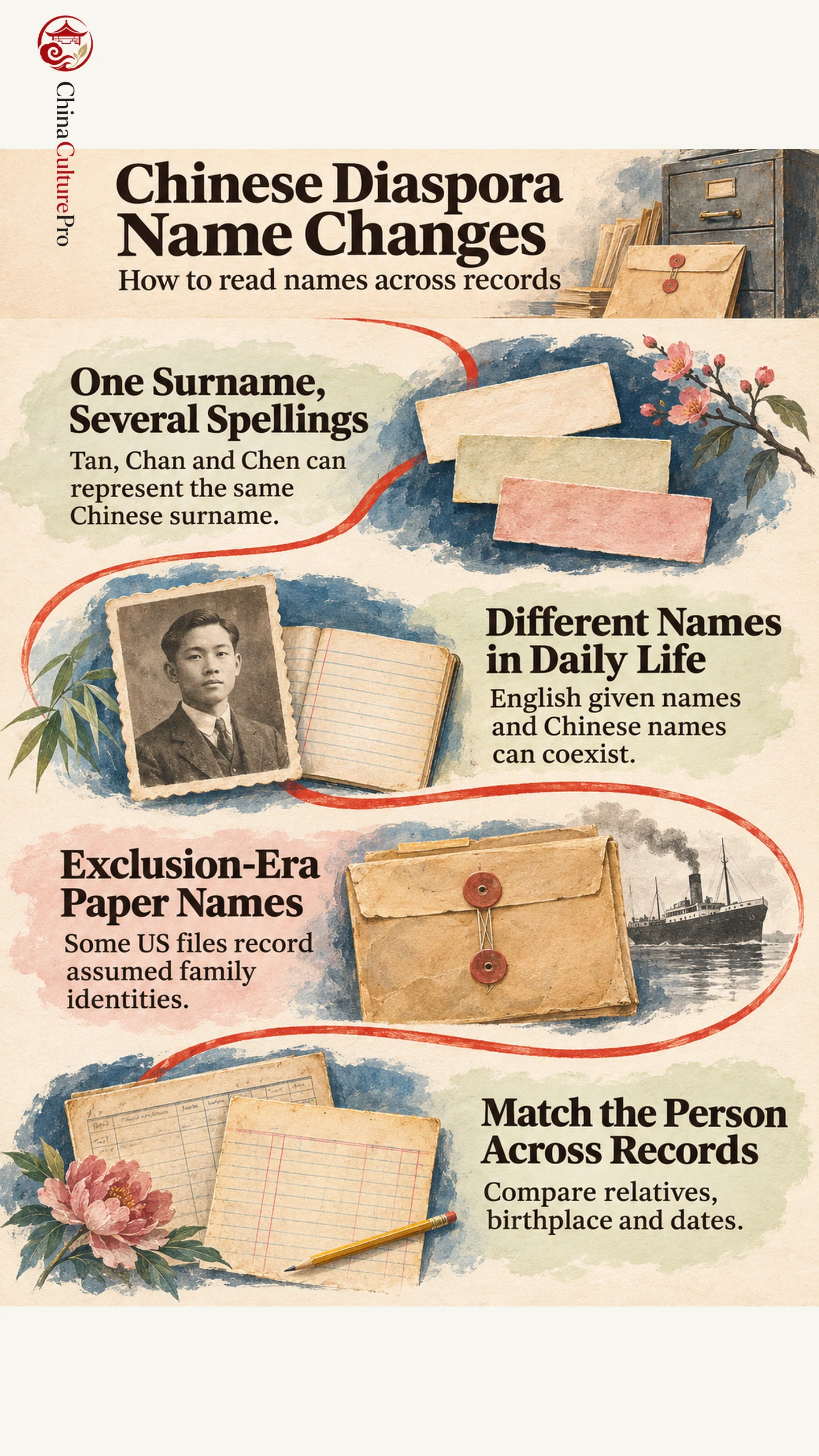
A Chinese diaspora name can look different when the same Chinese characters are spelled through another language, a person uses an English given name, or a clerk records the names in a different order. In Singapore, Tan, Chan and Chen can all represent the surname 陈 (Chén). In United States exclusion-era files, a paper name can indicate an assumed family identity. [1][2]
- Spelling: Check the Chinese characters if they survive. A change in letters can reflect a change in romanization. [1]
- Usage: A name used at school or work can coexist with a Chinese name used by family. [1]
- Identity: Compare names with relatives, birthplace and dates before merging two records. [2][3][4]
Keep each spelling as written until you know which details link the records.
An immigration register, an association roll and a lineage book may each list a different version of one person’s name. The difference could begin with how the name was spoken, with the form’s assumptions about name order or with the circumstances of migration. Reading the document alongside a second record can reveal which explanation fits. [1][2][3][4]
How One Surname Acquires Several Spellings
In Singapore, linguist Lee Cher Leng gives Tan as a Hokkien or Teochew spelling of 陈 and Chan as a Cantonese one. Chen is the usual unaccented form in Hanyu Pinyin (汉语拼音, Hànyǔ Pīnyīn), the system that romanizes Standard Mandarin. Keeping Tan could preserve a spelling associated with the family’s speech. Another household could use Chen for the same character when it adopted a Mandarin spelling. Read the guide to regional romanization for other systems that can produce different spellings of Chinese characters. [1]
Surname and given name can follow different conventions within a single name. Lee describes Singaporeans who retained a surname spelling associated with their family speech and used Pinyin for the given name. An apparently mixed spelling may reflect a family choice. Conversely, a shared spelling is weak evidence by itself because a short Latin-alphabet form can correspond to more than one set of Chinese characters. The languages of the Chinese diaspora help explain why pronunciations diverge. [1]
Why One Person May Use Different Names
A Chinese family name usually comes before the given name in Chinese order. A person using an English given name may put that name before the surname in English contexts. Some Singaporean Chinese names combine an English given name, a family surname and a Chinese given name. On a document with separate surname and given-name fields, check the field labels before interpreting a shortened or reordered name. See the Chinese surnames guide for the role of the family name. [1]
National Archives of Australia lists a file cataloged under variants including Una Chen (Ha Song) Sing and Mrs Choy Jack, with the entry also giving Una Chin Ah Song. The listing shows how variant forms can accumulate within one file. It does not, by itself, say when each form was chosen or which form the person preferred. Read the file itself if it is available. A name in a letter signed by the person has a different provenance from a clerk’s label on the file. [3]
What a Paper Name Means in US Exclusion Records
The US National Archives uses the term paper sons for people who immigrated using paperwork that presented them as the children of someone who could claim the right to bring them into the United States. This happened under the Chinese exclusion system. Some people entered under an assumed family identity, which could carry a surname different from the one their family used in China. That difference has a separate history from a surname spelled in two languages. [2]
The National Archives notes that case files can include interrogation transcripts. Officials questioned applicants to test their claimed relationships. A transcript can preserve details about households and villages, but the applicant was responding to officials who controlled entry. Keep the claims in the interview distinct from family information confirmed by other sources. The Chinese diaspora history guide puts this example in a wider migration context. [2]
How to Match a Person Across Records
Copy the spelling, order, source and date exactly as you find them. Compare details that can stay recognizable across spellings. Library and Archives Canada lists birthplace, occupation, age and arrival information among the fields in its General Registers of Chinese Immigration. A shared village, the same relative and a compatible arrival date together carry more weight than a similar surname. Search multiple forms if the catalog permits it. [4]
For a Chinese-language comparison, look for a family genealogy (族谱, zúpǔ). The National Library of Australia explains that some genealogies recorded the male line in Chinese and that relatives in one generation sometimes shared a character in their given names. This can help connect entries when the original characters are available. A missing entry carries less weight if the genealogy covers only part of the family. The guide to reading Chinese genealogy pages explains how to interpret the entries. [5]
If the details conflict, write down which fields disagree and keep the entries separate while you look for another source. Record the archive’s reference number alongside the name. Two search results with different spellings may point to the same underlying file, and the reference number helps distinguish that situation from two independent records. [3][4]
FAQs About Chinese Diaspora Name Changes
Can Tan, Chan and Chen be the same Chinese surname?
Yes. In one documented Singapore naming pattern, those forms can represent 陈. Check the actual characters for a particular family because a Latin-alphabet spelling can have more than one origin. [1]
Does a different English name mean the Chinese name was legally changed?
A person may use an English given name in one setting while keeping a Chinese name in another. Look for a dated document identifying a formal change before assuming that one occurred. [1][3]
Does a mismatched surname prove that an ancestor used a paper name?
A mismatched surname is a reason to compare the records. Exclusion-era immigration files and independent family records can help show whether the difference reflects an assumed identity or another kind of name variation. [2][4]
資料來源
[1] Lee Cher Leng. Ethnography of Singapore Chinese Names: Race, Religion, and Representation
[2] US National Archives. Chinese Immigration and the Chinese in the United States
[3] National Archives of Australia. Chinese–Australian Journeys
[4] Library and Archives Canada. Immigrants from China, 1885–1952
[5] National Library of Australia. Chinese-Australian Family History Research Guide