

Quick Answer: How Do You Teach a Chinese Culture Timeline?
Build it around a few dated objects students can examine. A Shang oracle bone, a Tang tomb camel, a Southern Song painting, a Ming ewer and a Qing export dish each give students something specific to discuss. Together they connect dates with writing, burial, art and trade.[1][2][3][4][5][6]
- Start with what students see: Ask them to describe a material, figure or mark.
- Reveal the label: Place the object on the line using its museum date or date range.
- Ask what the object supports: Have students explain one inference and identify a question the object leaves open.
This is a selection of classroom examples. Use a Chinese dynasties timeline to fill in periods between the objects and identify governments that overlapped.

Give students an image of an object with its date covered. What can they tell from the material, shape or marks? When they reveal the museum label, ask which of their ideas it supports. This Chinese culture timeline lets them repeat that exercise with five objects across more than two thousand years.
Five Objects on a Chinese Culture Timeline
An object’s date gives it a place on the line. A dynasty label gives a wider political context and sometimes the only date range the museum supplies. Keep the museum’s date wording even when one label spans most of a period and another names a particular century.[1][2][3][4][5][6]
| 時期 | Museum object | Museum date |
|---|---|---|
| Shang | Inscribed oracle bone | Shang dynasty, c. 1600–1046 BCE |
| 唐 | Glazed tomb camel | c. late 7th to first half of the 8th century |
| Southern Song | Ma Yuan’s Scholar viewing a waterfall | Early 13th century |
| 明 | “Magic Fountain” ewer | Mid-16th century |
| 青色 | Export porcelain dish | 1736–95 |
What to Ask About the Objects
With the oracle bone, have students look for the placement of the marks. The label identifies it as an inscribed bone. Students can point to marks in the image before tackling what the historical inscription means.[1][2]
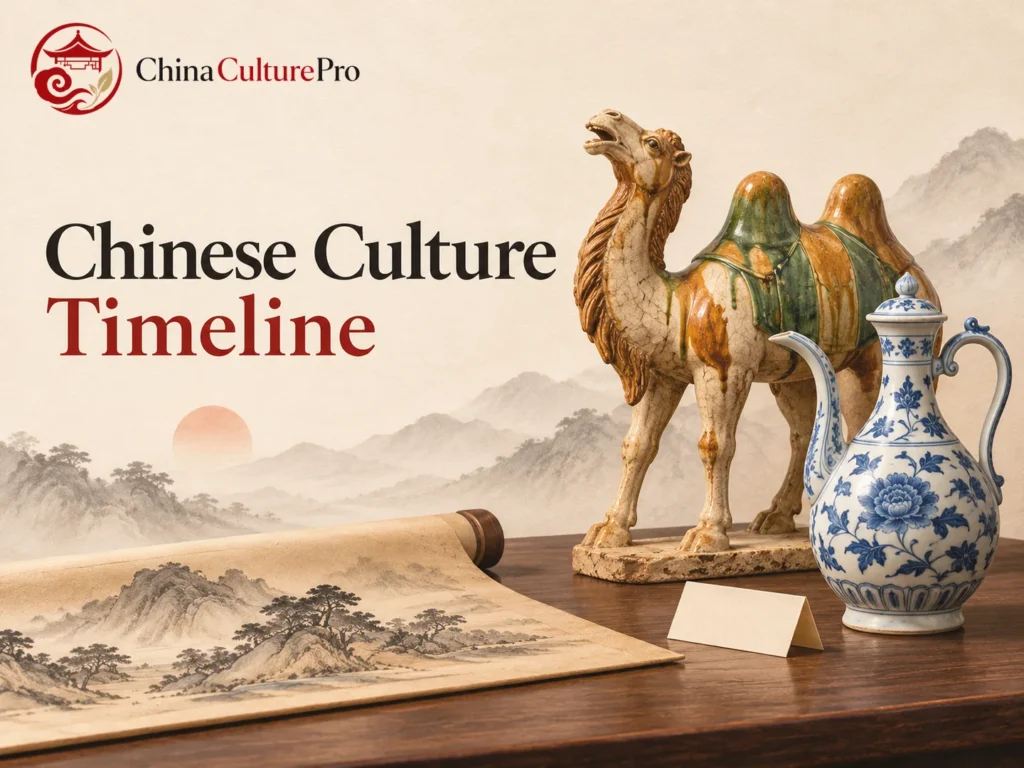
Compare the Tang camel with the Song painting. The camel is earthenware with coloured glaze, a type often called three-colour glaze (三彩, sāncǎi). Its packed load invites a question about the role of two-humped camels in long-distance transport, even though the sculpture itself comes from a tomb context. Ma Yuan’s painted album leaf uses ink and colour on silk. Ask how a small figure and the waterfall help organise the scene.[3][4]
Use the Ming and Qing vessels to look at exchange. The museum links the Ming ewer’s shape to Middle Eastern metal pitchers and offers a possible European source for the design motif. The Qing dish was made in China and later belonged to a New York family’s porcelain service. Ask what different kinds of evidence shape and ownership supply. A documented owner and a proposed design source should be labelled differently on a classroom card.[5][6]
How to Teach the Timeline With Object Cards
1. Prepare one card per object
Put the image on the front and the museum title, date range, medium and collection reference on the back. Leave the date visible only after students have described the image.
2. Observe, then place the cards
Have students record one visible detail and propose one use or association. Turn the cards over, compare those ideas with the museum labels, and place each card using the date provided.
3. Compare two cards and show a gap
Choose two objects and ask what changed in materials, use or ownership. Have students support one claim with a visible detail or a museum label. Mark at least one blank stretch on the line and ask what kind of object could help fill it.
For younger learners, compare just two pictures aloud before adding the rest. The Chinese culture activities for kids guide offers other topics that can complement the object exercise.
FAQs About a Chinese Culture Timeline
Should students memorise all the dynasty dates?
Start with the order of the objects, then add dynasty ranges as students need them. The key task is to connect a dated example with something the student can observe and explain.
What if the museum gives only a date range?
Keep the range on the card. The date communicates the precision of the label, and a broad range can give students a reason to ask what evidence the curator used.
資料來源
[1] Smithsonian National Museum of Asian Art. Timeline of Chinese History, Art, and Culture
[2] The Metropolitan Museum of Art. Shang Oracle Bone
[3] The Metropolitan Museum of Art. Tang Camel
[4] The Metropolitan Museum of Art. Ma Yuan: Scholar Viewing a Waterfall
[5] The Metropolitan Museum of Art. Ming Magic Fountain Ewer
[6] The Metropolitan Museum of Art. Chinese Export Porcelain Dish