


Quick Answer: Where Did Chinese Civilization Begin?
Chinese civilization grew from several regional societies. Early farmers, large settlements, political centers and written records appeared at different times in what is now China. The Yellow River (黄河, Huáng Hé) basin was important to early states. The Yangtze River (长江, Cháng Jiāng) basin and other regions also developed major centers.[1][5][7][10][12]
- Farming: Millet became important in the north, and rice cultivation supported settlements in the Yangtze basin.[1][2][3][4]
- Regional centers: Excavated dams, stone walls and jade objects show distinct ways of organizing work and ritual.[5][6][7][8][9]
- Early states and writing: Central Plains centers grew during the Bronze Age. Late Shang inscriptions preserve the earliest extensively attested Chinese writing.[10][12][13]
Farming, urban development, writing and imperial unification are separate historical milestones.[1][5][12][16]
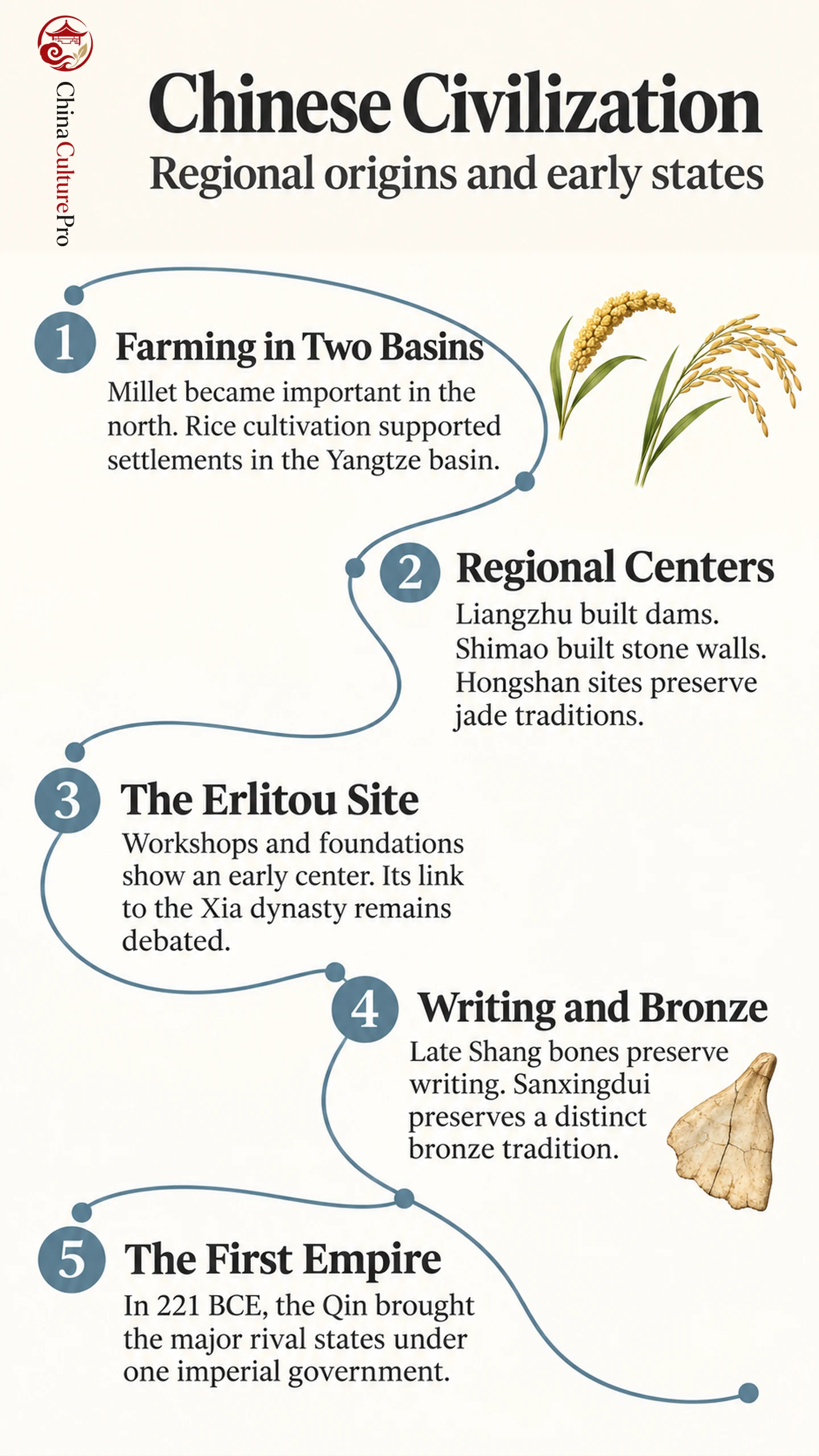
A storage pit preserves signs of food production. A dam points to coordinated construction. A written bone can preserve the questions people asked. Each tells a different part of the history.[2][3][6][12]
Early Farming in the Yellow and Yangtze River Basins
Settlements in the Yellow and Yangtze river basins used different combinations of local plants and animals. Over time, millet became important across much of the north, and rice was cultivated in parts of the Yangtze basin. That pattern emerged over time. A broad account of Chinese prehistory draws on evidence from many such sites.[1][2][3][4]
At Shangshan (上山, Shàngshān) in Zhejiang, researchers analyzed microscopic residues from pottery roughly 10,000 years old. They identified traces associated with processing rice and interpreted some samples as evidence of fermentation. At Cishan (磁山, Císhān) in Hebei, researchers identified microscopic remains of common millet in storage pits. Pottery residues show what went into a vessel. The pits show that millet was kept at a settlement, even where the amount each household ate is uncertain.[2][3]
Finding millet at a settlement and establishing that millet was a staple are different tasks. Chemical signatures in human bone can reflect long-term diet. In some northern populations, those signatures help trace when millet became a substantial part of what people ate. Crop remains and evidence of diet can give different dates for the same region because they record different changes.[3][4]
Regional Centers and Their Material Cultures
Liangzhu (良渚, Liángzhǔ) developed near the lower Yangtze and Lake Tai between about 3300 and 2300 BCE. The site includes earthen structures, an extensive system of dams and burials furnished to different degrees. Rice farming supported the settlement. Building across valleys and managing water over a wide area required workers to coordinate beyond the level of a single household.[5][6]
Far to the northwest, Shimao (石峁, Shímǎo) in present-day northern Shaanxi flourished around 2300–1800 BCE. Stone walls and a prominent elevated central complex show a different use of monumental construction. The walls organize movement across a high site. At Liangzhu, structures across the lower landscape affected the movement of water. Both projects document labor on a scale beyond the household.[5][6][7]
The northeastern Hongshan (红山, Hóngshān) tradition offers another kind of evidence. Jade objects found at sites including Niuheliang (牛河梁, Niúhéliáng) help document practices associated with burials and ceremonial places. A carved plaque preserves the choices of a craftsperson. An excavated burial also records where such an object lay and which objects accompanied it. The archaeological context is especially useful when interpreting what jade did in a ceremony.[8][9]
Erlitou, the Central Plains and the Xia Question
Erlitou (二里头, Èrlǐtóu), in present-day Henan, had emerged as a regional center by about 1750 BCE. Excavations have revealed large building foundations and areas where craftspeople worked bronze, turquoise and other materials. The location of workshops near a central complex is useful evidence for studying how production and power were organized.[10]
The site is often associated with the Xia dynasty (夏朝, Xià Cháo), described in much later texts. The site’s date, scale and location make the association plausible to many archaeologists. The dynastic identification remains debated because no excavated text from Erlitou identifies its rulers as Xia. The buildings and workshops can still be studied as evidence of an early political center, whatever its rulers called themselves.[10][11]
Shang Writing and Regional Bronze Traditions
The late Shang dynasty (商朝, Shāng Cháo) left a different kind of record at Yin Xu (殷墟, Yīnxū), near Anyang in Henan. Inscriptions in oracle-bone script (甲骨文, jiǎgǔwén) on turtle shells and animal bones record questions and other details of royal divination. The texts give historians direct access to words used in a late Shang court, alongside remains of buildings, tombs and workshops.[12][13]
Some much older objects also carry marks. At Jiahu (贾湖, Jiǎhú), signs on objects from the seventh millennium BCE are evidence of deliberate marking. The surviving examples are too few to demonstrate that the people who made them used a developed script to record language. Late Shang inscriptions preserve enough connected language for scholars to study how words and statements were formed.[13][14]
Bronze Age sites outside the Central Plains produced work with distinctive forms. Excavations at Sanxingdui (三星堆, Sānxīngduī) in Sichuan uncovered large bronze masks and human figures. These works stand beside Shang ritual vessels as evidence for more than one center of sophisticated bronze casting, each with its own combinations of forms and uses.[12][15]
From Zhou States to the First Empire
The Zhou dynasty (周朝, Zhōu Cháo) succeeded the Shang.[17]
A ninth-century BCE Zhou bronze grain vessel has the same inscription cast inside the bowl and the lid. It records who commissioned the vessel and for whom. This is a different use of writing from the royal divination on Shang bones. On the bronze, the record of a relationship formed part of an object meant to last.[12][18]
Over centuries, regional states developed their own political centers and competed for territory. By the Warring States period (战国时期, Zhànguó Shíqī), several powerful rivals were fighting for supremacy. The Qin dynasty (秦朝, Qín Cháo) brought the major rival states under one imperial government in 221 BCE.[16][17]
Imperial government changed the scale at which rules and administrative practices operated. The Qin pursued common standards across conquered territories, including in writing and measurement. The Han dynasty (汉朝, Hàn Cháo) built on parts of the imperial system. By 221 BCE, farming, monumental building, bronze casting and writing already had long regional histories. A Chinese dynasties timeline places political consolidation alongside those earlier developments.[1][12][16][17][19]
FAQs About the Origins of Chinese Civilization
Did Chinese civilization begin only in the Yellow River basin?
The Yellow River basin was a major center of millet agriculture and early states. Evidence from the lower Yangtze, the northeast and other regions documents additional centers of farming, ritual and large-scale construction.[1][5][7][9]
What is the oldest surviving Chinese writing?
Late Shang oracle-bone inscriptions provide the earliest extensive surviving evidence of a developed Chinese writing system. Earlier marks exist, including signs from Jiahu, but their relationship to later writing is uncertain.[12][13][14]
Did the Qin dynasty create Chinese civilization?
In 221 BCE, the Qin founded the first unified empire by conquering the rival states. The cultures it incorporated already had long histories of farming, craft production, ritual and government.[1][12][16][17]
資料來源
[1] Smithsonian National Museum of Asian Art. Neolithic Period
[2] Proceedings of the National Academy of Sciences. Rice Processing and Fermentation at Shangshan
[3] Proceedings of the National Academy of Sciences. Early Common Millet at Cishan
[4] American Journal of Physical Anthropology. The Earliest Evidence of Millet as a Staple Crop
[5] UNESCO World Heritage Centre. Archaeological Ruins of Liangzhu City
[6] Proceedings of the National Academy of Sciences. Early Hydraulic Engineering at Liangzhu
[7] Nature. Ancient DNA from Shimao City
[8] The Metropolitan Museum of Art. Hongshan Jade Plaque
[9] The Oxford Handbook of Early China. The Jade Age Revisited
[10] Cambridge University Press. Introduction to the Archaeology of Bronze Age China
[11] Early China. Erlitou and the Search for the Xia
[12] UNESCO World Heritage Centre. Yin Xu
[13] Cambridge University Press. Chinese Writing
[14] Antiquity. Sign Use at Jiahu
[15] The Metropolitan Museum of Art. Ancient Sichuan: Treasures from a Lost Civilization
[16] The Metropolitan Museum of Art. Age of Empires: Exhibition Galleries
[17] The Metropolitan Museum of Art. China, 1000 BCE to 1 CE
[18] The Metropolitan Museum of Art. Western Zhou Grain-Serving Vessel
[19] The Metropolitan Museum of Art. Qin and Western Han Dynasties