

Quick Answer: Who Was Cao Pi?
Cao Pi (曹丕, Cáo Pī, 187–226) was the son and heir of Cao Cao (曹操, Cáo Cāo). In 220, he received the abdication of Emperor Xian (汉献帝, Hàn Xiàndì) and became the founding emperor of Cao Wei (曹魏, Cáo Wèi). He is also known as Emperor Wen of Wei (魏文帝, Wèi Wéndì).[1][2]
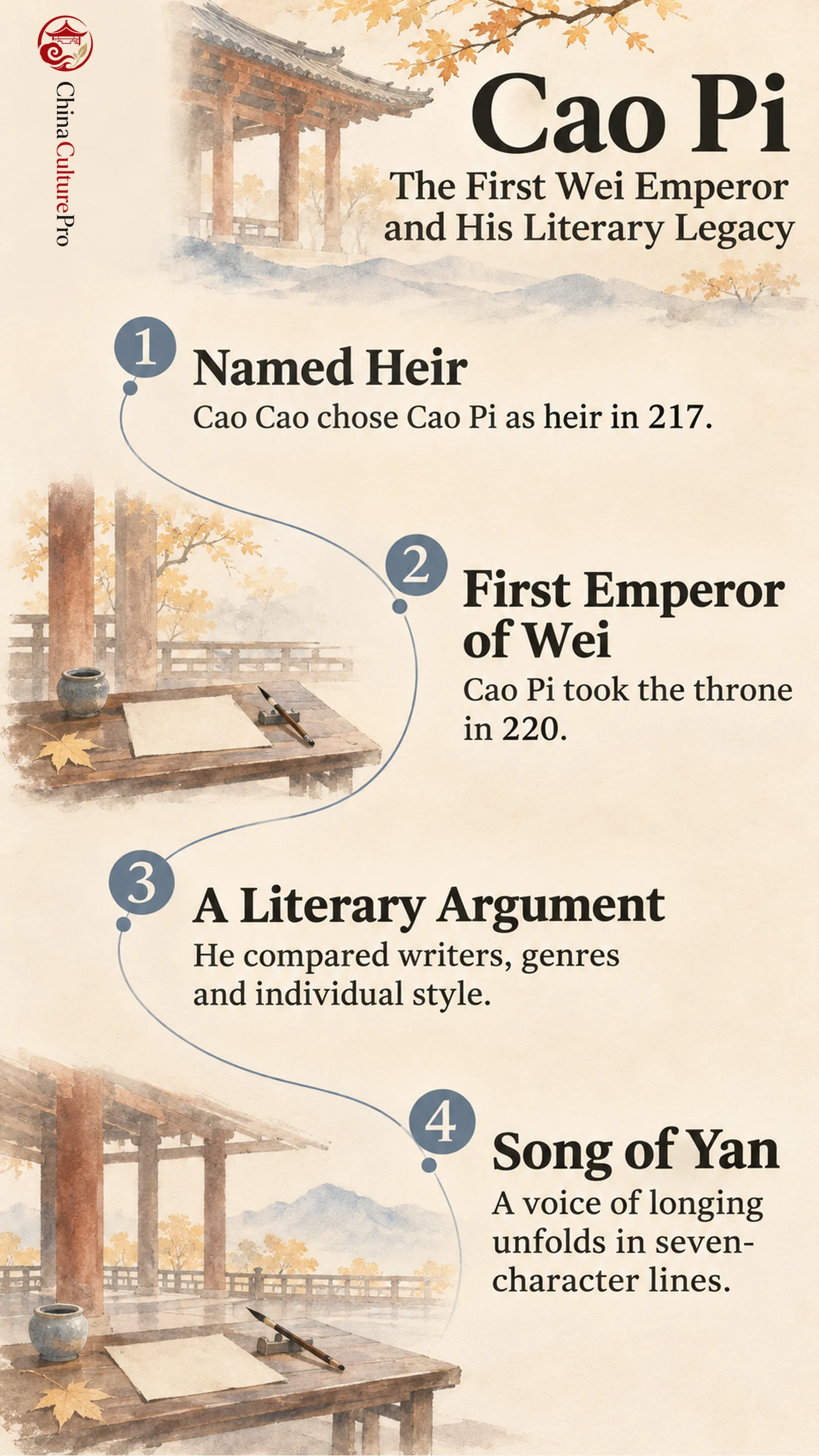
- Succession: Cao Cao chose him as heir in 217 after a contest in which his younger brother Cao Zhi (曹植, Cáo Zhí) was a possible successor.[1][2]
- State: His accession ended the Eastern Han imperial line and established Wei as an imperial dynasty.[1]
- Literature: His surviving work includes a sustained argument about writing and poems about separation.[4][6]
The official history tells the story of a ruler. His surviving writing lets you hear him as a critic and watch him adopt the voice of a fictional speaker.
Cao Pi’s two most visible legacies call for different kinds of reading. To follow the transfer of power in 220, use dates, offices and the political language of the official record. To read his essay or his poetry, listen for the differences between writers, genres and voices. The same court sustained both kinds of activity.
How Cao Pi Became Heir to Cao Cao
The Records of the Three Kingdoms (三国志, Sānguó Zhì) records Cao Pi’s appointments and his designation as heir in 217. By then, Cao Cao had assembled a powerful administration in northern China while the Han emperor remained on the throne.[1]
Cao Zhi was a younger brother and literary contemporary. The possibility that Cao Cao might choose him shaped accounts of the two men. The sources also preserve the work of both brothers among the writers associated with the Jian’an era (建安, Jiàn’ān). The literary circle was larger than the succession contest.[2][7]
The chronology is useful when reading later stories. Cao Pi was first an heir to the kingdom of Wei, then inherited it on his father’s death, and only afterward became emperor. Those steps involved different titles and political arrangements.[1]
What Changed When Wei Replaced the Han
In 220, the last emperor of the Eastern Han formally abdicated in favor of Cao Pi. The official account presents the transfer with formal language about the authority of the old and new rulers. The transition ended the Han dynasty and gave Wei an emperor of its own. Liu Bei and Sun Quan still held separate power bases, so Wei’s new title did not reunify the former Han empire.[1]
In government, the nine-rank system (九品中正制, jiǔpǐn zhōngzhèng zhì) is associated with Wei and the official Chen Qun (陈群, Chén Qún). Officials assessed candidates in local communities and assigned grades that could guide recruitment. This helps show the difference between early medieval selection and the later imperial examinations.[3]
Cao Pi died in 226 and was succeeded by his son Cao Rui (曹叡, Cáo Ruì).[1]
The wider Three Kingdoms period continued beyond both reigns. For the later storytelling tradition, consult the Romance of the Three Kingdoms as a separate work with its own treatment of the past.
How Cao Pi Judged Other Writers
Cao Pi’s Discourse on Literature (论文, Lùnwén) survives from the Dianlun (典论, Diǎnlùn). The larger work survives in fragments. The essay begins with writers undervaluing one another and illustrates the problem through authors with different strengths. It distinguishes kinds of composition by what each demands.[4][5]
His use of qi (气, qì) connects the quality of writing to a writer’s individual disposition, often explained as a kind of vital force. A comparison with musical performance helps make the idea concrete. People can learn the same piece and follow the same rhythm, while the way they breathe and carry the music remains their own.[4][5]
Cao Pi also argues that writing can matter to a state and outlast the writer. Put that argument beside the opening about authors misjudging each other. The essay asks how to assess particular skills and why it matters to preserve good writing, both recurring questions in Chinese literature.[4][7]
What His Song of Yan Does as a Poem
In the first Song of Yan (燕歌行, Yān Gē Xíng), the speaker watches autumn take hold and thinks about someone far from home. She turns to music, and the night sky brings a pair of figures separated by the Milky Way into view. The movement from the room to the sky keeps the poem’s focus on distance.[6]
It is an early surviving example of an extended poem built from seven-character lines. The same seven-character frame carries images of weather, a room, a musical instrument and the night sky. If you are reading in translation, follow the repeated return to separation. If you have the original, count the characters of each line before considering how the form sits in the wider history of Chinese poetry.[6]
FAQs About Cao Pi
When did Cao Pi become emperor?
He became the first emperor of Wei in 220, after Emperor Xian abdicated. He reigned until 226.[1][2]
Was Cao Pi the father or brother of Cao Zhi?
Cao Pi was Cao Zhi’s older brother. Both were sons of Cao Cao. Cao Rui, who succeeded Cao Pi, was his son.[1]
Where can you read Cao Pi’s literary criticism?
Look for Discourse on Literature, the surviving essay from the Dianlun. Xiaofei Tian’s English translation appears in Hawai‘i Reader in Traditional Chinese Culture.[4][5]
資料來源
[1] Chen Shou. Records of the Three Kingdoms, Volume 2
[2] Rafe de Crespigny, Cambridge University Press. The Three Kingdoms and Western Jin
[3] Cambridge University Press. The Political Economy of China’s Imperial Examination System
[4] Cao Pi. Discourse on Literature, from the Dianlun
[5] Xiaofei Tian, University of Hawai‘i Press. Cao Pi: A Discourse on Literature
[6] Cao Pi. Song of Yan
[7] Chen Ching-yuan, Bulletin of Chinese Literature. The Historical Significance of the Discourse on Literature