


Quick Answer: What Is Bubble Tea?
Bubble tea is a Taiwanese drink family best known for pearl milk tea (珍珠奶茶, zhēnzhū nǎichá): tea mixed with a milk component and chewy tapioca pearls. It developed in Taiwan in the 1980s, although competing invention accounts remain unresolved.[1][2]
- Classic cup: Tea, milk or creamer, sweetener and tapioca pearls.
- Modern menu: Milk-free fruit teas, different tea bases and many toppings also appear.
- Ordering: Choose the drink first, then check toppings, sweetness, ice and available milk options.
The name covers a flexible menu category. A drink sold by a bubble-tea shop does not necessarily contain tea, dairy or traditional pearls.
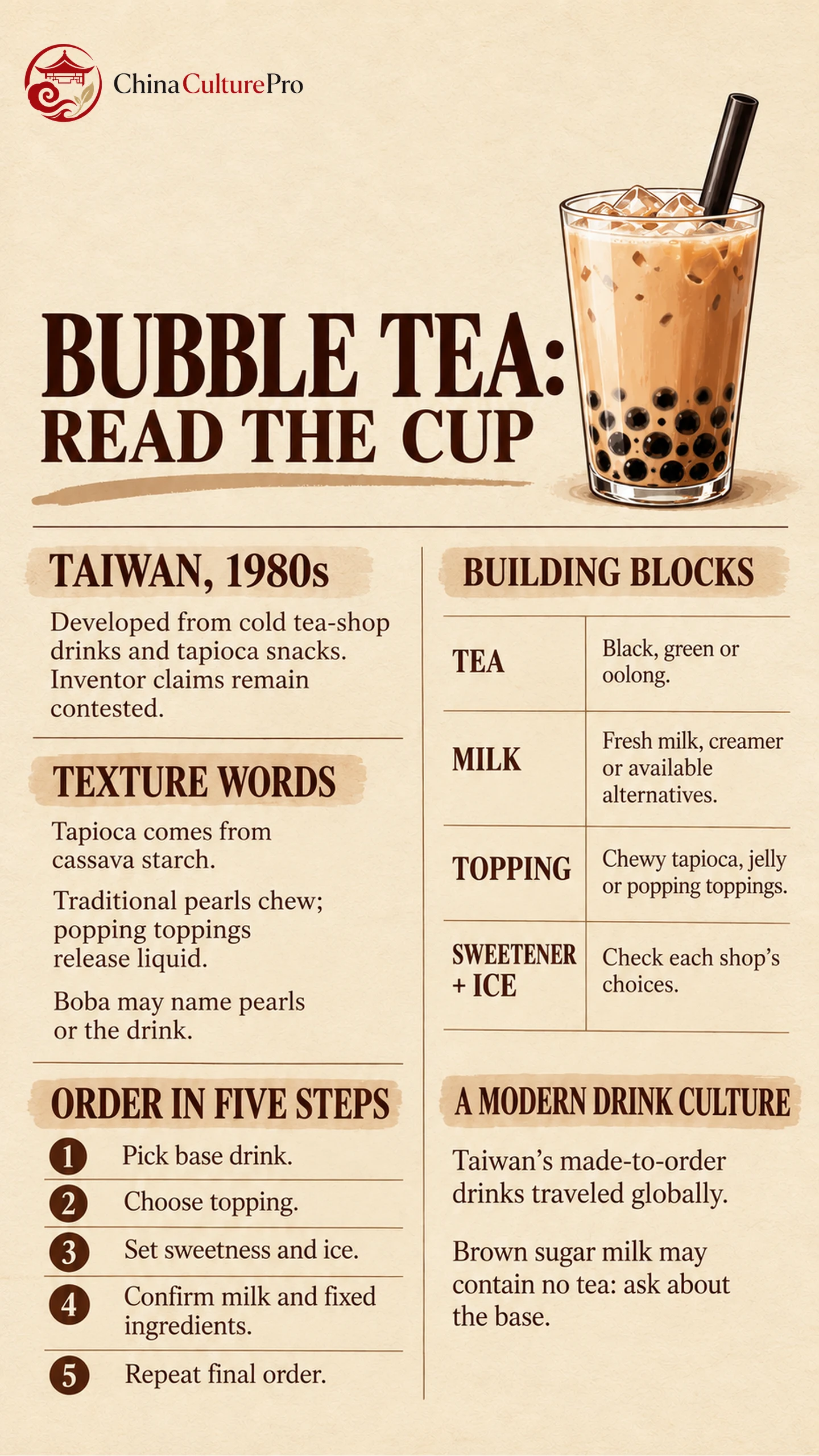
The pleasure of bubble tea lies partly in texture and partly in choice. Tea may be the main flavor, or it may share attention with milk, fruit or syrup. Reading those elements separately makes a crowded menu easier to navigate and helps distinguish this Taiwanese tradition from other Chinese milk tea styles.
Taiwanese Origins Without a Single Inventor Story
The broad historical setting is clear: Taiwan’s tea shops developed cold, shaken tea drinks, and the addition of familiar tapioca snacks created a new combination of drinking and chewing. Tourism accounts place pearl milk tea after the development of foam black tea.[2]
Accounts associated with tea houses in Taichung and Tainan offer competing explanations of who first combined the ingredients. Dates and details differ between tellings. It is more accurate to identify 1980s Taiwan as the setting than to present one staff-meeting anecdote or one shop’s claim as a settled invention record.[1]
This distinction preserves what matters culturally. Bubble tea emerged from an existing environment of tea drinking, small shops and sweet snacks, then became a recognizable drink in its own right. Its history does not require imagining that tea, milk or tapioca itself was newly invented at that moment.
What Goes into a Cup
Think of a cup as several components rather than a single standard formula. Shops’ customization of sweetness, ice, pearls and milk makes those components visible to the customer.[3]
| 組成 | What to check on the menu |
|---|---|
| Tea base | Black, green or oolong tea may lead the flavor; some milk-based drinks omit tea altogether. |
| Milk component | Fresh milk, creamer or an offered plant-based alternative can produce different textures and ingredient profiles. |
| Pearls or other topping | Traditional tapioca gives chew; jelly or popping toppings create a different sensation. |
| Sweetener | Added syrup is one source of sweetness, but toppings and prepared mixtures may contribute their own. |
| Ice and temperature | Available settings affect chill and dilution; not every drink permits every option. |
中國紅茶 can provide a pronounced base for milk, while 烏龍茶 offers another aromatic direction. Those broad differences help with a first choice, but brewing strength and the rest of the recipe matter too. Compare the finished recipe as well as the tea name.
If ingredients matter to you, ask about the actual product rather than relying on the drink’s color or the word “milk.” A creamer-based drink and a fresh-milk drink are different recipes. Likewise, a plant-based milk option does not establish the ingredients of every syrup, foam or topping added to the cup.
Pearls, Boba and Other Toppings
Traditional tapioca pearls are connected with fenyuan (粉圓, fěnyuán), a familiar Taiwanese starch-based snack. Tapioca itself is starch obtained from cassava root.[2][4] Cooked tapioca pearls contribute a resilient chew, making texture part of the drink rather than an incidental garnish.
Boba (波霸, bōbà) can refer to larger pearls and, in some English-speaking settings, to the drink category more generally. Local usage is not perfectly uniform. If size or texture matters, the topping description is more reliable than assuming “boba” has only one meaning everywhere.
Not every round topping is tapioca. Popping toppings are designed to release liquid, while jellies have a different bite; a menu may also offer pudding or other additions. Treat them as alternatives, not merely different colors of the same pearl. Ingredient lists and staff explanations are useful when the menu uses a proprietary name.
For a first cup, choosing one topping makes its texture easier to recognize. Adding several can be enjoyable, but it also changes the balance between drink and solids. Choose the combination for its flavor and texture rather than treating the number of toppings as an authenticity test.
How to Read a Bubble Tea Order
A short sequence turns customization into a clear request rather than a string of unfamiliar options.
- Pick the base drink. Decide whether you want tea with milk, a milk-free tea drink or a milk-based specialty; ask whether tea is included if the name is ambiguous.
- Choose the topping. Check whether pearls are already included, then select the texture you want rather than assuming every option is tapioca.
- Set sweetness and ice. Use that shop’s available terms; the same percentage at another shop need not produce the same sweetness.
- Confirm the milk and fixed ingredients. Ask which components can change and whether a prepared syrup, topping or mixture remains sweetened.
- Repeat the finished order. A description such as black milk tea, tapioca pearls, less added syrup and regular ice identifies the important choices without needing a universal naming system.
“No added sugar” needs particular care as menu language. Analysis of tea-based beverages has separately examined no-added-sugar drinks and their tapioca portions: sweetened toppings can remain even when extra syrup is omitted.[5] For taste preferences, ask whether the requested setting changes only the liquid or also the topping. It is a recipe question, not a guarantee about the whole cup.
From Tea Shops to a Global Everyday Drink
Hand-shaken drinks (手搖飲, shǒuyáoyǐn) form a wider Taiwanese shop category in which bubble tea sits alongside other made-to-order beverages. Customization is part of the encounter: the customer chooses a combination, and the shop prepares a specific cup. Bubble tea has also traveled internationally and acquired new flavors and names.[1][3]
Brown sugar pearls with fresh milk illustrate how the category can expand beyond the classic tea-and-milk formula. Such a drink may omit tea; a similar-looking cup at another shop may include it. Taiwan’s drink culture includes both versions rather than one recipe that defines every modern order.[6]
For the wider context, explore Chinese tea culture and the broader Chinese drinks guide. Bubble tea’s particular contribution is the combination of a tea-shop setting, a chewable ingredient and a highly personal order.
FAQs About Bubble Tea
Does every bubble tea contain milk?
No. Milk-free tea and fruit-tea versions are common menu possibilities. Check the recipe, including toppings and foams, if you want to know the full ingredient list.
Is brown sugar milk always made with tea?
No. Some versions combine milk, brown sugar syrup and pearls without tea. Ask whether a tea base is included in that specific drink.
Does zero sugar mean the whole drink contains no sugar?
Not necessarily. It may mean no extra syrup in the liquid. Prepared toppings and other ingredients can still contain sugar, so clarify what the shop’s setting changes.
資料來源
[1] Taiwan Immigrants Global News Network. The Origins of Bubble Tea, One of Taiwan’s Most Beloved Beverages
[2] Taiwan Tourism Administration. Snacks and Drinks
[3] Taipei City Department of Information and Tourism. A Taster’s Guide to Taipei
[4] US Department of Agriculture. Cassava Inspection Instructions
[5] Centre for Food Safety. Sugar and Energy Contents of Common Non-Indigenous Tea-Based Beverages in Hong Kong
[6] Taipei City Department of Information and Tourism. Drinkipedia: The Lowdown on Taiwanese Drinks