
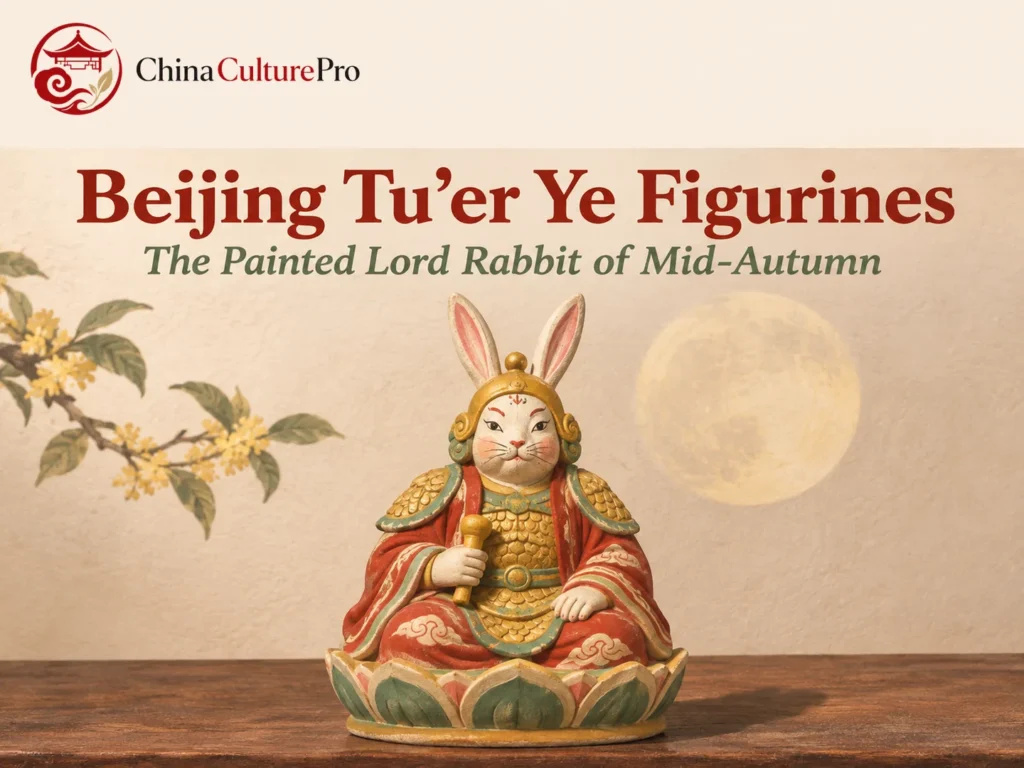

Quick Answer: What Is a Beijing Tu’er Ye Figurine?
Tu’er Ye (兔儿爷, tùr yé), or Lord Rabbit, is a painted clay figure with a rabbit’s head and a human body. In Beijing the figure is closely associated with the Mid-Autumn Festival. It can wear armor or an ornate robe and may hold a pestle, an attribute of the rabbit in the moon. [1][2][4][7]
- Material: A clay body carries painted clothing and facial details.
- Season: The figurine appeared in Beijing’s markets around Mid-Autumn.
- Variation: Artists give it different outfits, mounts and seats. [1][4][5]
The ears and rabbit face help identify the figure. A tiger or another mount is a design choice. [1][2][4]
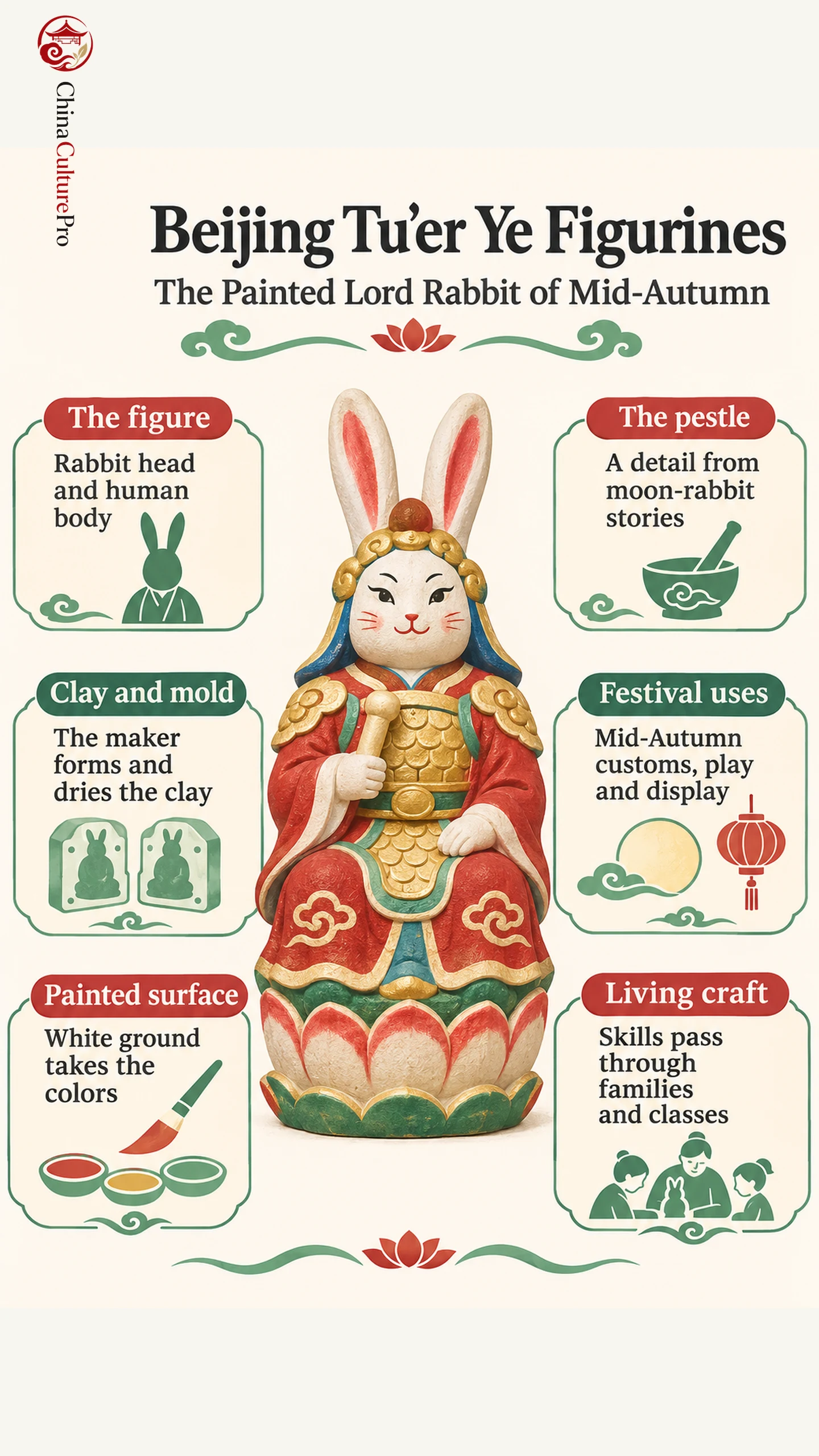
The figure can look solemn even when it is only a few centimeters tall. Its upright ears and small mouth announce a rabbit, while armor, a robe or a seat suggest the human character the maker has given it.
Why Lord Rabbit Appears at Mid-Autumn
In moon stories, the Jade Rabbit (玉兔, yùtù) pounds medicine with a pestle. The Beijing figurine gives this character a human body and a costume. The national heritage account also records a local legend about the rabbit coming down to help people during an epidemic. The story gives the pestle a local meaning. It recalls the moon rabbit’s healing role and gives the figure a place in wishes for good health. [1][2][4]
Beijing’s municipal heritage guide points to a late-Ming account by Ji Kun of children venerating painted clay rabbits at Mid-Autumn. The Palace Museum cites the later festival chronicle by Fucha Dunchong for the sale of clay figures in the city. The heritage account describes children playing with them after observances, showing how a single object could serve in both Mid-Autumn customs and play. [1][2][4]
How Clay Takes Shape and Color
A museum program at Prince Kung’s Palace documented kneading the clay, forming it in a mold and letting it dry. Forming sets the figure’s proportions. The painted face, border lines and costume colors then make the same basic shape read as a particular character. This places Tu’er Ye within the wider tradition of Chinese clay figurines. [1][3]
The class taught brushing on a white ground and adding colors. The Palace Museum catalog describes this layered treatment on one of its own figures. A pale face with softly tinted cheeks can sit beside much stronger reds, greens or gold tones in the costume. At this scale, a fine line around a sleeve or a trace of red at the cheek can separate one part of the figure from the next. [2][3][5]
Reading Two Figurines in the Palace Museum
One late-Qing example stands just 7.5 centimeters high. It sits on a model city wall with a camel at its side. The Palace Museum identifies it as part of the former imperial collection and notes that court examples were purchased outside the palace. Its collection history shows that a figure sold outside the court for a seasonal custom could also enter the palace. [4]
A second catalog entry describes a rabbit with a green headcloth, red robe and pestle, seated on a cluster of lotuses. The museum reads its costume and pose as an echo of Guan Gong. Its pestle points to the moon-rabbit story, while the costume borrows a different visual language. On one figure the architecture gives Lord Rabbit a commanding seat. On the other, dress and pose suggest a familiar hero. Both preserve the rabbit face. [4][5]
How the Craft Is Taught Today
The Beijing Lord Rabbit entry from Chaoyang joined China’s national intangible cultural heritage list in 2014 as an extension of the clay-sculpture category. The register identifies Shuang Yan (双彦, Shuāng Yàn) as a representative practitioner. He learned painted clay sculpture from his father as a child and began taking apprentices in 2000. [1][6]
Museum teaching offers another way to encounter the craft. Prince Kung’s Palace described a class in which students learned how the clay form was made and tried applying the white ground and paint. The 2018 museum class focused on handling materials and painting. Beijing’s later heritage guide also describes studio-based teaching, another setting in which people encounter the figure as folk art. [1][2][3]
FAQs About Beijing Tu’er Ye Figurines
Is Tu’er Ye the same as the Jade Rabbit?
The Jade Rabbit is a character in stories about the moon. Tu’er Ye is the Beijing festival figure made in human dress, often with the rabbit’s medicine pestle. [1][2][4]
Does Lord Rabbit always ride a tiger?
No. Examples may sit on a tiger, deer or other mount, and some have no animal mount. Museum objects include a figure on a city wall and another on lotuses. [1][4][5]
Are Tu’er Ye figurines always toys?
They have served as festival objects, children’s toys and ornaments. Their role depends on how a household, maker or institution uses them. [1][2][3]
資料來源
[1] China Intangible Cultural Heritage Digital Museum. Clay Sculpture: Beijing Lord Rabbit
[2] Beijing Municipal Government. Heritage Renewed, Values Shared: Lord Rabbit Clay Figure
[3] Prince Kung’s Palace Museum. Museum Class on Lord Rabbit Clay Figures
[4] The Palace Museum. Clay Lord Rabbit, Gu 00179933
[5] The Palace Museum. Clay Lord Rabbit, Green Headcloth and Red Robe
[6] China Intangible Cultural Heritage Digital Museum. Representative Practitioner: Shuang Yan
[7] Taiwan Ministry of Education. Revised Mandarin Chinese Dictionary: Lord Rabbit