

Quick Answer: What Happened at the Battle of Red Cliffs?
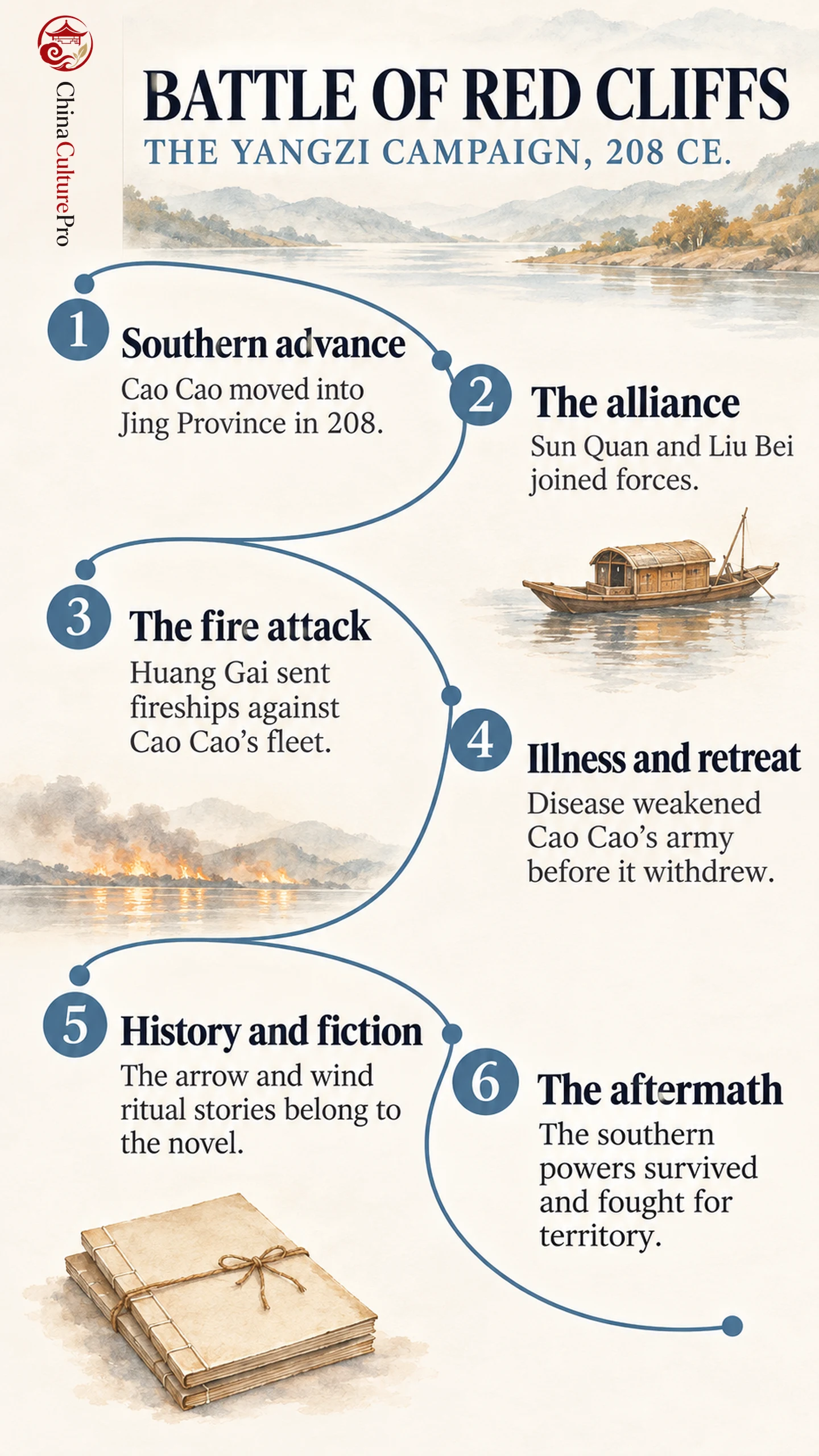
The Battle of Red Cliffs (赤壁之战, Chìbì zhī zhàn) was a victory in 208 CE for the allied forces of Sun Quan (孙权, Sūn Quán) and Liu Bei (刘备, Liú Bèi) over Cao Cao (曹操, Cáo Cāo) on the middle Yangzi. The southern alliance used fireships. Cao Cao’s army also suffered from disease and withdrew. [1][2][3]
- Before the battle: Cao Cao moved south after gaining ground in northern China.
- During the battle: Fireships struck Cao Cao’s fleet, and fire spread to positions ashore.
- After the battle: The southern powers survived, but further fighting over territory followed. [1][3][4]
The battle belongs to the end of the Han. The later states emerged from several more years of fighting and political change. [3][4]
At Red Cliffs, control of the river mattered as much as the size of an army. Ships moved men and supplies and could threaten positions on either bank. The battle became famous for fire because a smaller allied force found a way to use those ships against an advancing opponent.
How Cao Cao’s Southern Advance Created an Alliance
In 208, Cao Cao advanced into Jing Province (荆州, Jīngzhōu). Its governor Liu Biao (刘表, Liú Biǎo) died and his son Liu Cong (刘琮, Liú Cóng) surrendered. The surrender gave Cao access to a fleet and supplies in a region where control of the river was essential. Liu Bei retreated rather than submit. His position weakened after the fighting at Changban, and he sought support while moving toward the river. Sun Quan, who held the lower Yangzi, now had to decide whether to resist or accept Cao’s advance. [1][3][4]
Liu Bei sent Zhuge Liang (诸葛亮, Zhūgě Liàng) to Sun Quan as an envoy. Sun chose to fight and sent a force led by Zhou Yu (周瑜, Zhōu Yú) and Cheng Pu (程普, Chéng Pǔ) to cooperate with Liu Bei. The alliance joined men whose immediate interests overlapped. They still had separate forces and ambitions. [1][3][4]
The alliance did not need to defeat every part of Cao’s army at once. It needed to stop his advance along the river. Zhou Yu’s biography presents him arguing that Cao’s forces were extended, had little familiarity with fighting on water and had already traveled far. Those were arguments for taking the risk of resistance, rather than an exact comparison of troop strengths. [1][3]
How Huang Gai’s Fire Attack Worked
The Records of the Three Kingdoms (三国志, Sānguózhì) describes illness in Cao Cao’s army before the main attack. After an initial engagement, Cao’s troops withdrew toward the north bank, identified in the received geography with Wulin (乌林, Wūlín). Zhou Yu’s officer Huang Gai (黄盖, Huáng Gài) proposed attacking the ships by fire because they were close together and a fire could spread among them. [1][2][8]
The Wu account says Huang Gai prepared vessels carrying combustible material and sent word that he intended to surrender. The ships approached under that pretext. Once they were set alight, wind helped the flames spread from ships to positions ashore. The deception mattered because it let the fireships approach before the defenders recognized what they were. [1][3]
Cao Cao’s annals stress setbacks, disease and withdrawal. An annotation in Zhou Yu’s biography also preserves a later claim attributed to Cao that he burned ships himself before retreating. One statement need not account for every burned vessel. The sources assign different weight to allied action and Cao’s decisions, but they agree that his advance failed. [1][2][3]
What History and Fiction Say About Red Cliffs
The Romance of the Three Kingdoms (三国演义, Sānguó Yǎnyì) builds a different role for Zhuge Liang. It has him collect arrows using straw boats and later perform a ritual connected to the wind. The earlier historical account describes his participation in securing the alliance and gives the fireship plan to Huang Gai. The history credits wind with spreading fire. The novel gives Zhuge Liang a ritual role in obtaining it. [1][5]
The novel also supplies its own story for the linking of the ships. The historical passage describes a formation in which vessels were close enough for fire to spread, and a commander who recognized that weakness. It does not need the novel’s additional plot in order to explain why fireships were effective. [1][5]
The same distinction helps when reading Red Cliff in art. The Song writer Su Shi (苏轼, Sū Shì) used a Red Cliff landscape as the setting of his two rhapsodies. Those writings inspired later works, including a Qing vase that depicts the theme. The literary site is associated with Huangzhou. The ancient battlefield is usually identified farther upstream near modern Chibi. The name of a landscape in a poem or painting alone does not establish the precise place of the 208 battle. [6][7][8]
What the Battle Changed Along the Yangzi
The alliance checked Cao Cao’s effort to advance along the Yangzi. He remained powerful in northern China, and the fighting did not end with the fleet’s withdrawal. The contest for Jiangling and other positions in Jing Province continued after Red Cliffs, as both sides fought for control of the corridor. [1][3][4]
Fighting at Jiangling also clarifies what “winning the river” meant. Control of a landing or a fleet did not automatically put a fortified base in allied hands. The ability to hold positions along the Yangzi remained a separate military problem after Cao’s departure. [1][3][4]
The battle mattered because it gave Sun Quan and Liu Bei room to survive and expand. The later Three Kingdoms period grew out of those competing bases. The battle itself created neither a permanent alliance nor an immediate three-way settlement. [3][4]
FAQs About the Battle of Red Cliffs
Is Red Cliffs the same battle as Chibi?
Yes. Chibi is the Chinese place name commonly translated as Red Cliffs. The two English names refer to the same battle. [3]
Where did the Battle of Red Cliffs take place?
The battle took place on the middle Yangzi in present-day Hubei, upstream of Wuhan. The recognized battlefield is near Chibi, across the river from the area associated with Wulin. Individual positions are harder to reconstruct. [1][3][4][8]
Did the battle create the Three Kingdoms in 208?
No. It blocked Cao Cao’s southern advance in 208 and helped the other powers survive. The formal regimes of Wei, Shu-Han and Wu followed later. [3][4]
資料來源
[1] Chen Shou, with annotations by Pei Songzhi. Records of the Three Kingdoms, Volume 54: Zhou Yu, Lu Su and Lü Meng
[2] Chen Shou, with annotations by Pei Songzhi. Records of the Three Kingdoms, Volume 1: Annals of Cao Cao
[3] Rafe de Crespigny. Wei, in The Cambridge History of China
[4] Rafe de Crespigny. Generals of the South: The Foundation and Early History of the Three Kingdoms State of Wu
[5] Luo Guanzhong, traditionally attributed. Romance of the Three Kingdoms, Chapters 46–49
[6] The Metropolitan Museum of Art. Square-form Vase with Decoration of Su Shi’s First and Second Rhapsody on Red Cliff
[7] Xiaofei Tian. The Halberd at Red Cliff: Jian’an and the Three Kingdoms
[8] Hubei Provincial Archives. Red Cliff: The Literary Site and the Ancient Battlefield