

Quick Answer: What Was the Baojia System?
The baojia (保甲, bǎojiǎ) system organized households into groups with local leaders and duties for maintaining order. In the Northern Song, the groups carried out patrol and reporting duties and later supplied men for military training. Under the Qing, versions of baojia placed particular emphasis on registering households and monitoring local residents.[1][2][3][4]
- Membership: The household was the basic unit.
- 責任感: Headmen helped organize duties or report information.
- Records: A posted notice or register could identify who belonged to a unit.
Unit names and duties changed with the period and locality.
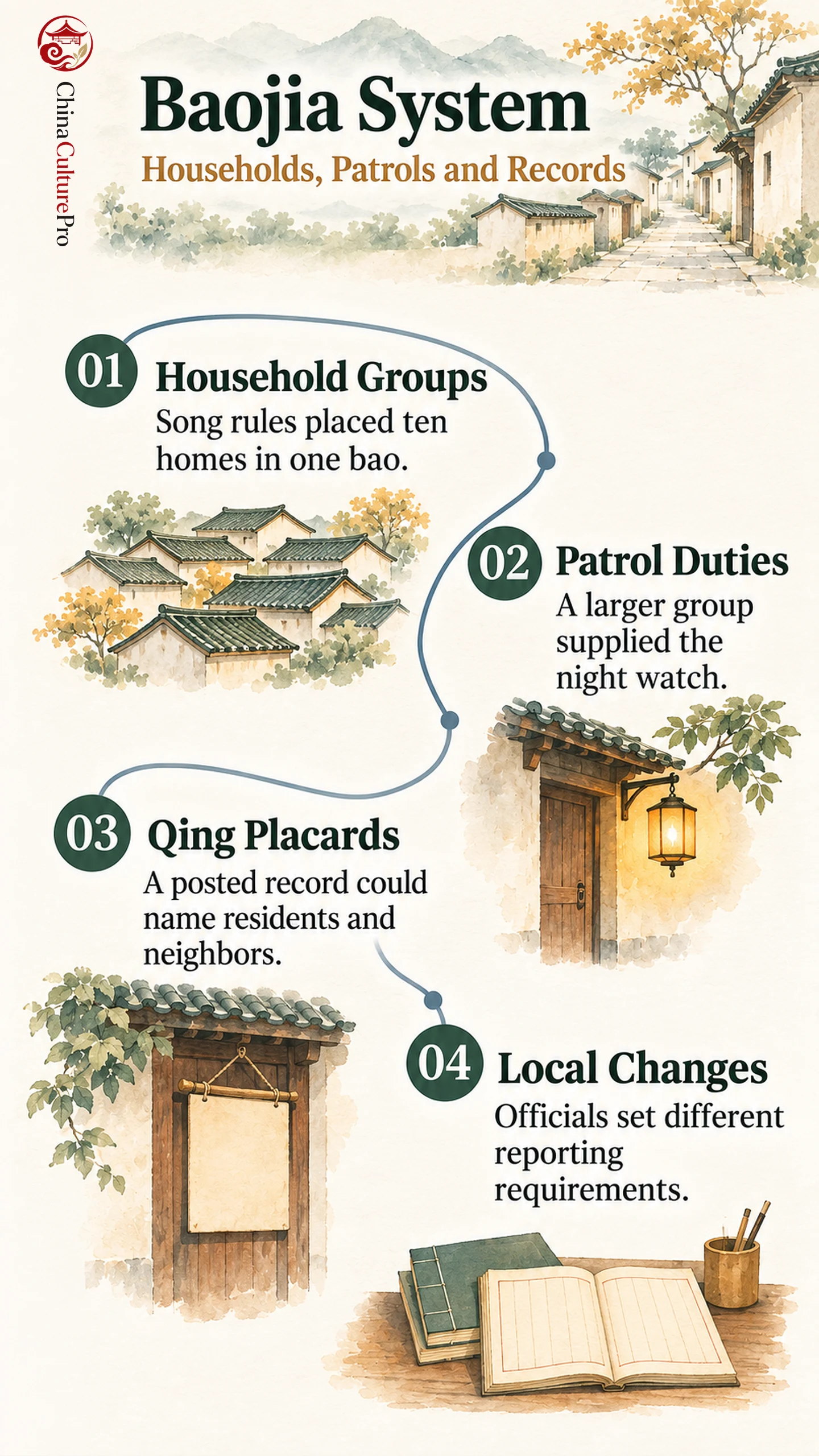
A Northern Song ordinance and a Qing household placard both show neighbors assigned to groups. The ordinance describes who would stand watch and report serious offenses. The placard names the people living at one address and the households beside it.
The Northern Song Plan: Household Groups and Patrols
The Northern Song dynasty reformer Wang Anshi promoted baojia under Emperor Shenzong. According to the later History of Song, the court began grouping households in 1070. The capital region’s regulations placed ten households in one bao (保, bǎo), fifty in a larger unit and ten of those larger units in the top tier. Each tier had a leader, and the top tier also had a deputy.[1]
The rules called for five people at a time from each fifty-household group to keep watch at night. A household with at least two adult men could be required to provide one for duty. The chronicle distinguishes the initial emphasis on catching offenders from the later introduction of military training. The court was already using the groups for local security when it began training men for military service.[1]
Responsibility was defined by specific rules. In certain serious offenses, a neighbor who knew of the crime and withheld a report could face penalties. The account also lists exceptions and circumstances where liability was assigned differently. The term mutual responsibility covers those duties without making every member equally liable for every offense.[1]
The Qing System: Registration, Placards and Local Headmen
A common Qing dynasty scheme arranged ten households into a pai (牌, pái), ten of those into a jia (甲, jiǎ) and ten jia into a bao. The name for the lowest unit had shifted from the Song example. A door placard (门牌, ménpái) could identify the people registered at a dwelling, while officials and local headmen kept or collected corresponding information.[2][3][4]
Grouping households gave local authorities named people to ask about residents, arrivals or local disturbances. It operated alongside other forms of county administration. In 1757 officials tried to distinguish the policing duties of baojia from responsibilities such as handling tax payments that belonged to other local agents. The division was difficult to maintain in practice.[3]
What a Surviving Household Placard Tells Us
The National Museum of Taiwan History holds a placard for Ye Hexiu dated to the ninth year of the Daoguang reign. A printed frame provides fields filled in by hand. The entry identifies Ye as a farmer from Lufeng and lists relatives in his household. It also names the households on either side and records the name of the local headman.[2]
Printed instructions called for the document to be mounted above the door. The form could therefore tie a household to a physical dwelling and to other named households. The placard tells us what was recorded for one dwelling. Other documents would be needed to establish how many homes were registered and how often the entries changed.[2]
How Officials Adapted Baojia to Local Conditions
Qing officials could disagree about what information was worth collecting. Some nineteenth-century proposals called for detailed entries on women, children and people who had moved for work. In the late Qing, Dai Zhaochen’s rules in Lianzhou retained the small household group and sent reports directly to local militia bureaus, bypassing the larger baojia tiers. He asked the group heads to report household heads’ names and the number of people in each household, leaving out other individuals’ names and ages.[4]
The rules show how a change in the reporting chain could alter the work expected of local leaders. A proposal shows an official’s priorities. A placard or compiled register shows what someone entered. Local archives and county gazetteers can help place either document in a particular administration.[2][4]
FAQs About the Baojia System
Did a bao always contain ten households?
Ten households formed a bao in the early Song capital-region rule. In a common Qing scheme, bao named a much larger unit. The same name needs to be read with the local regulations.
Was baojia the same as a militia?
Baojia organized households. Some governments used those groups to supply or train men for defense, while other duties involved reporting, patrols and keeping household records.
Did every household automatically share punishment?
The Northern Song text tied penalties to particular offenses and reporting duties. Check the specific provision before deciding when responsibility extended from an offender to other households.
資料來源
[1] History of Song, Wikisource. History of Song, juan 192, Military Treatise
[2] National Museum of Taiwan History. Baojia door placard of Ye Hexiu from the ninth year of Daoguang
[3] China Report, SAGE Journals. Household Registration System in the Qing Dynasty
[4] Charles Argon, Journal of Chinese History. Dai Zhaochen Learns to Be an Official