

Quick Answer: What Is Jianzi?
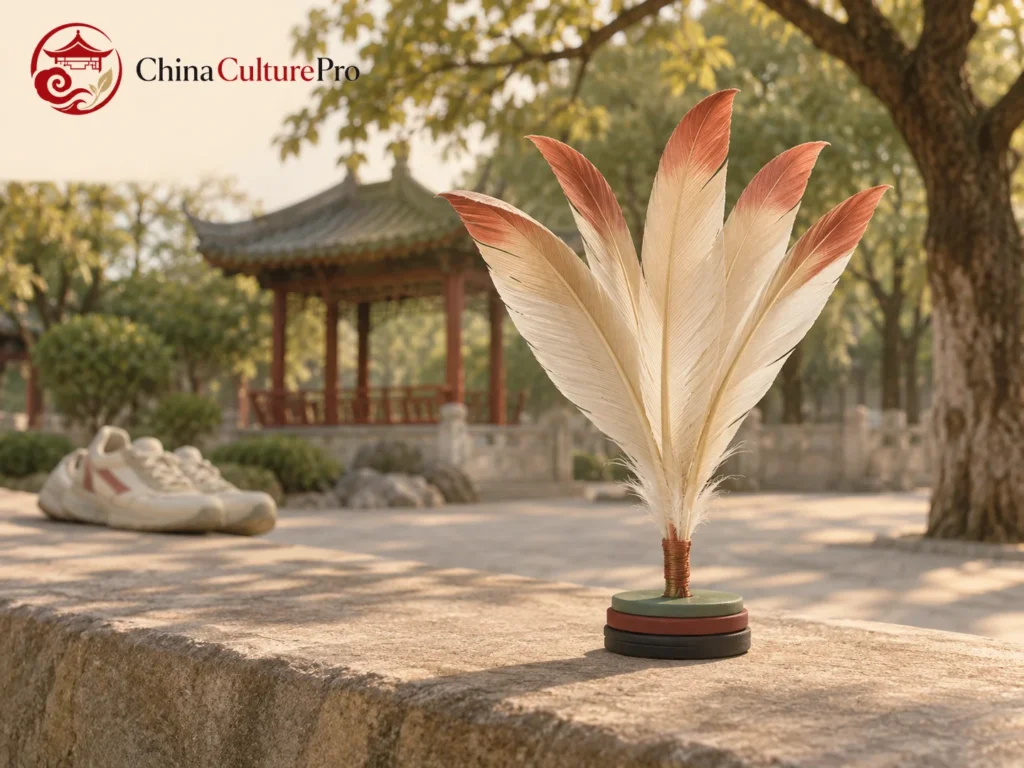
Jianzi (毽子, jiànzi) is a feathered, weighted shuttlecock kept airborne with the feet and other permitted body contacts. The kicking activity is called ti jianzi (踢毽子, tī jiànzi). Its familiar casual form needs neither a racket nor a net.[1]
- Practise alone by linking controlled touches.
- Pass around a circle for a shared keep-up rally.
- Choose a net game when you want opposing sides and formal scoring.
Casual play, trick performance and competitive net sport have different aims. A tournament’s contact limits do not automatically govern a park circle.[1]
The appeal lies in the small object and the changing rhythm around it: a short lift can become a pass, a recovery or the start of a trick. Among Chinese traditional games, jianzi makes the playing skill especially visible.
A Feathered Shuttlecock With a Long History
A jianzi has a weighted base beneath an upright cluster of feathers. A modern competition featherball commonly has four feathers and weighs about 15 grams, but informal handmade objects vary. Those competition specifications describe one sporting implement, not every historical toy.[1]
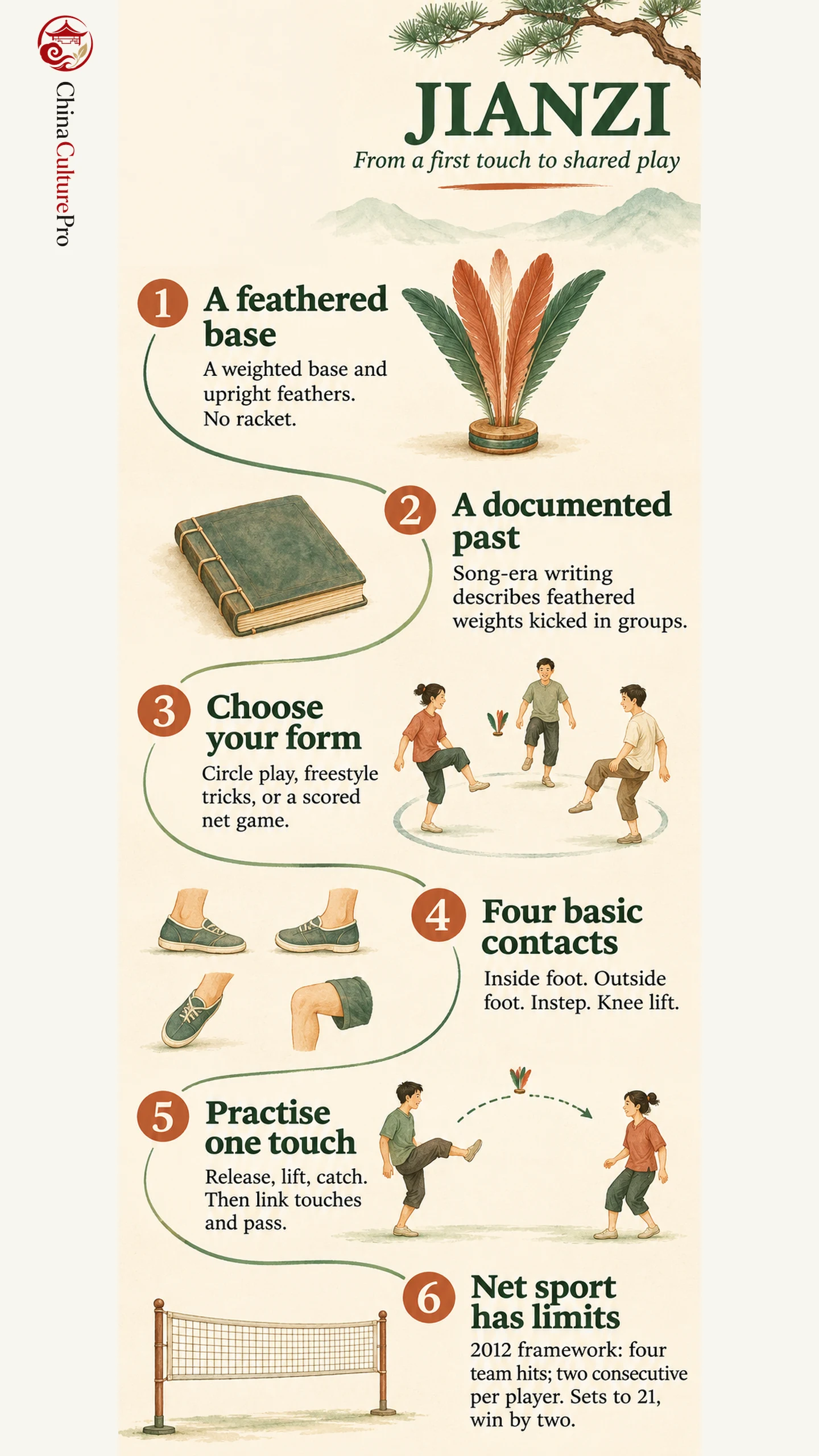
Early-origin accounts associate shuttlecock kicking with the Han period. A clearer written description comes from the Song-era The Origin of Things (事物纪原, Shìwù jìyuán): children fitted chicken feathers to small metal weights and kicked the object in groups. The account describes materials and play; it does not establish one inventor or a precise first year.[3]
The same historical description connects kicking with cuju (蹴鞠, cùjū), the older ball game. That relationship belongs to the history of kicking activities, while a feathered shuttlecock remains a different object from the ball used in cuju.[3]
The move from folk practice into organized sport was gradual. Modern milestones include recognition as a national competition event in 1984, the Chinese association’s establishment in 1987, an international federation in 1999 and the first world championship in Hungary in 2000. These dates concern sporting institutions, rather than the invention of the underlying game.[6]
Choose Between Circle Play, Freestyle and Net Sport
Before joining, look at what the players are trying to accomplish. Three broad forms help explain why one group welcomes a gentle pass while another attempts a demanding individual sequence.[2]
| 形式 | Main aim | 預期特色 |
|---|---|---|
| Circle play | Keep a shared rally alive | Passes between players; a cooperative target |
| Freestyle | Perform controlled tricks or routines | Individual skill and linked movements |
| Net sport | Return the shuttlecock across a net | Opposing sides, boundaries and scored rallies |
In a casual group, agree whether anyone may make several touches before passing, whether you will count a shared total, and how to restart after a drop. These are proposed choices for a beginner session, rather than a universal official circle code.
For example, three friends might try one controlled touch each before passing to the next person. If that makes the rally too short, allow an extra setting touch. The useful measure is whether each player can participate, not whether an invented local rule resembles a championship.
Learn Four Basic Contacts, Then Link Them
Four foundational contacts use different striking surfaces. Begin with the inside-foot contact or a gentle knee lift, rather than trying an acrobatic recovery.[4]
| 聯絡方式 | Surface used |
|---|---|
| Inside-foot kick | Inner arch of the foot |
| Outside-foot kick | Outer edge of the foot |
| Instep kick | Top of the foot |
| Knee lift | Front of the thigh near the knee |
Try this short progression:[4]
- Stand comfortably with room to move, holding the shuttlecock in front of you.
- Release it, raise the inside of one foot under the base, and lift it upward.
- Catch it after that single touch. Repeat before trying consecutive touches.
- Remove the catch, link a few controlled lifts, then pass gently to a partner.
The catch belongs to the drill. It lets you reset and practise contact without pretending that hand catches continue a normal live rally.
Warm up first, use secure footing and leave space between players. Begin with low, manageable movements; stop to reset when balance goes. Difficult jumps and high kicks are skills to learn progressively, rather than requirements for joining a beginner circle.[2]
How Competitive Jianqiu Changes the Rules
The net sport is often called jianqiu (毽球, jiànqiú). It adds defined court space, sides and contact restrictions to the basic challenge of keeping a featherball airborne.[3]
For orientation, the published international version 3.03 rules, released in August 2012, specify the following framework:[5]
- Court: 11.88 metres long and 6.10 metres wide.
- Team event: three players on court for each side.
- Contacts: a side has at most four hits in team games and doubles; singles allow two.
- Individual limit: a player may make two consecutive contacts, but not three.
- Scoring: win a set at 21 with a two-point lead; the match winner takes two sets.
- Rally outcome: landing the shuttlecock on the opponent’s court or receiving an opponent’s fault wins a point.
For example, Player A touches twice, Player B once, and the fourth contact returns the shuttlecock. Four hits belong to the side, not each teammate.[5]
Net play excludes hands and arms. Check the event’s adopted rules before competing; the framework above explains the action.[5]
Sharing the Circle and Building Control
Circle play turns an individual touch into a social exchange. A reachable pass gives another person time to act, while repeatedly driving the shuttlecock away makes cooperation harder. Adjust the challenge to the group rather than expecting every participant to perform the same trick.[2]
For a first shared rally, choose one simple target: involve every player before counting a second circuit. Announce a restart without blaming the person who missed. This is a suggested way to learn together, not an inherited etiquette requirement.
Keep competition scoring separate from that goal. A longer cooperative rally and a successful net attack solve different problems: one helps the group sustain play, while the other tries to end the opponent’s rally. Recognizing the purpose makes unfamiliar jianzi scenes easier to understand.
FAQs About Jianzi
Can you use your hands in jianzi?
Hands can release or catch the shuttlecock during a beginner drill. During normal keep-up play, catching ends the continuous sequence; formal net play excludes hands and arms.[4][5]
Do you need a net or a team?
No. You can practise alone or pass with others in an informal circle. A marked court and net belong to the competitive version.[1]
Is jianzi the same as badminton?
No. Jianzi kicking uses body contacts, while badminton uses rackets. A net-sport court can look familiar, but the equipment and way of striking the shuttlecock differ.[1]
資料來源
[1] International Shuttlecock Federation. Shuttlecock: forms, history and the featherball
[2] Hong Kong Leisure and Cultural Services Department. Shuttlecocks: community sports introduction
[3] National Ethnic Affairs Commission of China. Jianqiu
[4] Hong Kong Education Bureau. Shuttlecock: teaching resource package
[5] International Shuttlecock Federation. Official Rules, version 3.03, August 2012
[6] China Sports Museum. Traditional Chinese Sports Culture: Jianqiu