

Quick Answer: What Is Meihua Yishu?
Meihua Yishu (梅花易数, méihuā yìshù), often translated as Plum Blossom Numerology, is a Chinese divination tradition that constructs and interprets hexagrams associated with the Yijing (易经, Yìjīng), the Book of Changes.
- Inputs: Numbers, calendar information, sounds or observed circumstances can supply a starting point.
- Structure: Two three-line trigrams form a six-line hexagram, with one line selected to change.
- Interpretation: Trigram images and traditional relationships provide the reading’s symbolic language.
- Context: The received book is traditionally associated with Shao Yong (邵雍, Shào Yōng); its attribution and its stories do not independently establish predictive accuracy.
Reproducible arithmetic and a successful prediction are separate claims.
Unlike a method that begins by repeatedly casting coins, Plum Blossom divination can begin with an observed moment. Its distinctive move is to turn selected information into a structured image, then interpret relationships within that image.
This places it within Chinese fortune-telling traditions while connecting it specifically to the hexagram vocabulary of the 《易經》.
The Plum Blossom Story and the Book’s Attribution
The received narrative describes Shao Yong observing two sparrows struggling on a plum branch. He calculates a hexagram and interprets it as foretelling a girl’s fall while picking flowers. The story explains the method’s plum-blossom name and presents a model of meaningful observation.[1]
Read this as a traditional origin narrative. The account is not a dated experimental record, and attaching a respected thinker’s name to a book is not the same as establishing that he wrote every surviving passage.
Edition dates also need care. A digitized copy cataloged as a 1925 publication has five volumes, whereas the online transcription used here arranges its material in three. A date on that printed edition identifies that edition; it is neither the method’s invention date nor evidence of a Song-period autograph.[4]
Eight Trigram Numbers
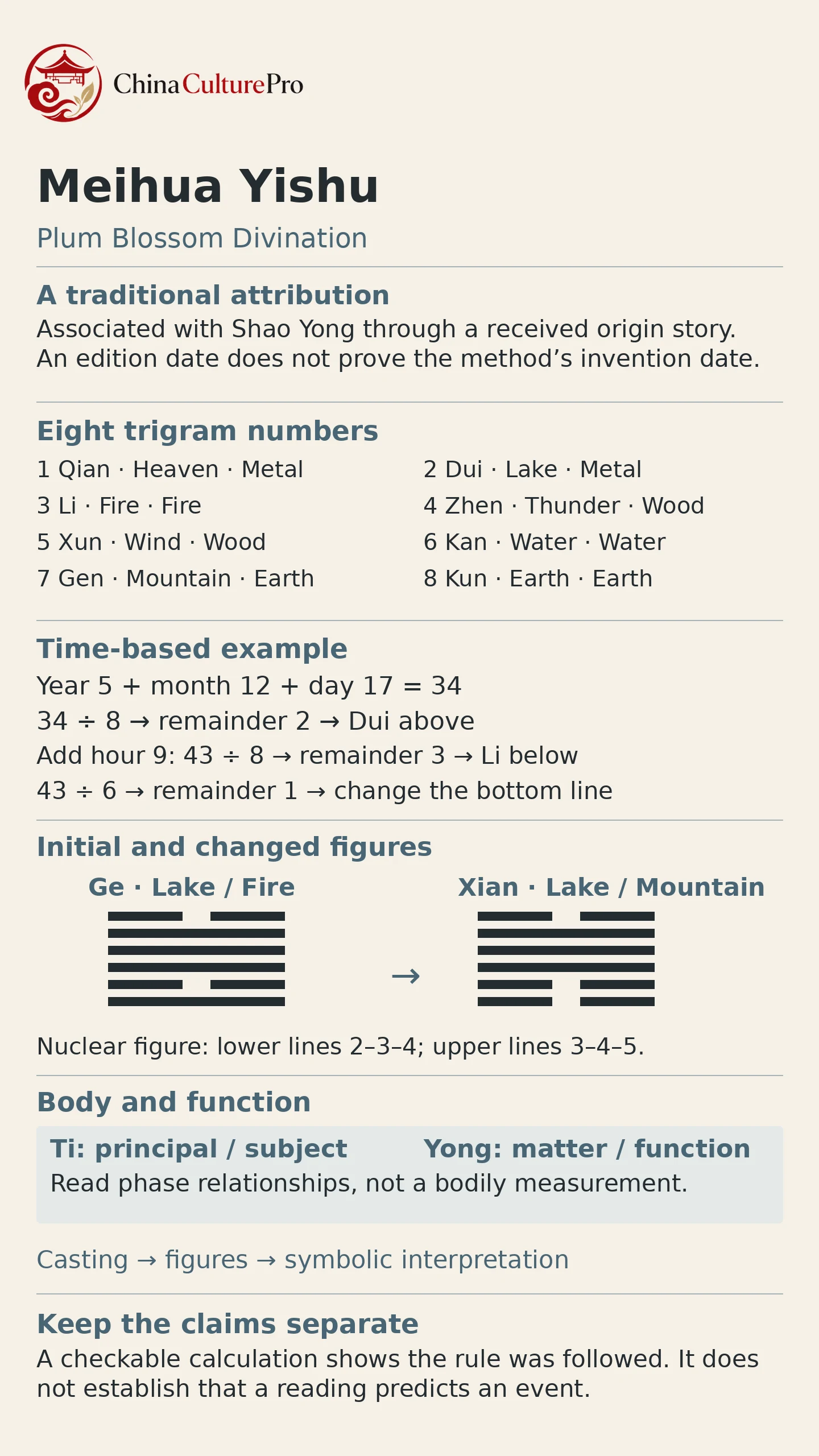
The Bagua (八卦, bāguà), or eight trigrams, have the following numbers in this method. These are a particular sequence, not interchangeable with every numbered diagram used elsewhere in Chinese cosmology.[2]
| Trigram | Number, image and phase |
|---|---|
| Qian trigram (乾, qián) | 1: Heaven; Metal |
| Dui trigram (兑, duì) | 2: Lake; Metal |
| Li trigram (离, lí) | 3: Fire; Fire |
| Zhen trigram (震, zhèn) | 4: Thunder; Wood |
| Xun trigram (巽, xùn) | 5: Wind; Wood |
| Kan trigram (坎, kǎn) | 6: Water; Water |
| Gen trigram (艮, gèn) | 7: Mountain; Earth |
| Kun trigram (坤, kūn) | 8: Earth; Earth |
The eight-trigram reference gives the wider associations. Here the numbers perform a precise job: they convert a remainder into a three-line figure.
How Time, Numbers and Observations Become a Hexagram
The text’s time-based recipe can be reproduced as follows:[2]
- Identify the inputs: Record the year-branch ordinal, lunar month, lunar day and two-hour branch ordinal.
- Find the upper trigram: Add year, month and day, divide by eight and use the remainder, treating zero as eight.
- Find the lower trigram: Add the hour ordinal to that total, divide by eight and apply the same remainder rule.
- Find the changing line: Divide the year-month-day-hour total by six, treating zero as six, and count the selected line from the bottom.
The year value is a position in the twelve-branch sequence, not automatically the four digits of a Gregorian year. The Heavenly Stems and Earthly Branches 及 Chinese lunar calendar explain the background needed to identify these inputs.
Other procedures begin with counted objects, sounds or a direct association between an observation and a trigram. They should be recorded as different input recipes. “Using numbers” does not specify which numbers, how they were selected or whether an hour was included.[5]
A Worked Calculation from the Plum Blossom Story
Use the narrative’s own stated inputs: a Chen year (辰年, chén nián), twelfth month, seventeenth day and Shen hour (申时, shēn shí). Their values are 5, 12, 17 and 9 respectively.[2]
Recalculate the three stages:
- Upper: 5 + 12 + 17 = 34. Dividing 34 by 8 leaves 2, selecting Dui.
- Lower: 34 + 9 = 43. Dividing 43 by 8 leaves 3, selecting Li.
- Changing line: Dividing 43 by 6 leaves 1, selecting the bottom line.
Lake above Fire forms the Ge hexagram (革, gé), usually translated as Revolution or Radical Change. Changing the bottom line turns the lower trigram into Gen, producing Lake above Mountain, the Xian hexagram (咸, xián), often translated as Influence.
No Gregorian date has been invented for this example. It demonstrates a rule using the story’s supplied calendar labels, rather than providing a prediction for the reader.
Primary, Nuclear and Changed Hexagrams
The primary hexagram is the initial six-line figure. The changed hexagram results from switching the selected line between solid and broken while leaving the other five unchanged.
The Hugua (互卦, hùguà), or nuclear hexagram, is formed from overlapping inner lines: original lines 2–3–4 make its lower trigram, and lines 3–4–5 make its upper trigram. Count all positions from the bottom. This operation extracts internal structure; it is not a second independent casting.[5]
Write down which figure a comment refers to. A statement about the primary figure cannot be checked against a changed figure without explaining the transition. The three images may be read as aspects or stages of one matter, but those meanings belong to the interpretive framework, not to the line arithmetic alone.
Body and Function: Interpretation within the Tradition
The Ti trigram (体, tǐ), often glossed as “body” or subject, represents the principal in the reading. The Yong trigram (用, yòng), “function” or application, represents the matter encountered. In a common assignment, the trigram containing the changing line is Yong and the other is Ti.[3][5]
Their Five Phases (五行, wǔxíng) associations introduce relationships of generation, control and sameness. Within the text’s judgments, a phase generating Ti is treated differently from a phase controlling Ti; Ti generating the other phase is described as expenditure or depletion. The Five Phases and their generating and controlling cycles explain that symbolic vocabulary.[3]
“Body” identifies an interpretive role here; it does not report bodily measurements. A single favorable relationship is also not a substitute for stating which hexagram, changing line and context produced the interpretation.
Reading the Method without Treating It as Proof
The traditional text itself warns against expecting the same image to produce the same literal event every time. Its examples require contextual reasoning rather than a fixed dictionary in which one trigram always predicts one incident.[3]
That flexibility is culturally significant, but it also makes a prediction harder to evaluate if the interpretation is changed after events occur. To assess a claim fairly, keep the original question, input selection, calculation and interpretation together. Record the outcome separately, including misses and ambiguous results.
A reproduced calculation shows that a procedure was followed. A memorable story shows how a tradition teaches meaning. Neither observation, by itself, demonstrates a reliable forecasting system.
FAQs About Meihua Yishu
Do you need actual plum blossoms?
No. The name comes from a traditional story. The method’s starting information can instead come from time, numbers, sounds or selected observations.
Is this the same as tossing three coins?
No. A common three-coin method constructs a hexagram line by line over six tosses and can produce several changing lines. The numerical procedure illustrated here constructs two trigrams and selects one changing line.
Why can calculators give different results?
They may use different input conventions: a branch ordinal versus a calendar year number, different calendar conversion choices, or different treatment of boundary times and leap months. Compare the stated recipe and intermediate totals before comparing the final figures.[5]
資料來源
[1] Meihua Yishu, traditional attribution to Shao Yong. Received Preface
[2] Meihua Yishu, traditional attribution to Shao Yong. Volume One: Trigram Numbers and Casting Examples
[3] Meihua Yishu, traditional attribution to Shao Yong. Volume Two: Body, Function and Interpretation
[4] National Library of China collection, digitized on Wikimedia Commons. Meihua Yishu, Wenming Shuju edition, 1925
[5] Guanyitang. Plum Blossom: Documented Casting and Interpretation Conventions