
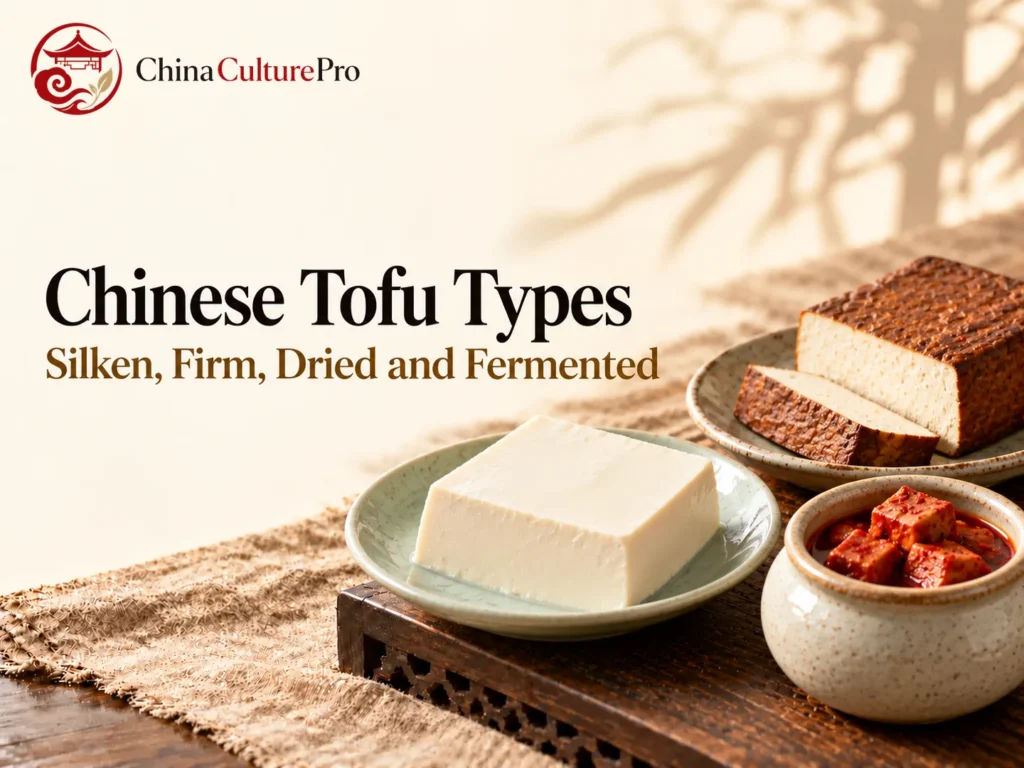

Quick Answer: What Are the Main Chinese Tofu Types?
Tofu(豆腐,dòufu), or bean curd, begins with soy milk set by a coagulant. Chinese tofu types are best understood through both texture and later processing: a soft block, a pressed slab, a fried puff and a fermented seasoning cube perform different jobs. They are not simply four steps along one firmness scale. [3][4]
- Fresh blocks: Soft, medium, firm and extra-firm labels indicate handling and texture, with variation between makers.
- Silken: A smooth, unpressed style that can itself have several firmness labels.
- Processed forms: Pressing, frying and freezing create dense, crusted or porous textures.
- Fermented forms: Some are concentrated condiments rather than the main body of a dish.
Choose for the cooking task and read the packaging. The word tofu does not establish a dish’s sauce, animal ingredients or storage requirements.

A supermarket tub of white bean curd, a brown pressed square and a jar of creamy fermented cubes may all be called tofu. Their differences explain why one stays delicate in a gentle sauce while another remains chewy in a stir-fry. Start with structure, then choose the dish.
Fresh Tofu: Silken, Soft and Firm
Regular tofu is made by setting soy milk into curds, then draining and pressing to the desired texture. Silken tofu is set without breaking and pressing those curds in the same way, producing a more continuous, custard-like structure. Some silken products set directly inside their sealed package. [1][3][6]
Silken and soft are therefore not exact synonyms. Soft describes texture, while silken also describes how the structure forms. A firm silken product can remain smoother and more delicate than a regular pressed block with a similar English firmness label. Compare the actual product rather than relying on one word. [1][3]
| Fresh label | Texture and useful cooking roles |
|---|---|
| Silken | Smooth, custard-like and available in more than one firmness. Useful for gentle dishes, blending and delicate preparations; handle according to the specific product. [1] |
| Soft or medium regular tofu | Tender curds that may crack under vigorous handling. Suitable for soups, gentle simmering and dishes that prize softness. [2][4] |
| Firm or extra-firm regular tofu | Denser curds that tolerate cutting, turning and frying more readily. Useful for stir-fries, pan-frying and dishes needing distinct pieces. [2] |
Pressed Tofu, Sheets and Soy-Milk Skin
Dougan(豆干,dòugān)is pressed tofu often translated as dried bean curd. Much of its liquid has been removed, giving a dense, resilient bite. It can be plain, braised or spiced. Dried in this name does not necessarily mean a brittle, completely dehydrated product: many packs are moist enough to slice and cook directly. [4][5]
Thin pressed tofu sheets are another curd-based form, often cut into strips for salads or stir-fries. They differ from the film lifted from the surface of heated soy milk, which may also be translated as tofu skin or bean curd sheets. The shared English names can hide different structures. [4][5]
Fuzhu(腐竹,fǔzhú)is a familiar dried-stick form made from that soy-milk film. Its preparation differs from a ready-to-slice pressed slab. The broader Chinese soy-products guide covers this film-based family and other products beyond curd blocks. [5]
Fried and Frozen Tofu
Frying creates a golden exterior, but the interior depends on the starting tofu and the product. Some fried pieces remain relatively solid; airy puffs have a spongier center that takes up broth or sauce. A golden color alone does not tell you which texture is inside. [4][5]
Freezing changes tofu in another way. Ice formation creates cavities, so thawed tofu can become more porous and chewy. This makes frozen tofu useful in broths and simmered dishes. It is a texture transformation, distinct from fermentation or simply pressing out water. [3][5]
Fermented Tofu: Seasoning Cubes and Stinky Tofu
Furu(腐乳,fǔrǔ), or fermented bean curd, usually comes as small cubes in a seasoned liquid. It has a creamy, concentrated character and is commonly used in small amounts as a condiment or cooking seasoning. White and red versions are familiar examples. A little can accompany Chinese congee or flavor a sauce; it is not a direct block-for-block replacement for fresh tofu. [4][5]
Stinky tofu(臭豆腐,chòu dòufu)is a separate brine-flavored category commonly cooked as a snack. Its regional methods and serving forms differ from jarred furu. Neither category should be understood as ordinary fresh tofu left to spoil, and fermentation is not another position on the soft-to-firm scale. [4][6]
Choosing Tofu for a Chinese Dish
Decide what the tofu must do in the dish: stay intact, remain delicate, absorb broth or season other ingredients. Then match the form to that task. Use the label alongside the actual texture and the recipe’s handling requirements. [1][2][4]
- For tenderness in a light sauce or soup: choose soft tofu and move it gently. Cut into appropriate pieces before mixing rather than vigorously breaking it up in the pan. [2][4]
- For distinct pieces in wok cooking: firm blocks or sliced pressed tofu are more resilient. Drain surface water, and press only when the recipe and product call for it. [2][5]
- For a broth-filled, chewy bite: choose an appropriate frozen or puffed product. It will not behave like a smooth silken cube. [3][5]
- For concentrated fermented flavor: choose a seasoning such as furu and use it in a recipe designed for that ingredient. [4][5]
Buying, Storage and Dietary Checks
Plain soy tofu is made from plant ingredients, but a prepared tofu dish may contain meat, seafood, egg or animal-based stock. Seasoned pressed products and accompanying sauces also need checking. For vegetarian food, ask about the complete dish rather than just the white blocks. [4]
Soy is relevant to allergy checks. Additional ingredients and sauces can introduce other allergens or wheat, so plain tofu and a flavored meal require different assessments. Follow the actual label when a gluten-free or other dietary restriction matters. [7]
Keep refrigerated products cold and observe their use-by directions. Shelf-stable aseptic cartons are a packaging-specific exception before opening, not proof that every silken tofu can sit in a cupboard. Once opened, refrigerate unused portions promptly and follow the manufacturer’s storage method and deadline. [1][6]
For cold preparations, use a product intended for that use and follow its handling directions. Tofu’s cooked-soy-milk production step does not make contamination or poor storage irrelevant. Homemade uncontrolled fermentation creates additional risks and should not be treated as a way to rescue spoiled tofu. [6]
FAQs About Chinese Tofu Types
Are Soft Tofu and Silken Tofu the Same?
The labels overlap in everyday use, but they describe different things. Silken indicates a smooth style of formation and can be sold in several firmness levels. Soft is a texture description, so check the specific product.
Do You Need to Press Every Type of Tofu?
No. A delicate silken block may collapse under a weight, and dense pressed tofu has already lost much of its water. Press suitable firm blocks only when the recipe benefits from that preparation.
Does Dried Tofu Need Soaking?
A moist pressed slab sold as dried bean curd often does not. Brittle dried soy-milk-skin sticks usually need rehydration. Identify the actual product and follow its directions rather than applying one rule to both.
Are All Tofu Dishes Vegetarian or Vegan?
No. The basic soy curd can be plant-based while the dish includes pork, seafood, eggs or animal stock. Check seasonings and toppings as well as the main tofu ingredient.
資料來源
[1] Morinaga Nutritional Foods. Silken Tofu: Production, Textures and Storage FAQ
[2] House Foods. How to Choose the Right Tofu
[3] NIFTEM. PM FME: Processing of Soya Paneer
[4] Shanghai Municipal Information Office. Heaps of Beans Create a Most Versatile Ingredient
[5] The Woks of Life. Chinese Tofu, Bean Curd and Seitan Glossary
[6] Colorado State University. Tofu: Production and Food Safety