

Quick Answer: Who Was Song Renzong?
Song Renzong (宋仁宗, Sòng Rénzōng; 1010–1063) ruled the Northern Song from 1022 to 1063. His reign encompassed a long regency, a short-lived reform program, costly frontier conflict and an influential culture of scholar-official government.[1][3][5][8]
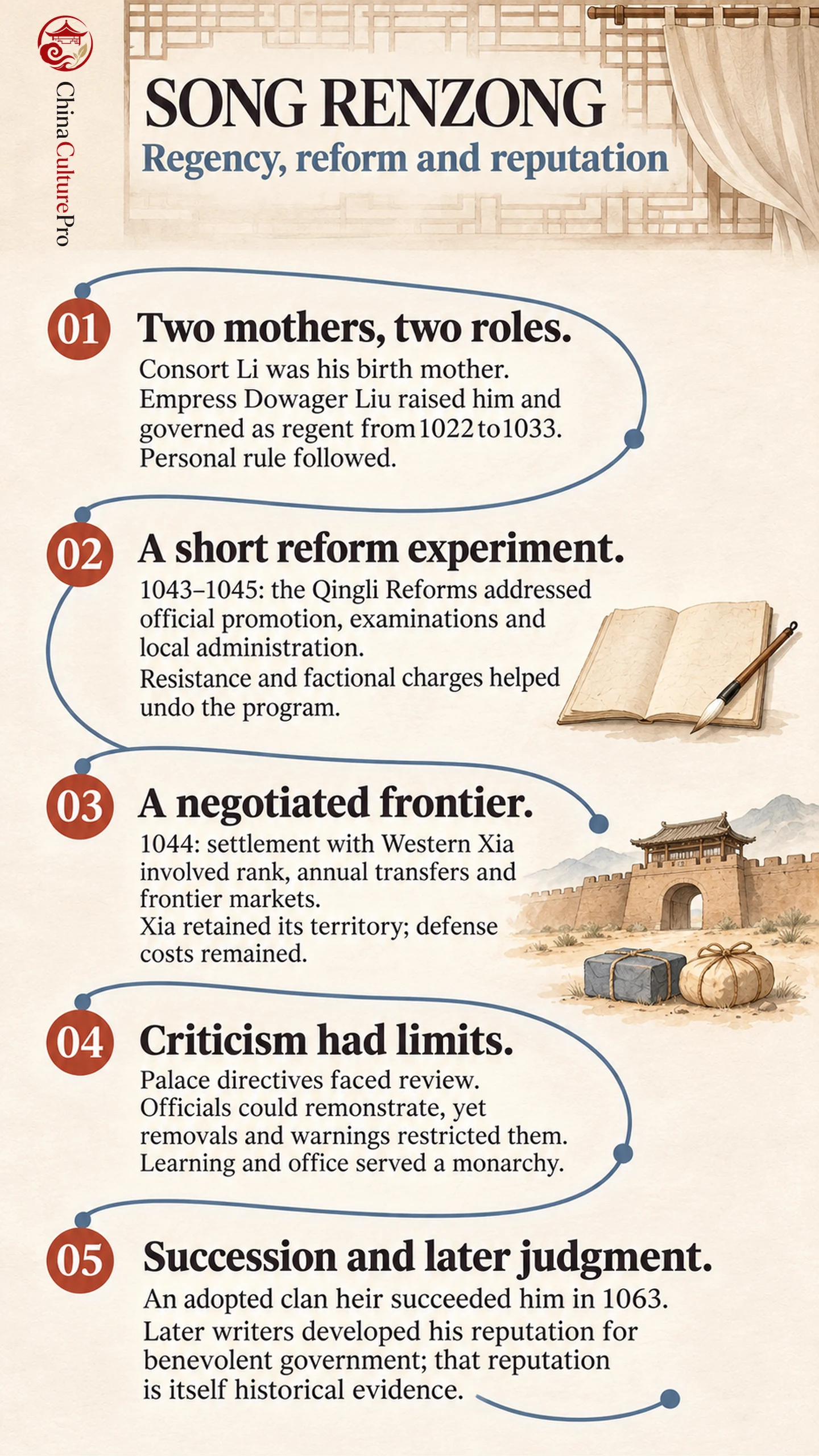
- Early rule: His adoptive mother governed as regent until 1033.
- Policy: The Qingli reform initiative sought to improve official selection and administration.
- Legacy: Later historians made his reign an important model of benevolent government.[2][3][6]
A reputation for humane rule is part of his historical legacy, rather than a substitute for examining particular decisions.
Renzong often appears as the kindly emperor behind famous ministers and courtroom legends. His forty-one-year reign becomes more intelligible when the regency, reform experiment, frontier settlement and succession are examined separately, with later praise read alongside the institutions and conflicts it describes.
A Child Emperor and Two Mothers
His personal name was Zhao Zhen (赵祯, Zhào Zhēn). He was a son of Emperor Zhenzong (宋真宗, Sòng Zhēnzōng), born to Consort Li (李宸妃, Lǐ Chénfēi) and raised as the child of Empress Dowager Liu (刘太后, Liú Tàihòu). These were distinct biological and political relationships.[1][7]
He became emperor when Zhenzong died in 1022. Liu’s regency continued until her death in 1033, when the annals explicitly mark the beginning of his personal administration. Court officials, palace access and the authority to process documents mattered alongside the emperor’s formal title.[1][2]
The same annals place his discovery of his birth mother’s identity after Liu’s death. The consort’s biography adds a dispute over her funeral and the emperor’s response to an allegation of mistreatment. Neither passage supplies the familiar theatrical plot of a cat substituted for a newborn prince. These accounts must be distinguished from later legend.[2][7]
The Qingli Reforms and Their Reversal
The Qingli Reforms (庆历新政, Qìnglì Xīnzhèng) began in 1043. Fan Zhongyan (范仲淹, Fàn Zhòngyān) presented a ten-point memorial after receiving the emperor’s requests for proposals. Ouyang Xiu (欧阳修, Ōuyáng Xiū) was among the officials who supported his promotion into central government.[3][8]
| 分野 | Proposal recorded in Fan’s biography |
|---|---|
| Official careers | Tie advancement more closely to service and restrict inherited or preferential access to office. |
| Examinations | Give policy discussion and understanding of the classics greater weight in selection. |
| Local administration | Improve the choice of local officials and address irrigation, agricultural conditions and burdensome service. |
The emperor adopted substantial parts of the program, although a militia proposal was stopped after objections. Inspectors’ accusations and tighter promotion rules disturbed established interests; charges of factionalism increased. By 1045 Fan and his associates had lost their central positions, and the program was being dismantled.[3][8]
The proposals linked official selection to performance, making them part of the history of imperial recruitment.
War and Settlement with Western Xia
The northwest imposed urgent military demands. War with the Tangut state of Western Xia (西夏, Xī Xià) brought serious Song reverses in the early 1040s. Fan’s biography also records fortification, troop organization and efforts to restore frontier communities, showing that civil officials could direct military preparation.[3][8]
In 1044 Renzong accepted a settlement with Li Yuanhao (李元昊, Lǐ Yuánhào). Yuanhao acknowledged a subordinate status in correspondence and received the Song title of king of Western Xia. The arrangement included annual transfers of silver, silk and tea, together with official frontier markets. Xia retained its territory under a negotiated accommodation.[4][8]
The settlement left frontier defense and its costs unresolved. The emperor’s pursuit of peace did not remove the pressures that had produced war. The agreement addressed a recent war while leaving an expensive defense system in place.[4]
Scholar-Officials, Criticism and Imperial Authority
Renzong’s court gave scholar-officials routes to advise and criticize the ruler, but access to criticism was not a guarantee of political security. The annals for 1050 require palace directives to receive scrutiny rather than automatic execution. They describe an institutional check on the way commands entered government.[5]
In 1061 Bao Zheng (包拯, Bāo Zhěng) became a deputy commissioner in the central military administration. The same year’s record includes the removal of several remonstrance and censorial officials and an imperial warning against harmful rumors. Such entries show both the importance of criticism and the limits imposed on those who delivered it.[5]
Written examinations were another continuing institution: shortly before his death in 1063, Renzong conferred examination distinctions on a recorded group of 341 candidates across the relevant categories. The Song court linked learning to service, while appointments and final decisions remained acts of monarchy.[5]
Succession and the Reputation for Benevolence
With no surviving biological son to inherit, the court turned to a member of the imperial clan. In 1062 the annals record his recognition as imperial son and renaming as Zhao Shu (赵曙, Zhào Shǔ). When Renzong died in 1063, this adopted heir succeeded as Emperor Yingzong (宋英宗, Sòng Yīngzōng). Succession continued the ruling family through adoption rather than a new dynasty.[5]
The History of Song (宋史, Sòng Shǐ) praises Renzong’s restraint, mercy and government through humane officials. It also admits administrative weaknesses and the expense of frontier accommodation. That appraisal is evidence for a historical judgment, not an unfiltered transcript of every subject’s experience.[5]
In the published summary of his study of Song historiography, Charles Hartman traces the idealized Renzong era to later political argument. Critics of subsequent reforms used it as a model of benevolent rule. The emperor’s reputation therefore has a history of its own: later writers selected and organized his reign to make claims about good government.[6]
FAQs About Song Renzong
What was Song Renzong’s personal name?
His personal name was Zhao Zhen. Renzong is his temple name, not the personal name he used while alive.[1][5]
Did Empress Dowager Liu rule throughout his reign?
No. Her regency ran from his accession in 1022 until her death in 1033. His reign continued until 1063.[1][2][5]
Was a cat really substituted for the infant Renzong?
The annals and consort’s biography describe concealed maternity and its later disclosure. They do not substantiate the cat-substitution plot familiar from drama.[2][7]
出典
[1] Tuotuo and other compilers. History of Song, Chapter 9: Emperor Renzong, Part One
[2] Tuotuo and other compilers. History of Song, Chapter 10: Emperor Renzong, Part Two
[3] Tuotuo and other compilers. History of Song, Chapter 314: Fan Zhongyan
[4] Paul Jakov Smith, Journal of Chinese History. The Fragility of Peace: Song China’s Northwestern Frontier and Erosion of the Chanyuan Paradigm in the Mid-Eleventh Century
[5] Tuotuo and other compilers. History of Song, Chapter 12: Emperor Renzong, Part Four
[6] Charles Hartman, Cambridge University Press. An Empire of Benevolence, in The Making of Song Dynasty History
[7] Tuotuo and other compilers. History of Song, Chapter 242: Empresses and Consorts
[8] Tuotuo and other compilers. History of Song, Chapter 11: Emperor Renzong, Part Three