


Quick Answer: Who Was Ouyang Xiu?
Ouyang Xiu (欧阳修, Ōuyáng Xiū; 1007–1072) was a Northern Song writer, historian and senior official. His influence joined literary practice with public life: he promoted classical prose, helped shape examination standards and produced historical scholarship alongside poetry and essays.[1][2]
- Writing: Clear argument, narrative and personal reflection gave his prose lasting influence.
- Government: His career included reform advocacy, demotion, provincial service and high office.
- Scholarship: His projects encompassed dynastic histories and the collection of ancient inscriptions.[1]
His own essays, surviving handwriting and the later official biography offer different kinds of evidence, each with a distinct relationship to his life.
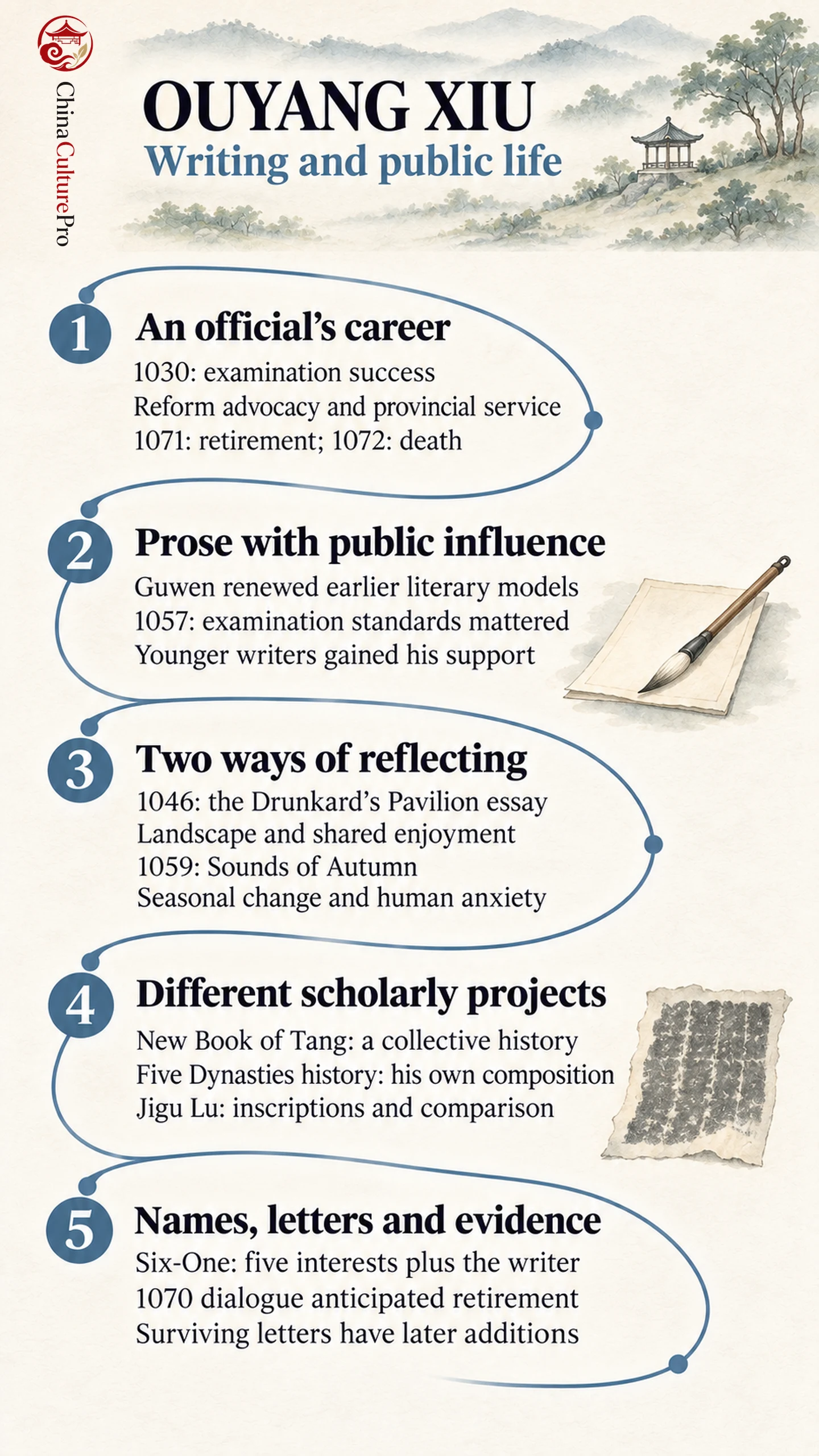
Ouyang Xiu’s essays remain familiar long after the administrative disputes that shaped his career. Reading them beside his histories and surviving correspondence reveals an official who connected learning with government, and who made leisure, landscape and old inscriptions subjects of serious writing.
Official Service, Reform and Political Setbacks
After passing the metropolitan degree examination in 1030, Ouyang Xiu entered the civil administration of the 北宋. His early work in Luoyang brought him into circles of writers who exchanged poems and argued about public affairs. Literary reputation developed through relationships as well as individual study.[1][2]
He defended Fan Zhongyan (范仲淹, Fàn Zhòngyān) when that official faced criticism, and suffered demotion himself. During the Qingli (庆历, Qìnglì) reform period under Emperor Renzong, he supported officials seeking changes in government and served as a remonstrance official, charged with offering criticism to the throne.[1]
His essay Pengdang Lun (朋党论, Péngdǎng Lùn), on political associations, argued that officials could unite through shared moral commitments, whereas alliances of private advantage were unstable. This was an intervention in accusations of faction, not a description of modern political parties.[1]
Political setbacks took him to provincial posts, including Chuzhou (滁州, Chúzhōu). He later returned to senior government, becoming deputy chief councilor in 1061. His final years brought renewed disputes and requests to withdraw; he retired in 1071 and died the following year.[1]
Classical Prose and the Examination of 1057
The prose tradition called guwen (古文, gǔwén), or ancient-style prose, looked to earlier models for flexible narration and sustained argument. Ouyang Xiu admired Han Yu (韩愈, Hán Yù), a Tang predecessor. His achievement was to renew and promote this approach in Song literary life.[1][2]
“Ancient-style” does not mean everyday modern Chinese or the rejection of all artifice. His writing remained classical, carefully patterned and capable of elaborate imagery. The preference concerned how language carried meaning, rather than whether an essay had literary craft.[1][3][4]
In 1057 he supervised an important examination and rejected writing he regarded as strained or obscure. The official biography records angry protests from disappointed candidates, followed by a change in examination fashion. His position gave literary judgment institutional force within the imperial examination system.[1]
He also encouraged younger authors, including Su Shi (苏轼, Sū Shì). Such recognition helped establish a wider literary network. His later inclusion among the Eight Prose Masters of the Tang and Song (唐宋八大家, Táng Sòng Bā Dàjiā) reflects his canonical reputation; it was not the name of an organization he founded.[1][2]
Reading the Drunkard’s Pavilion and Sounds of Autumn
The Pavilion of the Old Drunkard, Zuiweng Ting Ji (醉翁亭记, Zuìwēng Tíng Jì), dates to 1046. It moves from the hills around Chuzhou to a pavilion, changing seasons, townspeople at leisure and a banquet. Repeated descriptions of pleasure gradually connect scenery with shared social life.[3]
The ending distinguishes the visitors’ enjoyment from the prefect’s pleasure in their enjoyment. Drinking belongs to the scene, but the essay’s movement gives public companionship a larger role. The text also credits a monk with building the pavilion and the prefect with naming it, separating construction from authorship of the name.[3]
The 1059 fu (赋, fù), or rhapsody, The Sounds of Autumn, Qiu Sheng Fu (秋声赋, Qiū Shēng Fù), begins with a disturbing noise heard during nighttime reading. Images of waves and marching troops give way to an attendant’s report that the sound comes from trees.[4]
The piece turns seasonal change toward reflection on human anxiety and aging. Its dramatic sounds and dialogue show how his literary writing could be lucid without becoming plain or emotionally neutral.[4]
The Two Histories and the Study of Inscriptions
Ouyang Xiu’s historical work had several forms, with different relationships between personal authorship, collective editing and surviving evidence.[1][5]
| Work | 範囲 | Ouyang Xiu’s role |
|---|---|---|
| New Book of Tang (新唐书, Xīn Tángshū) | History of the Tang dynasty | A collective court project involving Ouyang Xiu, Song Qi (宋祁, Sòng Qí) and others. |
| New History of the Five Dynasties (新五代史, Xīn Wǔdài Shǐ) | The regimes preceding the Song | A history he composed personally, with strong moral judgments. |
| Jigu Lu (集古录, Jígǔ Lù) | Ancient inscriptions and related observations | Collection and comparison of surviving written traces from earlier periods. |
The Tang history was completed in 1060. The official biography assigns him responsibility for its annals, treatises and tables, identifying his contribution within the larger project. The Five Dynasties history was his own composition, although a personal author still worked from earlier records.[1][5]
His attention to inscriptions expanded the materials available for studying the past. Collecting fragments and comparing readings could reveal differences from transmitted accounts. At the same time, moral selection and concise narration shaped his histories: they organize and judge the past rather than reproduce it without interpretation.[1]
Six-One Recluse, Surviving Letters and Historical Evidence
His late name Liuyi Jushi (六一居士, Liùyī Jūshì), the Six-One Recluse, receives its own explanation in an autobiographical dialogue dated 1070. Five interests—books, collected inscriptions, a qin (琴, qín), a board game and wine—are joined by the aging writer himself as the sixth. The piece anticipates retirement rather than proving he had already left office.[6]
A surviving letter supplies a different view. Zhuo Ai Tie (灼艾帖, Zhuó Ài Tiè), catalogued by the Palace Museum, asks after an acquaintance’s health and proposes a visit. The museum identifies the recipient as his student Jiao Qianzhi (焦千之, Jiāo Qiānzhī). Written in running-regular script, it preserves an ordinary social exchange rather than a public essay.[7]
The letter also bears later collectors’ seals and accompanying inscriptions. Those additions document its transmission; they are not all Ouyang Xiu’s handwriting. Its place in Chinese calligraphy depends partly on that material history, as well as the script itself.[7]
His later biography praises an exemplary writer-official, while his own pieces construct particular authorial voices. His influence continued through the writers he encouraged, the institutions in which he served and the texts readers kept in circulation.[1]
FAQs About Ouyang Xiu
Is Ouyang one surname or two names?
Ouyang is a compound family name; Xiu is the personal name. Older English publications may spell his name Ou-yang Hsiu.[2]
Did Ouyang Xiu invent classical prose?
No. He developed a tradition associated with earlier writers such as Han Yu, bringing it new influence through his essays, literary relationships and examination service.[1][2]
Did Ouyang Xiu write both histories by himself?
He personally composed the Five Dynasties history. The New Book of Tang was a collective project, and credit for his contribution does not imply sole authorship.[1][5]
出典
[1] Tuotuo and other compilers. History of Song, Chapter 319: Ouyang Xiu
[2] The Chinese University of Hong Kong, Renditions. Ouyang Xiu: Author Biography
[3] Ouyang Xiu. Collected Works, Chapter 39: The Pavilion of the Old Drunkard
[4] Ouyang Xiu. Collected Works, Chapter 15: The Sounds of Autumn
[5] National Library of China Publishing House. Baina Edition of the New Book of Tang
[6] Ouyang Xiu. Collected Works, Chapter 44: Biography of the Six-One Recluse
[7] Hua Ning, Palace Museum. Ouyang Xiu: Zhuo Ai Tie