

Quick Answer: Who Was the Yongzheng Emperor?
The Yongzheng Emperor (雍正皇帝, Yōngzhèng Huángdì), who lived from 1678 to 1735, ruled the Qing dynasty from 1722 to 1735. His comparatively short reign strengthened imperial supervision through changes in official communication, military decision-making and the financing of government.[1][2][7]
- Succession: He inherited a throne surrounded by rivalry and disputed stories.
- Government: Direct reports and trusted advisers brought information closer to the emperor.
- Finance: Reforms addressed missing revenue, administrative expenses and the basis of tax collection.[1][2][4][5]
These developments were related, but a confidential report, an advisory institution and a fiscal rule served different purposes.
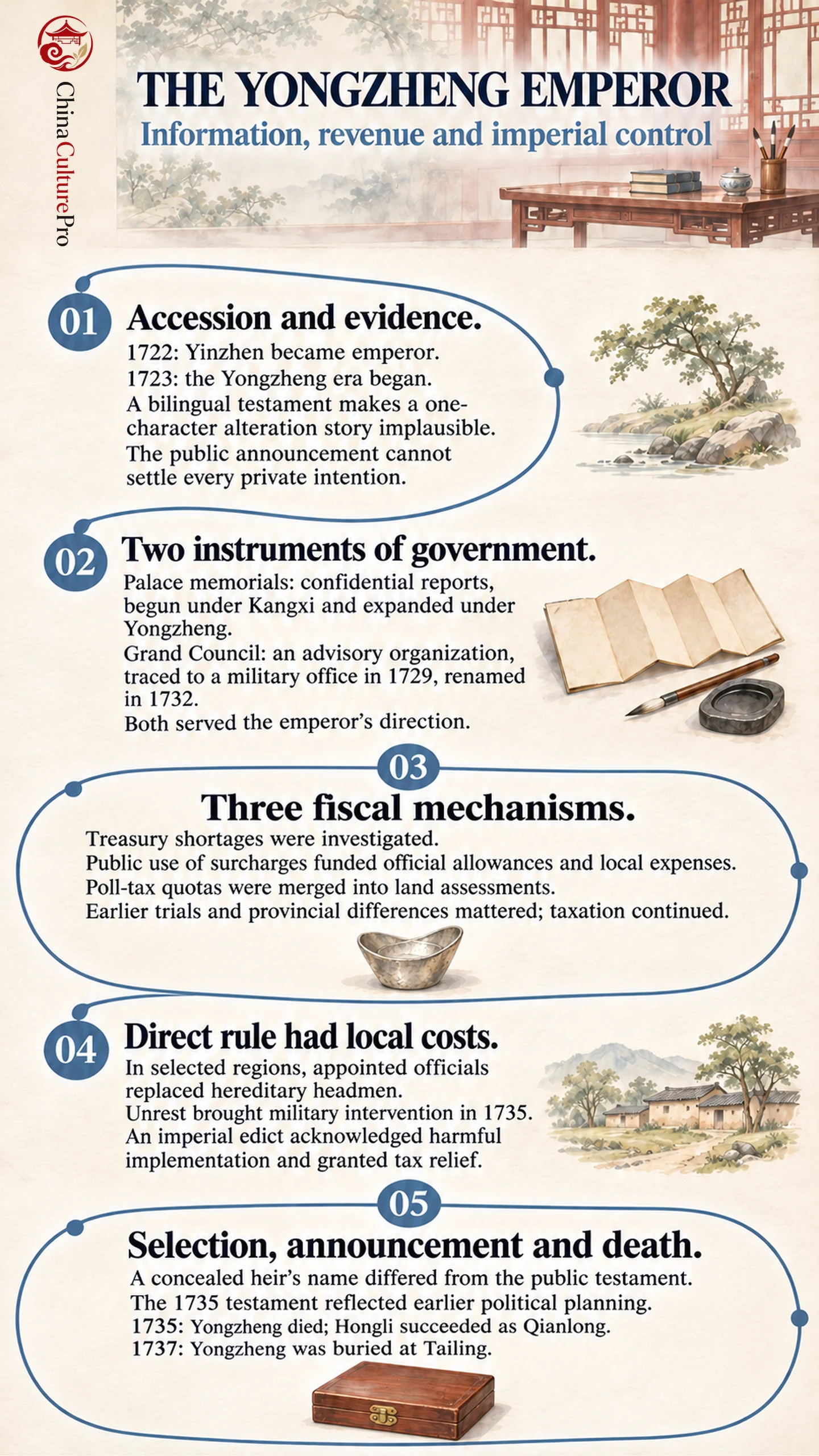
Yongzheng’s reign changed how officials reported, how government met its expenses and how the next emperor was selected. Examining these mechanisms reveals a ruler’s working methods while placing disputes about his accession within the limits of surviving evidence.
Accession in 1722: Documents and Disputed Stories
His personal name was Yinzhen (胤禛, Yìnzhēn), the fourth son of the Kangxi Emperor (康熙皇帝, Kāngxī Huángdì). He took the throne after his father’s death in 1722; the first year of the Yongzheng era began in 1723. The difference explains the two dates found in accounts of his reign.[1][7]
The official testament names him as successor, and Longkodo (隆科多, Lóngkēduō) transmitted the announcement. A familiar story claims that a character was altered to turn the fourteenth son into the fourth. The bilingual Chinese and Manchu document makes this simple character-changing explanation implausible.[3]
The public announcement was issued after Yinzhen had secured his position. It records the succession proclaimed by the new court, while leaving questions about Kangxi’s private intentions unresolved. The document’s wording and the circumstances of its production are separate parts of the evidence.[3]
Palace Memorials and the Emerging Grand Council
Government increasingly centered on Yangxin Hall (养心殿, Yǎngxīn Diàn) within the Forbidden City. Access to the emperor and the movement of paperwork mattered as much as the titles of offices.[7]
Palace memorials (奏折, zòuzhé) were reports that could reach the emperor through a confidential, sealed channel. The system began under Kangxi and was expanded and regularized under Yongzheng. It let selected officials communicate about local affairs and enabled the emperor to write responses directly on their submissions.[4][8]
The Grand Council (军机处, Jūnjīchù) was an advisory and working organization serving the emperor. Its development is commonly traced to a military office established in 1729 for northwestern operations against the Dzungars. In 1732, the office acquired the name associated with the council. The institutional sequence explains why a single founding date can conceal stages of development.[5]
The ministers’ work remained subject to the emperor’s direction. Surviving archives distinguish original palace memorials from the copies retained through the council, preserving both communications and their administrative handling.[4][8]
Fiscal Reform: Revenue, Surcharges and Local Government
At the start of his reign, the emperor demanded that shortages in government treasuries be investigated and repaired. He also prohibited shifting the cost of officials’ missing funds onto ordinary taxpayers. The orders addressed accounting and responsibility as well as revenue.[1][2]
| Measure | 仕組み |
|---|---|
| Surcharges into public funds (耗羡归公, hàoxiàn guīgōng) | Additional collection associated with handling silver was brought into supervised public use rather than left as unrestricted local income. |
| Official maintenance allowances (养廉银, yǎnglián yín) | Allowances provided official support, intended to reduce reliance on informal payments; they did not guarantee an end to corruption. |
| Poll-tax quotas merged into land tax (摊丁入亩, tāndīng rùmǔ) | Existing obligations associated with registered adult males were apportioned through land-tax assessments, changing how the burden was collected. |
The surcharge reform gained approval through proposals from Shanxi in 1724. Its revenues supported official allowances and local public expenses. Combining the two measures explains why reform involved funding government as well as disciplining officials.[2]
The tax merger likewise had a history. Kangxi had already fixed the poll-tax quota, and experiments in Sichuan and Guangdong preceded Yongzheng. His reign broadened the approach, with differing provincial arrangements. Merging a quota into land taxation did not erase the revenue obligation or abolish taxation.[2]
Stronger Administration and Its Limits on the Frontier
Gaitu guiliu (改土归流, gǎitǔ guīliú) replaced hereditary local headmen with officials appointed through the imperial administration in selected regions. The annals record such changes in Huguang in 1734. Extending direct administration altered who could appoint officers, enforce rules and mediate local disputes.[1]
Unrest in Guizhou brought military intervention in 1735. An imperial edict that year admitted that a policy intended to secure people’s livelihoods had, through poor implementation, become oppressive. Tax remissions accompanied the attempt to restore order. The edict preserves an admission of harmful implementation from within the court itself.[1]
Secret Succession, Death and Historical Legacy
To avoid a public contest over a designated crown prince, Yongzheng adopted a concealed nomination. The chosen name was placed in a sealed case behind the Fair and Impartial (正大光明, Zhèng Dà Guāng Míng) plaque in Qianqing Palace (乾清宫, Qiánqīng Gōng). The secret selection and the eventual public testament were different documents.[6]
The surviving public testament, object 038236-001, is dated 1735 and reflects political arrangements discussed during his serious illness in 1730. His son Hongli (弘历, Hónglì) succeeded as the Qianlong Emperor (乾隆皇帝, Qiánlóng Huángdì).[1][6]
Yongzheng died at Yuanmingyuan (圆明园, Yuánmíngyuán) in 1735 and was buried at Tailing (泰陵, Tàilíng) in 1737. His institutions outlasted him, while the disputes surrounding his rise continued to shape his reputation. Reading historical records alongside later stories requires attention to what each surviving document was produced to do.[1][7]
FAQs About the Yongzheng Emperor
Did Yongzheng’s reign begin in 1722 or 1723?
He became emperor in 1722. The Yongzheng era began in 1723; these are accession and era dates.[1]
Did Yongzheng invent palace memorials?
No. They developed under Kangxi. Yongzheng expanded their use and strengthened the system of direct communication.[4]
Did his tax reforms abolish taxation?
No. The merger changed the assessment and collection of existing obligations. Land taxation and other revenues continued.[2]
Did overwork cause his death?
His final illness is recorded, but attributing his death specifically to overwork goes beyond that account.[1]
出典
[1] Draft History of Qing, chapter 9. Annals of Shizong
[2] Draft History of Qing, chapter 121. Fiscal Administration, Taxation and Labor Service
[3] Museum of the Institute of History and Philology, Academia Sinica. Last Testament of Emperor Kangxi
[4] National Palace Museum, Qing Archives. Introduction to the Qing Archives
[5] Palace Museum. The Grand Council
[6] Museum of the Institute of History and Philology, Academia Sinica. Last Testament of the Yongzheng Emperor
[7] Palace Museum. The Yongzheng Emperor
[8] Institute of Modern History Archives, Academia Sinica. Qing Archival Terminology