

Quick Answer: Who Was Yang Guifei?
Yang Guifei (杨贵妃, Yáng Guìfēi), who lived from 719 to 756, was a favored imperial consort of the Tang dynasty. The word guifei (贵妃, guìfēi) is a high-ranking consort’s title. Her family gained extraordinary honors, while her death during the court’s flight became a major subject of literature and art.[1][2][7]
- Identity: She was an imperial consort, with a title below that of empress.
- Court: Histories describe her musical accomplishments and her relatives’ privileges.
- Legacy: Her historical death and later romantic image require different kinds of evidence.[1][2]
A poem, a historical biography and a much later portrait do not document the same things.
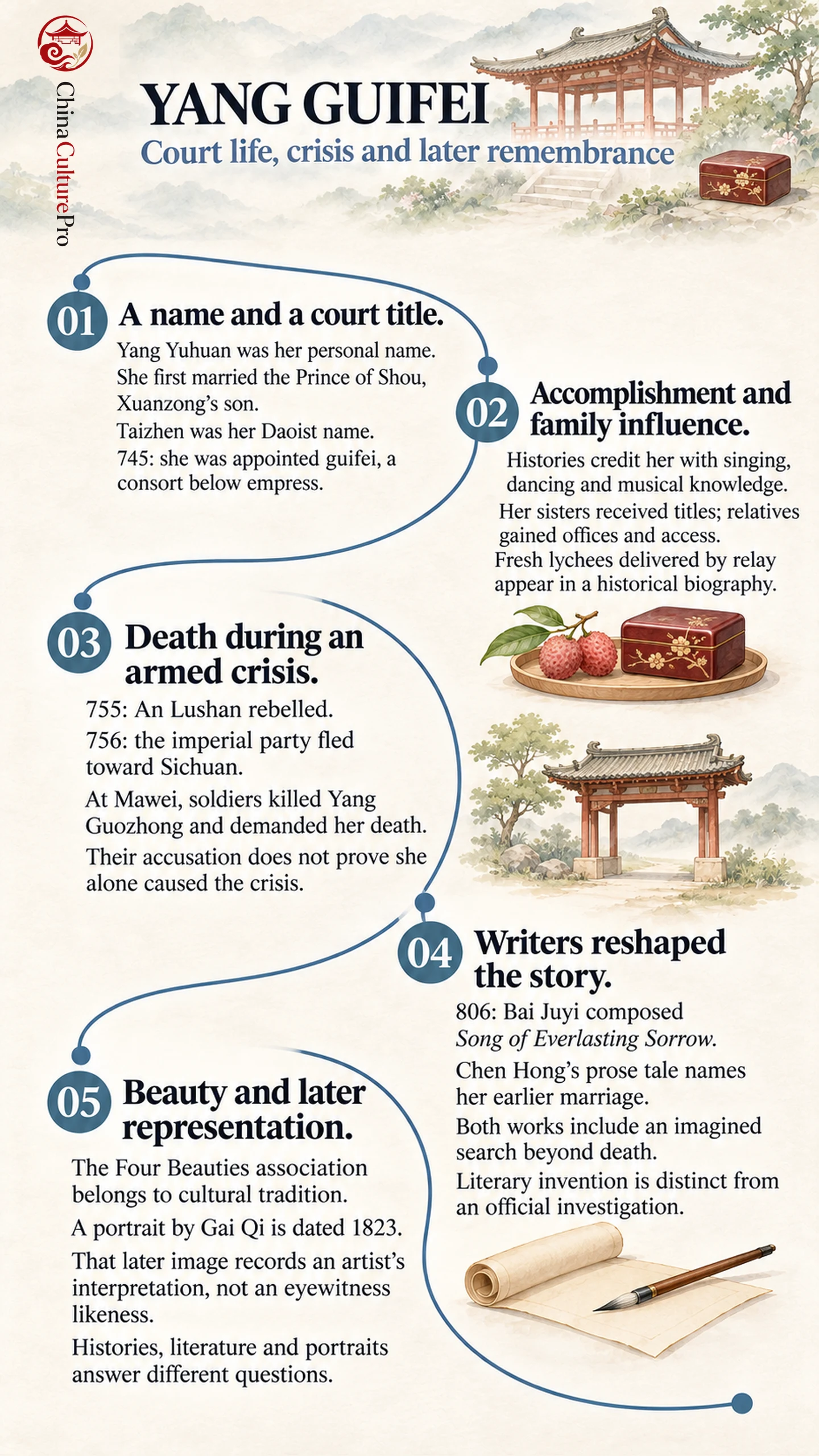
Yang Guifei’s name evokes beauty, courtly luxury and a doomed romance. Following her changing status reveals a more specific life: a prince’s wife became an emperor’s consort, her family gained influence, and military violence ended the protection that imperial favor had offered.
Names, Rank and the Path into Xuanzong’s Court
Her personal name was Yang Yuhuan (杨玉环, Yáng Yùhuán). Yang is her family name. At court, her exceptional treatment approached the ceremonial status of an empress.[1][7]
She was first married to Li Mao (李瑁, Lǐ Mào), the Prince of Shou (寿王, Shòuwáng), a son of Xuanzong of Tang (唐玄宗, Táng Xuánzōng). The later emperor–consort relationship thus crossed an existing marriage within the ruling household, an important feature often softened in romantic retellings.[1]
Between these positions she entered the register of female Daoist religious personnel under the name Taizhen (太真, Tàizhēn). This formal change provided a transition out of her earlier marriage; the history also records a new wife being chosen for the prince. In 745, Xuanzong formally appointed Taizhen as guifei. The annals provide the dated appointment, while the consort biography supplies the fuller sequence.[1][3]
Music, Patronage and the Yang Family
The histories credit her with singing, dancing and understanding music. These accomplishments place her within a cultivated court dance and music world. The surviving description leaves much of her repertoire unspecified.[1][2]
Her three sisters received the titles of Ladies of Han, Guo and Qin. Other relatives obtained offices, marriages and access to the palace. Yang Guozhong (杨国忠, Yáng Guózhōng), a relative of the same extended family, rose to the chancellorship. Accounts of petitions, gifts and richly appointed residences describe how imperial favor became a network of material and political advantages.[1][2]
The family accompanied imperial visits to Huaqing Palace (华清宫, Huáqīng Gōng), the hot-spring palace associated with her later image. The New Book of Tang (新唐书, Xīn Táng Shū) also records her wish for fresh lychees and their delivery by relay. Such details connect court consumption with the labor and transport used to sustain it. The account does not establish the precise origin of every shipment.[1]
The Rebellion and Her Death at Mawei
An Lushan (安禄山, Ān Lùshān) rebelled in 755, presenting his attack as a campaign against Yang Guozhong. After the defense at Tong Pass collapsed in 756, Xuanzong’s party fled the capital toward Sichuan. Yang Guifei accompanied the retreat.[1][3]
At Mawei (马嵬, Mǎwéi), soldiers killed Yang Guozhong and demanded action against the consort. The histories describe an escort that remained unwilling to proceed and an emperor who yielded to its demands. Yang was put to death by strangulation and buried beside the route. [1][2]
The soldiers’ accusation is evidence of the hostility directed at the family. It is not, on its own, proof that she caused the rebellion. The emperor’s decisions, the rebel commander’s ambitions and competition among officials also shaped the crisis. The Tang continued under another ruler after her death.[1][3]
How Poetry Recast Her Life
In 806, Bai Juyi (白居易, Bái Jūyì) composed Song of Everlasting Sorrow (长恨歌, Cháng Hèn Gē). Its opening presents a beautiful young woman emerging from secluded life into imperial favor. That literary introduction leaves out the prior marriage to the Prince of Shou.[1][4]
Chen Hong (陈鸿, Chén Hóng), writing The Tale of the Song of Everlasting Sorrow (长恨歌传, Cháng Hèn Gē Zhuàn), explicitly places her in the prince’s residence. His prose and Bai’s poem both turn the court story toward grief and an imagined supernatural search. Prose form alone does not turn a literary tale into an official investigation.[4][5]
Within Tang poetry, political catastrophe and longing can coexist. The poem’s imagined island, exchanged tokens and promises beyond death build an emotional narrative. Those episodes explain the endurance of the lovers’ story, while the historical accounts remain necessary for her status and the circumstances of her death.[4]
Beauty, Portraits and Historical Evidence
She is included among the Four Beauties (四大美女, Sì Dà Měinǚ) of Chinese tradition. The associated image of flowers shamed by her beauty belongs to folklore. This classification expresses cultural remembrance, not a measured ranking of historical appearances.[8]
| 証拠 | 分かること |
|---|---|
| Tang histories, compiled after her lifetime | Names, offices, family relationships and accounts of the Mawei crisis, shaped by historical narration. |
| The poem and prose tale of 806 | How writers reshaped the relationship through omission, grief and supernatural imagination. |
| A portrait dated 1823 | How a much later artist represented Yang; not an eyewitness record of her face. |
The 1823 painting is catalogued as the work of Gai Qi (改琦, Gǎi Qí), in the manner of Tang Yin (唐寅, Táng Yín), and carries the object number y1942-28. Its date makes the distinction between historical evidence and later representation visible. It documents a Qing artist’s interpretation, rather than the appearance of a sitter he had seen.[6]
FAQs About Yang Guifei
Was Yang Guifei’s personal name Yang Yuhuan?
Yes. Yang Yuhuan identifies the woman by her personal name; Yang Guifei combines her family name with her court title.[7]
Was Yang Guifei an empress?
No. She enjoyed exceptional favor, but guifei remained a consort’s rank below empress.[1]
Is the story about her lychees entirely fictional?
No. Relay delivery of fresh lychees appears in the New Book of Tang. Exact routes and origins asserted in later retellings need their own evidence.[1]
Was Yang Guifei the mother of Emperor Suzong?
No. Suzong (肃宗, Sùzōng) was born to another woman of the Yang family, later honored as Empress Yuanxian (元献皇后, Yuánxiàn Huánghòu). They were different people.[1]
出典
[1] New Book of Tang, chapter 76. Imperial Consorts: Yang Guifei
[2] Old Book of Tang, chapter 51. Biography of Yang Guifei
[3] New Book of Tang, chapter 5. Annals of Xuanzong
[4] Bai Juyi. Song of Everlasting Sorrow
[5] Chen Hong. The Tale of the Song of Everlasting Sorrow
[6] Princeton University Art Museum. Portrait of Yang Guifei, in manner of Tang Yin
[7] Berkshire Publishing, China Encyclopedia. Yang Guifei (719–756)
[8] Beijing Tourism. The Story of China’s Four Beauties